.jpg)
Rundāle Palace
Imants Lancmanis was 31 years old when he was appointed director of Rundāle Palace Museum in 1972. The palace at that point had been a school, a Russian field hospital for Napoleon's wounded, a Bermontian arson target, a Soviet grain storehouse, and most recently the local school's gymnasium - because somebody, at some point in the 1940s, had decided the grand dining room of the most beautiful baroque interior in the Baltic was the right place to install pommel horses. Lancmanis spent the next forty-three years undoing all of it. The restoration was officially declared complete in spring 2015. He was 73.
Built for the Empress's Favorite
Ernst Johann von Biron was the most spectacularly favored man in the Russian Empire of the 1730s. As lover and chief minister of the Empress Anna Ioannovna, he wielded power so absolute and so resented that the entire decade became known in Russian historiography as the Bironovshchina - the Biron Time. Anna made him Duke of Courland, the small German-aristocratic duchy that occupied modern western Latvia, and Biron promptly bought land at Rundāle in 1735 to build himself a summer residence worthy of his standing. He hired Bartolomeo Rastrelli, the Italian architect Anna had brought to Petersburg - the same Rastrelli who would later design the Winter Palace, the Smolny Convent, and the Catherine Palace at Tsarskoye Selo. Construction began in 1736. Then Anna died in 1740, the political wheel turned, and Biron was arrested and exiled to Siberia within months. The palace stood empty and unfinished for twenty-two years.
Catherine's Gift, Napoleon's Hospital
Catherine the Great let Biron come home in 1762. He returned to Rundāle, finished what Rastrelli had started, and brought in the German stuccoist Johann Michael Graff to fill the rooms with the cream-and-gold ornament that still defines the interiors. He had four years to enjoy it before he died in 1772. When the Russian Empire annexed Courland in 1795, Catherine gave the palace to Count Valerian Zubov - the youngest brother of Platon Zubov, her last lover, then in his sixties to her teenage favorite's twenties. The palace passed to the Shuvalov family by marriage and stayed with them through the nineteenth century. Then the wars came in waves. Napoleon's wounded were treated here in 1812; some are buried in the park. World War I turned the rooms into a German military hospital and commandant's office. In 1919, during the Latvian War of Independence, Bermontian forces - a Russian-German monarchist army retreating from the new Latvian state - set parts of the palace on fire as they fell back.
The Half-Century Restoration
What Lancmanis inherited in 1972 was a wreck dressed up as a school. The walls of Rastrelli's grand interiors had been whitewashed for hygiene, then divided with plywood for classrooms. The famous Long Gallery had been turned into a grain warehouse after World War II - the painted walls darkened with mildew, the floors warped under sacks of barley. He started with the wallpaper. Then the gilded carving. Then the ceiling frescoes. Then the parquet floors, recreated piece by piece from period drawings when no original survived. State funding lasted until 1992. After Latvian independence, Lancmanis kept going on private donations, then EU Structural Funds. Photographs from the 1970s show him on a scaffolding in workman's clothes, restoring the stucco himself. The total cost across forty-three years came to about 8.4 million euros - cheap, by palace-restoration standards, because so much of the labor was his own. The Long Gallery now glows.
The Latvian Versailles
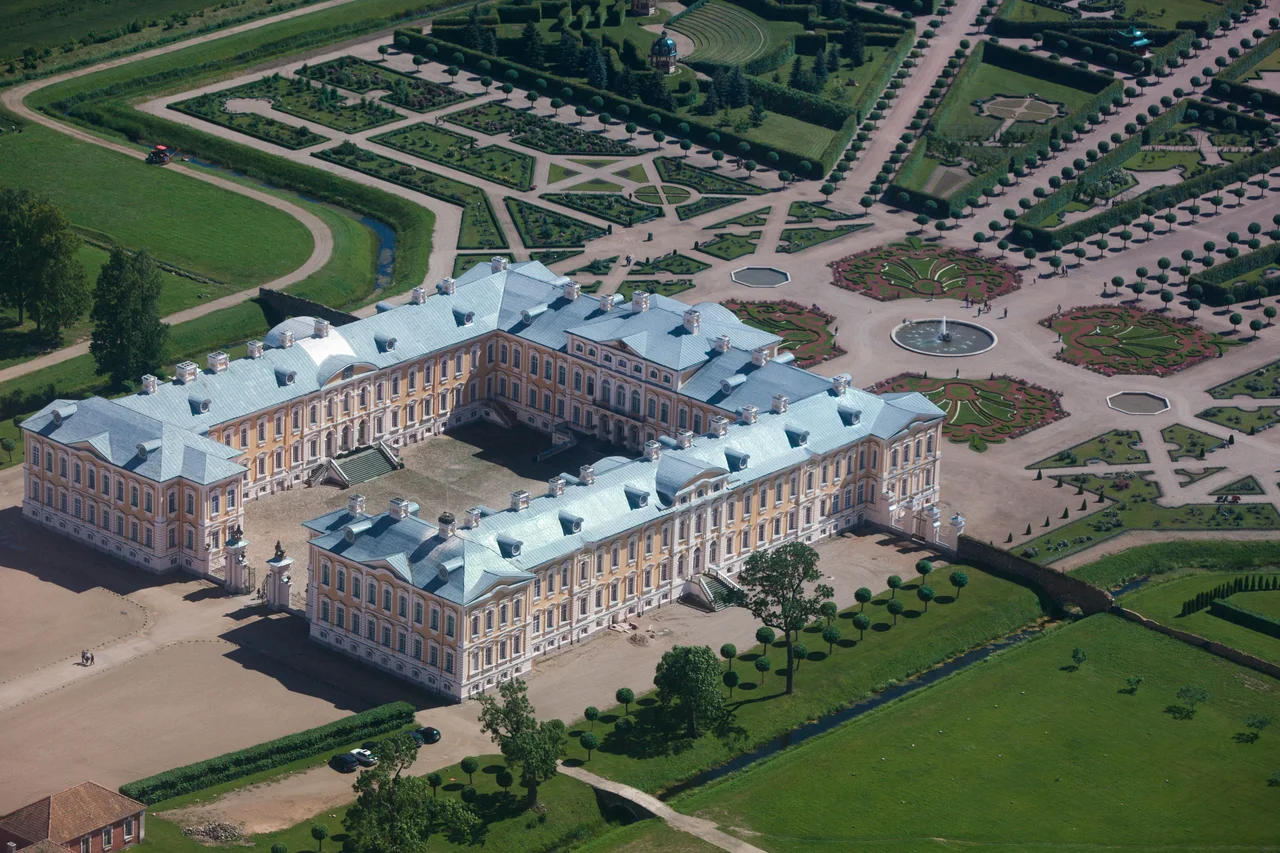
The marketing nickname is unavoidable, even if it understates the place. Versailles is bigger and grander, but Versailles also lacks Rundāle's strange intimacy - the sense, walking through the bedrooms and the bathing room and the duke's private toilet (yes, there is a duke's toilet, also restored), that an actual person once lived here who wanted his summer house to be beautiful. The state rooms run along a single enfilade you can walk in twenty minutes. The Throne Room is white and gold and large but not vast. The bedchambers are painted in soft greens and pinks and lavenders. The formal French gardens, expanded over the years to 10 hectares, include a rose garden of more than 2,200 varieties planted to mark the palace's restoration. The whole complex sits in flat Semigallian farmland 12 kilometers west of Bauska, with no city around it - just the road, the fields, and then the pink-and-cream facade rising from the green.
What You See Now
Rundāle is one of the things state visitors get shown when they come to Latvia. It is also still a working museum, with regular exhibitions and a steady flow of weekend tourists from Riga 80 kilometers north. The roof line is unchanged from Rastrelli's drawings. The colors of the walls - that particular warm Latvian pink that catches the low northern sun - are mixed from recipes Lancmanis worked out from paint chips found behind later layers. He served as director until 2018, then stayed on as scientific consultant - a man who spent his entire working life on a single building. Few people get to see their masterpiece finished. He did.
From the Air
Rundāle sits at 56.41 degrees north, 24.02 east, in flat Semigallian farmland 12 km west of Bauska and 65 km south of Riga, near the Lithuanian border. From cruising altitude the palace is unmistakable - a long pink-and-cream rectangle alone in the green fields, with the formal French gardens forming a clear geometric pattern to the north. Riga International (EVRA) is the nearest airport, 80 km north; Vilnius (EYVI) about 230 km south. Best viewed in late spring or summer when the rose garden (2,200+ varieties) shows color, or in low autumn light when the building's shadow stretches long across the parterres.
Nearby Stories
- Dobele Castle 17 km away
- Biržai Castle 18 km away
- Lielvārde Castle 19 km away
- Jelgava Massacres 21 km away
- Siauliai Ghetto 22 km away
- Battle of Saule 25 km away
- Lost Shtetl Museum 41 km away
- Daugavpils Fortress 119 km away