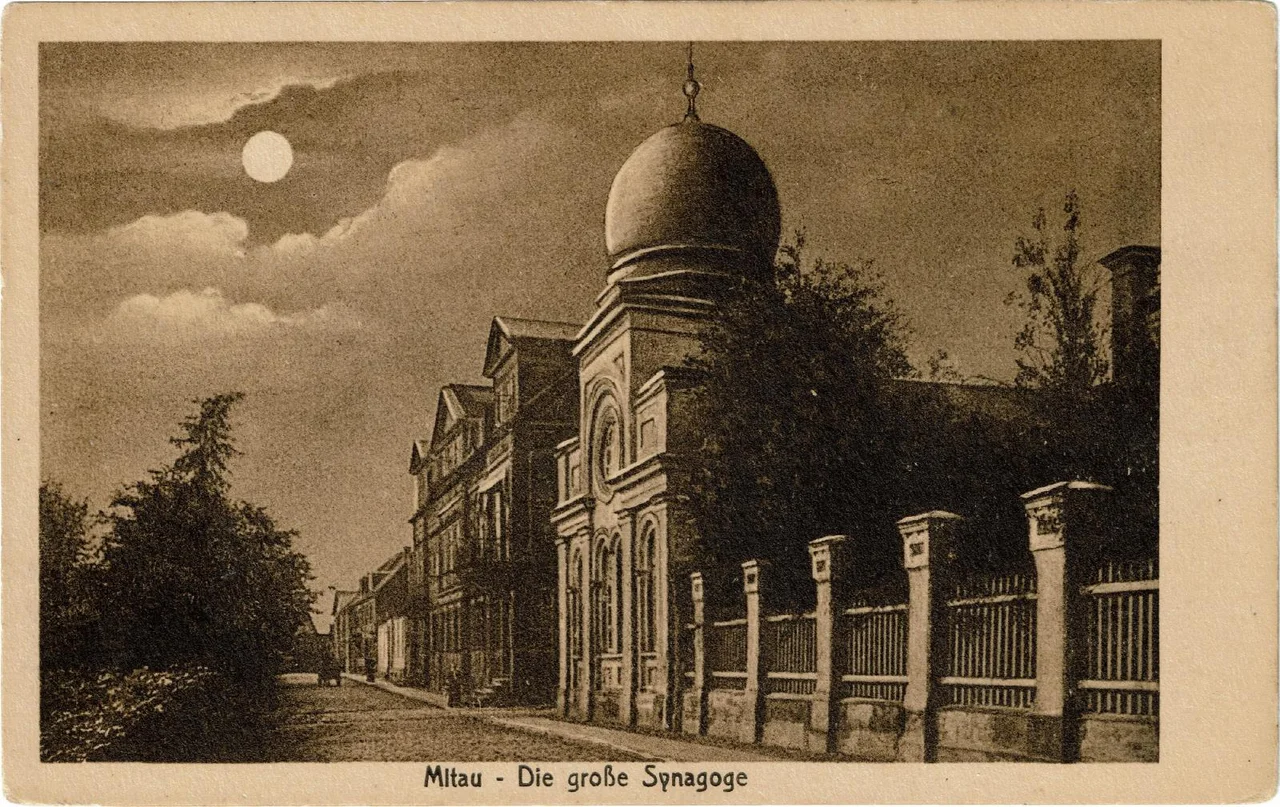

Jelgava Massacres
Jelgava had a Jewish community before it had a Latvian state. Jews had lived in this Courland market town for over three centuries when the German army arrived on 29 June 1941. By the end of August, almost none were left alive. The killing happened in the open countryside outside town, in a forest the locals called the Jelgava Forest. The murderers were German police units from Einsatzgruppe A and Latvian auxiliaries organized by a man named Martins Vagulans. The dead numbered roughly two thousand. They were among the very first victims of what would become the Holocaust - killed in the second month of the German invasion of the Soviet Union, before the gas chambers at Auschwitz were operational, before the Wannsee Conference, before the Nazi state had even formally adopted what it would call the Final Solution.
The Community That Was Lost
Jews first settled in Courland in the seventeenth century, and by the early twentieth century the Jelgava Jewish community numbered several thousand people. They were merchants, doctors, lawyers, craftsmen, religious teachers. They built a synagogue, schools, charitable societies. They had family names that reached back generations in this town. The interwar Latvian Republic that emerged after the First World War granted Jews full citizenship, and Jelgava's community continued the slow work of community life - weddings, funerals, schooling, the daily commerce of a Baltic town. Then came the Soviet occupation in June 1940 and the German invasion a year later. When German troops entered Jelgava on 29 June 1941, perhaps two thousand Jewish residents were still in the city. Most had been unable or unwilling to flee east during the brief Soviet retreat. They had nowhere to go. They believed - many people believed - that the German occupation would be terrible but that they would survive it.
The Killers Arrived Quickly
Einsatzgruppe A was one of four mobile killing units that followed the Wehrmacht into Soviet territory in 1941 with the explicit mission of murdering Jews, Communists, and other categories of people the Nazi state had declared enemies. SS-Brigadefuhrer Franz Walter Stahlecker commanded it. His subordinates Rudolf Batz and Alfred Becu took charge in Jelgava. They could not have done what they did without local help. Martins Vagulans, a Latvian collaborator, organized an auxiliary unit of roughly three hundred Latvian men - some genuine Nazi sympathizers, some opportunists, some men who saw a chance to settle scores or seize property. The Vagulans commando was the primary Latvian force in Jelgava. The notorious Arajs Kommando, which would become the most prolific Latvian death squad of the Holocaust, also operated in Zemgale during this period. These were not faceless perpetrators. They were named men who knew their victims by name.
The Summer Killings
The murders happened in the second half of July and into August 1941. Victims were rounded up from their homes, sometimes after being forced to hand over valuables, and taken to the Jelgava Forest outside town. There they were ordered to dig pits or marched to pits already dug. They were shot at the edge of the pits in groups, the bodies falling forward into mass graves. Survivors of similar killings across the Baltic have described the procedure in testimony: the orderly taking of clothing and valuables, the long wait, the sound of shots, the smell. The Jelgava Jewish community was effectively annihilated in those summer weeks. The main synagogue was burned. The Jewish cemetery was vandalized; in 1942 the Nazis removed all the tombstones, sold them, and leveled the site. The Jewish quarter was repopulated with non-Jewish residents. Two thousand human beings - parents, grandparents, children, neighbors who had lived in this town for generations - were gone.
Names That Survive
Most of the victims will never be named. The killings happened too fast, the records were too incomplete, and the survivors who could have remembered were themselves killed. But the historical work has continued. Latvian historians like Margers Vestermanis, himself a Holocaust survivor, and American historians like Andrew Ezergailis have spent decades reconstructing what happened. The Latvian Ministry of Foreign Affairs has supported Holocaust education and remembrance. The site of the killings in the Jelgava Forest has been marked. A small Jewish community has reconstituted itself in modern Latvia, including a Jelgava Jewish community organization that maintains the memory of those who were murdered. The model of the destroyed Jelgava synagogue has been preserved at the Shamir Latvia archive. Christopher Browning, Raul Hilberg, and other historians of the Holocaust have placed Jelgava in the broader story of the killing wave that swept across the Soviet Union in summer and autumn 1941.
Reckoning Without Sanitization
Latvian collaboration in the Holocaust is a difficult subject in modern Latvia. The country was first occupied by the Soviet Union in 1940, then by Nazi Germany in 1941, then by the Soviet Union again in 1944. Many Latvians who joined German police units or Latvian SS formations did so out of hatred for the Soviets who had deported their families to Siberia. None of that explains, much less excuses, the mass murder of Jewish neighbors. The Vagulans commando and the Arajs Kommando were not forced to do what they did. They volunteered. They were paid. They kept the loot from their victims. Modern Latvian historians have done serious work on this subject. The Jews in Latvia Museum in Riga documents both the centuries of Jewish life in Latvia and the catastrophe that ended it. The killings at Jelgava sit inside the larger story of the Latvian Holocaust, in which roughly seventy thousand of Latvia's ninety-three thousand Jews were murdered in the eighteen months between June 1941 and December 1942. Each of them was a person. Each had a name. Most of those names are lost. The remembering is the work of the living.
From the Air
Jelgava sits at 56.62°N, 23.74°E in the Zemgale region of Latvia, about 40 km southwest of Riga. The historical site of the killings - the Jelgava Forest - lies outside the town. Riga International Airport (EVRA) is about 30 km north-northeast. The town today is the fourth-largest in Latvia, dominated by Jelgava Palace and the surrounding agricultural plain. From altitude on clear days you can see the Lielupe River winding north toward Riga. This is a place to fly over with thought, not enthusiasm - one of the early sites of the Holocaust, where an entire community was destroyed in a few summer weeks.
Nearby Stories
- Riga Offensive (1917) 4.4 km away
- Rundāle Palace 18 km away
- Battle of Kircholm 19 km away
- Daugavgrīva Fortress 21 km away
- Biržai Castle 39 km away
- Firck Palace 49 km away
- Kuldiga Castle 81 km away
- Tytuvėnai Monastery 92 km away