.jpg)
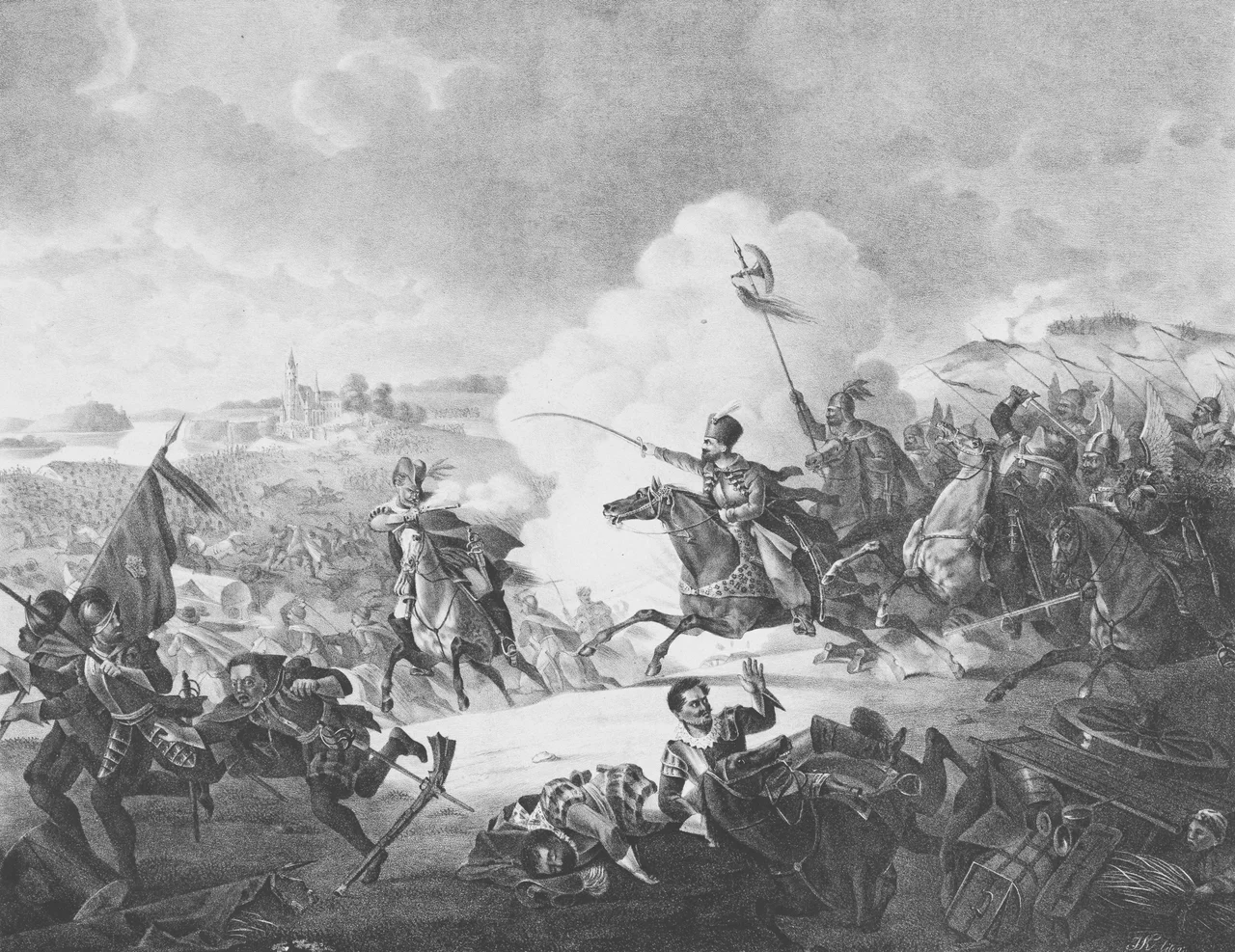
Battle of Kircholm
Three to one. That was the math facing Jan Karol Chodkiewicz at dawn on 17 September 1605, looking up the slope at the Swedish army of King Charles IX drawn up on a ridge near the small Livonian town of Kircholm — modern Salaspils, eighteen kilometers southeast of Riga. The Swedes had nearly 11,000 men and eleven cannons. Chodkiewicz had 1,000 infantry, 2,600 cavalry, and five guns. The Polish Crown had refused to fund the campaign; Chodkiewicz had pledged his own fortune to pay his soldiers' wages. His men had not slept properly in days. By noon, what remained of the Swedish army would be running for the Daugava River, drowning by the hundreds as they tried to cross. The Swedes had lost between five thousand and eight thousand killed. The Polish-Lithuanian Commonwealth had lost about a hundred. The whole thing took half an hour.
The hetman who paid his own soldiers
Jan Karol Chodkiewicz held the title Great Hetman of Lithuania — supreme commander of the Grand Duchy's armed forces — and he had inherited the kind of structural problem that destroyed European armies of the period. The Sejm, the Polish parliament, had voted no funds for the defense of Livonia. His soldiers had been promised pay that never arrived. They were eating what they could find. Yet they followed him, because Chodkiewicz had done the unthinkable: he had pledged his own family fortune to make good on the wages the state had withheld. New volunteers were riding in from Lithuania to enlist under a commander who paid out of his own purse. Among them were the men who would decide the day — the Winged Hussars, the elite heavy cavalry of the Commonwealth, riders with steel breastplates, lances five and a half meters long, and the famous wooden frames trailing eagle feathers behind their shoulders that gave them their name.
A morning march in the rain
Charles IX had brought a modern force, by the standards of the day. His infantry were drawn up in seven or eight independent squares — pikemen in the center, musketeers at the corners — arranged in a checkerboard with intersecting fields of fire. Cavalry from Sweden, Germany, and a few hundred Scots covered the flanks. The artillery was forward of the cavalry. It was a textbook Renaissance battle line, copied from the Dutch military reforms then sweeping Europe. But Charles's army had spent the night marching more than ten kilometers through torrential rain to reach the ridge. The horses were tired. The men were soaked and cold. Their carbines and pistols would have given trouble in wet conditions. They drew up on the high ground and waited.
The feint
Chodkiewicz spent hours doing nothing. He sent out light cavalry to skirmish, drawing scattered fire. He let the Swedes look down at his obviously inferior numbers and grow confident. Then, at the moment he chose, his entire line began to retreat — slowly at first, then faster, in what looked exactly like an army losing its nerve. Charles IX took the bait. His army left the high ground and advanced down the slope to finish off the apparent rout. When the Swedes were committed to the descent, Chodkiewicz turned. The Curonian harquebusiers of Friedrich Kettler, Duke of Courland, opened fire into the advancing Swedish infantry. Lieutenant Wincenty Wojna's three hundred hussars hit the Swedish line with their lances. On the right, six hundred and fifty more hussars under Jan Piotr Sapieha charged Mansfeld's reiters. Charles threw in his cavalry reserve of seven hundred. Chodkiewicz threw in his own. Within thirty minutes the Swedish cavalry was running on both flanks, fouling their own infantry as they fled.
What lances do to running men
The Swedish infantry, exposed in the center after their cavalry collapsed, faced something almost no European army of the period could withstand: hussar lances closing at a gallop into formed but disordered ranks. The squares broke. The killing happened mostly in the retreat — through the dense forests and marshes between the battlefield and Riga, and at the Daugava River itself, where many drowned trying to cross. The hussars spared few. One historian noted that the riders themselves took relatively light losses because they were largely shielded by the bodies and heads of their armored horses; the trained battle horses, in fact, were the most irreplaceable casualties of the day. Polish-Lithuanian dead numbered about a hundred, with two hundred wounded. The Swedish army of King Charles IX had effectively ceased to exist.
A victory that could not be exploited
Charles IX abandoned the siege of Riga and sailed back across the Baltic, surrendering control of northern Latvia and Estonia. It was one of the most complete tactical victories of the seventeenth century. And the Polish-Lithuanian Commonwealth could not capitalize on a single bit of it. The state had no money to keep the army in the field. Without pay, the soldiers could not buy fodder for their horses or replace their irreplaceable losses of trained mounts. The campaign sputtered. A truce came in 1611. By 1617 the war started again. In 1621 a new Swedish king — Gustavus Adolphus, the future architect of the Swedish military empire — landed near Riga and took the city in a brief siege, wiping out, in Swedish memory, the shame of Kircholm. But for the Commonwealth, the battle remained a touchstone. KIRCHOLM 27 IX 1605 is inscribed on the Tomb of the Unknown Soldier in Warsaw — preserved in the old Polish dating that places this small, devastating, ultimately wasted miracle of arms on a hillside outside modern Salaspils.
From the Air
The battlefield lies near modern Salaspils, Latvia, at 56.85°N, 24.35°E — about eighteen kilometers southeast of central Riga along the right bank of the Daugava River. From cruising altitude in good visibility, the Daugava and the Riga metropolitan area dominate the view; the precise battlefield is hard to pick out, but the geographic context — the river the Swedes drowned trying to cross — is unmistakable. Nearest major airport is Riga International (EVRA), about 25 kilometers west. Aircraft on Baltic transit routes between Vilnius (EYVI), Tallinn (EETN), and Helsinki (EFHK) often pass directly overhead.
Nearby Stories
- Battle of Aizkraukle 18 km away
- Sigulda Castle 26 km away
- Jelgava Palace 26 km away
- Siege of Cēsis Castle (1577) 28 km away
- Mežotne Palace 30 km away
- Koknese Castle 38 km away
- Battle of Saule 59 km away
- Battle of the Gulf of Riga 73 km away