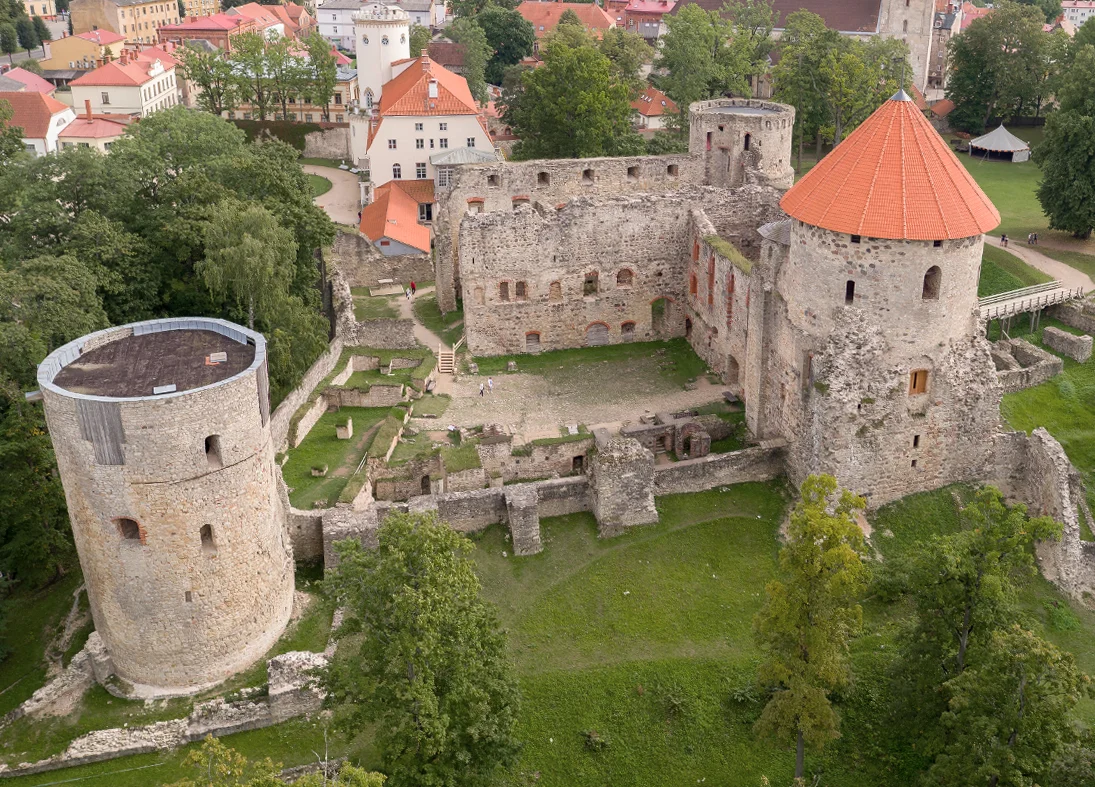

Siege of Cēsis Castle (1577)
Salomon Henning, who wrote the chronicle on which everything we know about the inside of Cēsis Castle in late August 1577 depends, recorded a detail that has stayed with everyone who has ever read it. As the gunpowder was being prepared in the first-floor hall of the western range, the people who had decided to die there knelt down together. Some men and women held hands. Children pressed against their parents. Some infants were still nursing at their mothers' breasts. Then someone touched a flame to the powder. Around three hundred people died in a single instant - most of them civilians who had taken refuge in the castle precisely because they knew what would happen if Ivan the Terrible's troops took them alive.
The Castle on the Hill
Cēsis Castle was built by the Livonian Brothers of the Sword in 1209 - a great rectangular stronghold on a defensible plateau above the Gauja River valley in what is now central Latvia, then the heart of the medieval Livonian Confederation ruled by the Teutonic Order's Livonian branch. For three and a half centuries it served as a residence of the Order's Master, the de facto ruler of much of the eastern Baltic. When the Livonian Order dissolved in 1561 under pressure from Muscovy, Sweden, and Poland-Lithuania, the castle was garrisoned by Polish troops who held it as part of the new Duchy of Livonia under the Polish-Lithuanian Commonwealth. It looked impregnable - thick stone walls, a commanding position, mature defensive works built up over generations.
The Wrong Choice of Patron
In summer 1577 the townspeople of Cēsis made what would prove a fatal mistake. They drove the Polish garrison out of the castle and declared their loyalty to Magnus, Duke of Holstein - a Danish prince whom Ivan the Terrible had appointed as his puppet King of Livonia. The townspeople had reason to hope this would protect them: Magnus was supposed to be Ivan's vassal, and his protection ought to mean Russian protection. They were wrong. Magnus arrived in Cēsis. Then Ivan the Terrible arrived too, personally, with a Russian army of thousands, and for reasons never fully recorded was furious to find Magnus already in possession. The Russians began moving on the castle. The townspeople and Magnus's small entourage barricaded themselves inside, joined by women and children from the town who had heard - everyone in late-16th-century Livonia had heard - what Ivan's army did to civilians of cities that fell to it.
Five Days of Bombardment
Ivan ordered the bombardment opened with full force after a stray defender's shot whizzed past his head. The Russian army had heavy artillery; the castle's defenders had little. The walls of Cēsis were thick, but five days of sustained shelling with heavy guns will defeat any pre-modern fortification. Henning records that defenders standing at the windows of the castle were hit and killed by cannonballs - and that as one fell, another would step into his place, hoping to die quickly the same way. By the fifth day, sections of wall had collapsed. The castle could not hold. The defenders also knew, with absolute clarity, what surrender would mean: Ivan the Terrible had a documented record of executing entire populations of captured cities, of torturing prisoners for entertainment, of devising public deaths so prolonged and cruel that even his own court chroniclers had trouble describing them. The decision to die quickly together, by their own hand, was made under those conditions.
The Powder Hall
Documentary evidence and later archaeology together identify the location: the first-floor hall of the western range of the castle. Four barrels of gunpowder were carried in and positioned. The people who had made the decision - men, women, children, including infants - gathered in the hall above. Henning's chronicle, published in 1594, gives an account that has the texture of testimony from someone who knew survivors: how families held one another, how the children were comforted, how those gathered waited together for what they called blessed Saint Simeon's hour. The powder was lit just as Russian troops were beginning to storm the castle. Roughly three hundred people died in the explosion. A few others, hidden elsewhere in the castle, survived to be captured.
What the Walls Remember
Cēsis Castle was rebuilt by the Poles after Ivan withdrew. It changed hands again - to Sweden, back to Poland, eventually to the Russian Empire of Peter the Great - and gradually fell into ruin during the 18th century as new fortification technology made it militarily obsolete. The romantic ruins are now one of Latvia's most visited heritage sites, beautifully preserved by the Cēsis Castle museum, and you can walk through the surviving towers and the inner court. Modern excavations have confirmed the location of the explosion. The story is told frankly in the museum's exhibits, and the new town that grew up around the castle - the medieval old town of Cēsis is exceptionally well preserved - knows the dates and the details. Latvia is a small country in which 1577 is not ancient history. The desperation of three hundred people choosing collective death over the alternatives Ivan the Terrible offered them remains one of the moments by which Latvians measure their long, hard relationship with eastern empires.
From the Air
Cēsis sits at 57.31 degrees north, 25.27 east, on the high right bank of the Gauja River in Vidzeme, the northern Latvian region, about 90 km northeast of Riga and 120 km southwest of the Estonian border. From the air the castle ruins and the small medieval town are visible as a tight cluster of red-tiled roofs and exposed stone walls on a defensible bluff above the river meander. Riga International (EVRA) is the nearest airport, 90 km southwest. The Gauja National Park surrounds the area to the east and north - wooded river valleys, sandstone cliffs, and the meandering Gauja itself, all best viewed from low altitude in autumn when the broadleaf forest turns gold and red around the stone ruins.
Nearby Stories
- Latvian War of Independence 19 km away
- Battle of Ērģeme 19 km away
- Battle of Salis 19 km away
- Riga Offensive (1917) 25 km away
- Gaujiena Castle 46 km away
- The Ethnographic Open-Air Museum of Latvia 49 km away
- Estonian War of Independence 55 km away
- Daugavpils Fortress 147 km away