
The Ethnographic Open-Air Museum of Latvia
The fisherman's house from Rucava parish smells of pine tar and woodsmoke even on a still summer afternoon. A Latgale Old Believer's house leans into a sandy clearing nearby. Down a path, a tavern from Vecumnieki, a Russian Orthodox church from Rogovka, a Roman Catholic chapel, a wooden windmill from the Latgalian village of Rundēni — and somewhere among the pines, the unmistakable low silhouette of a pirts, a Latvian bathhouse, where a hot day still ends in steam and birch switches and a plunge into the lake. None of these buildings began life on the shores of Jugla. They were taken apart, log by numbered log, in the four corners of Latvia, and reassembled here.
The Idea Came from Stockholm
The Latvian Council of Monuments signed the founding order in 1924. Skansen in Stockholm — the world's first open-air museum, opened in 1891 — had become a model across the Nordic and Baltic world for keeping rural architecture alive in a century that was rapidly tearing it down. Latvia's planners wanted a homestead from each of the country's four historical regions: Kurzeme to the west, Zemgale to the south, Vidzeme in the middle, and Latgale to the east. Each homestead would carry the crafts of its place. The state allotted land in the sandy dunes by Jugla Lake just outside the capital. In 1928 the first building, a barn from Vestiena parish, was carted in and reassembled. By 1932 the museum opened to the public with six buildings — a single Vidzeme homestead. Within seven years there were forty.
What the Twentieth Century Did
Then came the Soviet occupation, the German occupation, and the second Soviet occupation. The museum's pre-war staff were largely lost — repressed, exiled, or simply scattered — and many records vanished with them. The buildings themselves came through the Second World War mostly intact, which was its own small miracle on a continent where so much was burned. Under the Latvian SSR the museum was officially considered ideologically suspect; rural Latvia, Lutheran villages, Orthodox Old Believers, Catholic Latgalians, and ethnic minorities did not fit the proletarian story Moscow wanted told. Only in the late 1960s did a new generation of curators begin a careful expansion. When Latvia regained its independence in 1991, the museum widened its scope to include the agrarian-reform homesteads of the 1920s and 1930s — small farms shaped by the redistribution that had created the first Latvian Republic — and a new complex of those interwar farmhouses opened in 1997.
The Geography of a Nation, in 87 Hectares
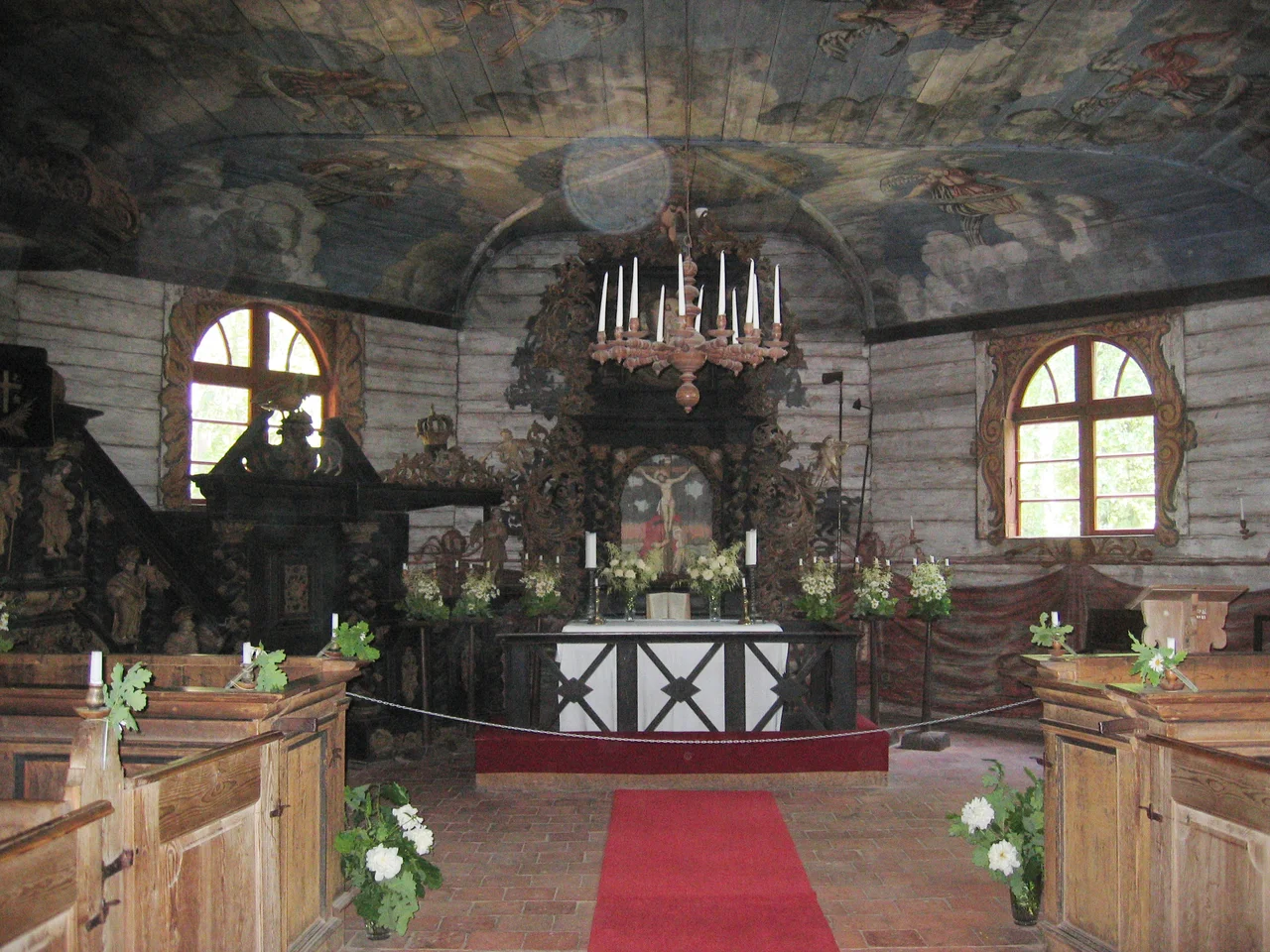
The museum today occupies 87 hectares of pine forest along Jugla Lake and contains 118 buildings, with a collection of about 150,000 artifacts. Walk the loop and you walk the country: the long timber hall of a Vidzeme farmhouse, with its cool tiled stove and woven wall hangings; the steeper roof of a Latgalian Catholic chapel; an Orthodox onion-domed church transplanted from a Russian-speaking village; the wooden interior of the Usma Lutheran Church, brought in from the Courland coast; a tavern where you can still buy a glass of beer; a four-sailed windmill on a low rise. This is not a generic rural Europe. It is specifically Latvia — a country whose population has always been a layered weave of Latvians, Livonians, Russians, Germans, Jews, and others, and whose buildings reflect that mixture more honestly than any speech.
The Crafts Fair
Since 1971 the museum has held an annual traditional craft fair, which has grown into one of the largest events of its kind in the Baltic region. Tens of thousands of people crowd the grounds for two days at the start of June. Blacksmiths work outdoor forges. Weavers set up looms in the shade of the pines. There are amber carvers, leatherworkers, beekeepers selling raw mead, ceramicists, and women in folk costume from each of the four regions, each costume distinct in its weave and its color. The food stalls run hot smoked fish from the Baltic, gray peas with bacon, rye bread, sklandrausis pies of carrot and potato. The museum also runs concerts of folk music throughout the warmer months, and the Midsummer celebration of Jāņi here, with bonfires and singing through the shortest night of the year, is one of the truest in the country.
Why It Matters
An open-air museum can read like a kind of frozen nostalgia, a country reduced to props. This one is more honest than that. Latvia spent most of the twentieth century being told its rural identity was either backward, wrong, or dangerous to the rulers of the moment. The act of physically moving the bathhouse, the windmill, the Old Believer's chapel, the fisherman's hut — and keeping them standing through occupation, war, occupation again, and finally independence — was a quiet, decades-long act of preservation. The buildings on the shore of Jugla are not the past. They are a country's argument with the twentieth century, made in pine logs and tar and thatch, and still being made.
From the Air
Located at 56.995°N, 24.265°E on the wooded southern shore of Jugla Lake, about 12 km northeast of central Riga. From altitude, look for the long lake with the museum on its southwestern bank, between the city and the forested hinterland. Riga International Airport (EVRA) is about 20 km southwest. The museum sits in pine forest, harder to spot than the lake itself.
Nearby Stories
- Jelgava Palace 17 km away
- Siege of Cēsis Castle (1577) 19 km away
- Lielvārde Castle 26 km away
- Battle of Aizkraukle 27 km away
- Lielstraupe Castle 31 km away
- Battle of Wenden (1626) 36 km away
- Jelgava Massacres 47 km away
- Battle of the Gulf of Riga 55 km away