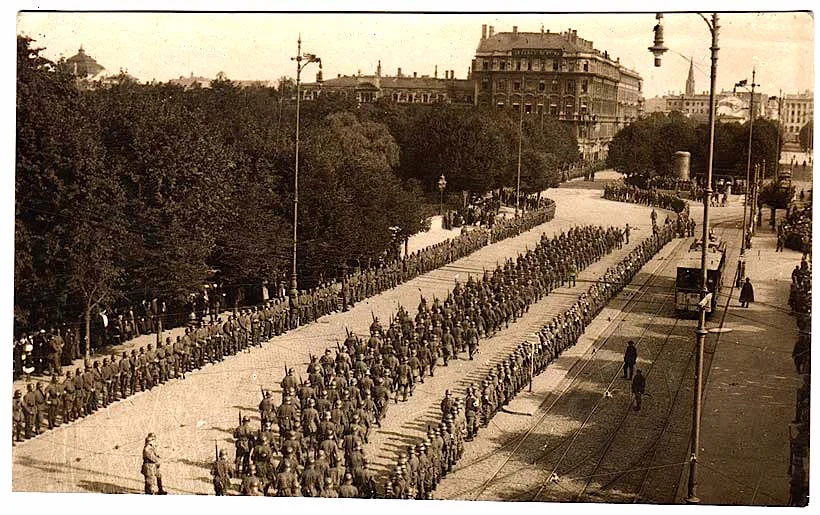

Riga Offensive (1917)
By the time the German artillery opened fire south of Riga at dawn on September 1, 1917, the Russian Twelfth Army was already a hollow thing. Soldiers had stopped saluting officers. Soldiers' committees voted on orders before obeying them. In the trenches along the Daugava, men read Bolshevik pamphlets passed hand to hand from the factories upriver, and many had quietly decided that whatever happened next, they were not going to die for Kerensky's government. Three days later, the city fell - not because the Germans broke the line, but because the line refused to hold itself together.
A City Caught Between Empires
Riga in 1917 was the third-largest industrial city of the Russian Empire, a Hanseatic port whose factories made artillery shells, locomotives, and rubber boots, and whose Baltic German aristocracy still spoke German in their drawing rooms. The front had stalled at the city's southern edges since the German advance of summer 1915. For two years the Twelfth Army held a bridgehead on the far bank of the Daugava, and Erich Ludendorff, the German quartermaster-general, decided in early August 1917 that taking Riga would pressure Russia toward peace. He chose the right moment. The February Revolution had shattered military discipline, the failed Kerensky offensive in July had broken what remained, and General Lavr Kornilov was already plotting a coup against the Petrograd Soviet.
Hutier's New Way of War
Oskar von Hutier did not attack Riga directly. Instead, his Eighth Army crossed the Daugava 30 kilometers southeast of the city, near the village of Iksķile, behind the screen of an artillery barrage Colonel Georg Bruchmuller had spent weeks engineering. Eleven hundred German guns fired chemical and high-explosive shells in a tight, brief storm rather than the days-long bombardments of earlier offensives. Then the infantry moved differently too - not in straight lines but in small groups, one squad advancing while another covered, slipping past defenders rather than fighting through them. These were the infiltration tactics the Western Allies would soon call Hutier Tactics. They would reappear at Caporetto a month later, and on the Western Front in spring 1918. Riga was their proving ground.
The Latvians Who Stood
Most of the Russian conscripts who held the line along the Maza Jugla river that day were not from Riga. They were peasants from Tula and Saratov and the Volga, men who had been drafted to defend a city they would never see again, for a government most no longer recognized. When the Germans came across the Jugla on September 2 with gas shells and flamethrowers, the cavalry held. The artillery held. A handful of infantry units held. But many of the rest melted away into the woods, refusing to die for symbols that had stopped meaning anything. The 2nd Latvian Rifle Brigade fought hardest of all - these were local men defending their own ground, and they took more than half their force as casualties holding the river crossings long enough for the Twelfth Army to slip out of the city behind them. The Germans walked into Riga on September 3.
The Coup That Helped Lenin
Riga's fall set off a chain that ran straight to October. Within days, Kornilov launched his coup, ordering the 3rd Cavalry Corps toward Petrograd to crush the Soviet. The ordinary soldiers refused to march. The coup collapsed. Kerensky removed Kornilov, but to defend the capital he had to arm the Bolsheviks - and once armed, they did not give the rifles back. The Latvian Riflemen who had bled at the Jugla would, within months, become Lenin's most loyal troops, a praetorian guard for the new Soviet state. The Baltic German aristocracy in Riga welcomed the German occupation politely, hoping for the old order back. They got something else instead: by 1918, Latvia was independent, by 1940 absorbed by the Soviets, by 1941 occupied by Germany again. Riga's twentieth century had only just begun.
What Remains
The battlefield south of Riga is now suburban sprawl, big-box stores, and forest. The Maza Jugla still meanders past Ropazi, where the 43rd Corps fought its rearguard action. The Iksķile ferry crossing where the Germans came over the Daugava is now a quiet weekend boating spot. There is no large monument to the offensive itself - the war, the revolution, and the wars that followed have written and rewritten the meaning of these woods too many times for any single memorial to stick. Latvians remember the riflemen. Russians, when they remember at all, remember the demoralization. Germans largely forgot. The river runs through it all, indifferent.
From the Air
Riga sits at 56.97 degrees north, 24.32 east, on the Gulf of Riga where the Daugava (Western Dvina) river meets the Baltic. The 1917 battlefield lies south and southeast of the modern city, around Iksķile and the Maza Jugla river. Nearest airport is Riga International (EVRA), 10 km southwest of the old town. Cruising altitudes of 5,000 to 8,000 feet show the broad floodplain of the Daugava, the city's distinctive Hanseatic core, and the wooded ridge lines along which the 1917 lines ran. Baltic visibility tends to be best in late spring and early autumn; winter brings persistent low cloud.
Nearby Stories
- Jelgava Palace 17 km away
- Siege of Cēsis Castle (1577) 19 km away
- Lielvārde Castle 26 km away
- Battle of Aizkraukle 27 km away
- Lielstraupe Castle 31 km away
- Battle of Wenden (1626) 36 km away
- Jelgava Massacres 47 km away
- Battle of the Gulf of Riga 55 km away