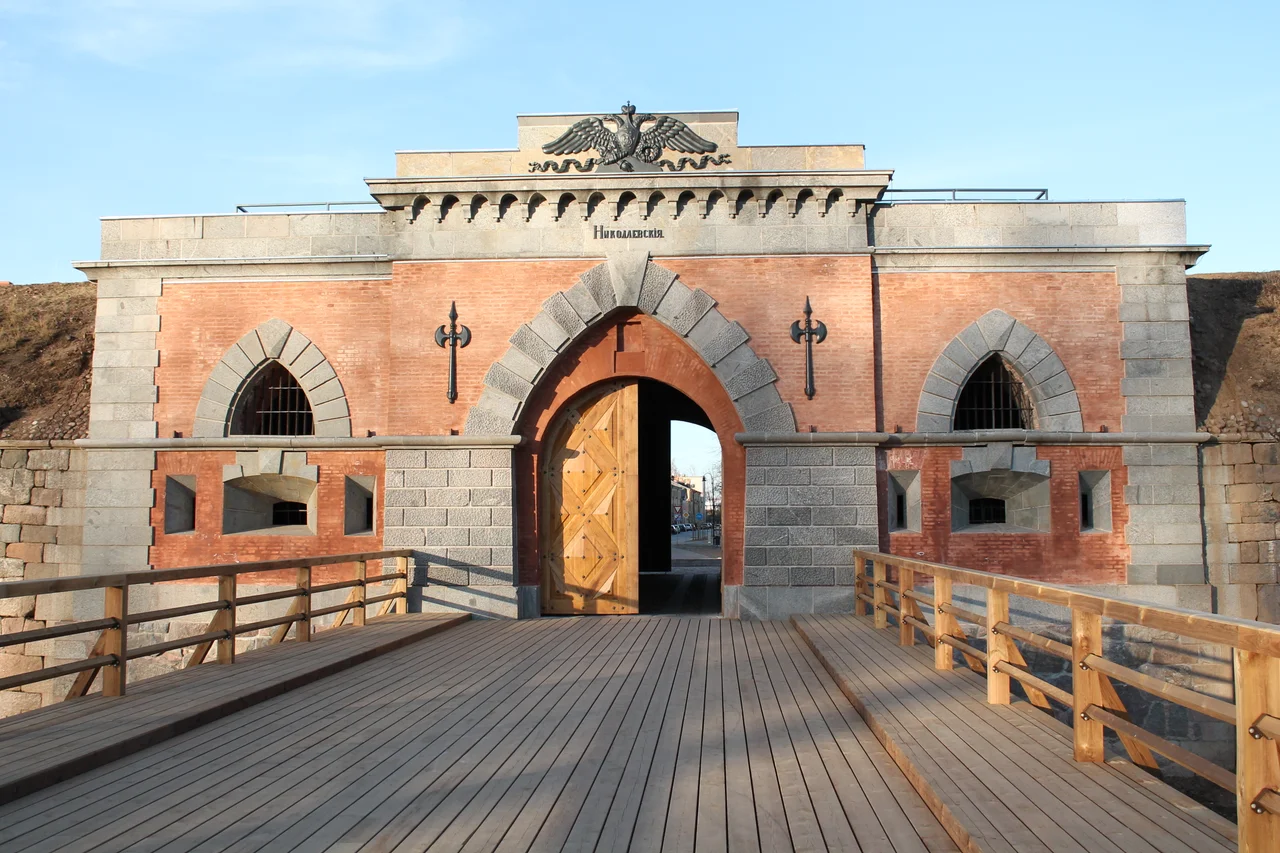

Daugavpils Fortress
Tsar Alexander I signed the construction order in 1810, and even then everyone knew Napoleon was coming. The fortress at Daugavpils - then called Dinaburg, the Russian outpost of a former Polish-Livonian frontier - was meant to anchor the western approaches to St. Petersburg against the French army that would invade two years later. Ten thousand workers labored in two shifts. The fortress was still half-built in 1812 when 24,000 French troops attacked it. Three thousand three hundred Russian defenders, manning two hundred cannons, held them off long enough to matter. Construction continued, sporadically, for another 66 years. By the time it was finally complete in 1878, the kind of warfare it was built for had largely ceased to exist.
The Last Intact Star Fort
Daugavpils Fortress is the only early 19th-century military fortification of its kind preserved in Northern Europe without significant later alterations. The classic star-fort geometry - angular bastions projecting from a central enceinte, designed to provide overlapping fields of cannon fire - filled an entire bend of the Daugava River. The walls enclose a barracks city of officer's houses, gunpowder warehouses, engineering arsenals, parade grounds, and a commandant's residence. Russian tsars on the road from St. Petersburg to Europe routinely stopped here. Alexander I, Nicholas I, Alexander II, Alexander III, and the last Russian tsar Nicholas II all stayed within these walls at one point or another. The route is now an empty fact of map geography, but for nearly a century the fortress functioned as both military garrison and imperial waypoint.
Stalag 340
After the fortress sheltered Russian royalty, it sheltered the Latvian army during the brief interwar republic from 1920 to 1940. Then came the Soviet occupation, and then the German invasion of June 1941. The Wehrmacht converted the fortress into Stalag 340, a prisoner-of-war camp for Soviet soldiers captured during Operation Barbarossa. Conditions in German Stalags on the Eastern Front were catastrophic. Of the roughly 5.7 million Soviet prisoners taken during the war, more than 3 million died in German captivity, most from starvation, exposure, and disease deliberately inflicted as policy. Stalag 340 was one of those places. Soviet POWs died in the thousands within these stone walls. After the war, the fortress passed back to Soviet military use, and the full story of Stalag 340 took decades to recover.
The Rothko Connection
Markus Rotkovich was born in Dvinsk - the Russian Imperial name for Daugavpils - on September 25, 1903. His family lived in a Jewish quarter near the fortress. They emigrated to Portland, Oregon, in 1913, escaping the antisemitism that would shortly afterward escalate into pogroms across the western Russian Empire. Markus became Mark Rothko, one of the great painters of the 20th century, whose color field canvases at the Tate Modern, the Rothko Chapel in Houston, and the National Gallery in Washington draw pilgrims by the hundreds of thousands. Daugavpils opened the Mark Rothko Art Centre in 2013 inside the former Artillery arsenal of the fortress, with reproductions of his major works and a small collection of originals donated by the Rothko family. The painter never returned to the city of his birth. The city has now made room for him.
A Fortress Becoming a Town
Today the fortress functions as something between a military monument and a still-inhabited neighborhood. Many of the historic buildings have been restored - the Engineering Arsenal, the Pump House, the Nicholas Gate, the Officer's House, the Gunpowder Warehouse - and the courtyards host concerts, markets, and weddings. The former Jesuit church inside the walls is gone, demolished in the 1950s after surviving as a Lutheran garrison church between the wars. The fortress is part of Daugavpils now, not separate from it: people live in some of the apartments, others house museums and restaurants, and the bastions themselves serve as elevated parks where dog-walkers in summer have a long view across the Daugava toward Lithuania and Belarus. Few European cities have a 19th-century imperial fortress as a working district. Daugavpils does.
From the Air
Coordinates 55.89 N, 26.50 E. Daugavpils Fortress sits on the north bank of the Daugava River in southeastern Latvia, in the Latgale region. From altitude, the angular star-fort geometry is clearly visible - distinct bastions projecting from a roughly square enceinte at a sharp bend in the river. The city of Daugavpils extends north and east. Closest airports: EVDA (Daugavpils, ~12 km north, currently low-traffic), EVRA (Riga International, ~225 km west), EYVI (Vilnius, ~165 km southeast).
Nearby Stories
- Battle of Vilnius (1915) 50 km away
- Battle of Selburg 62 km away
- Dubingiai Castle 65 km away
- Biržai Castle 90 km away
- Koknese Castle 94 km away
- Battle of Klyastitsy 96 km away
- First Battle of Polotsk 109 km away
- Pskov Oblast 192 km away