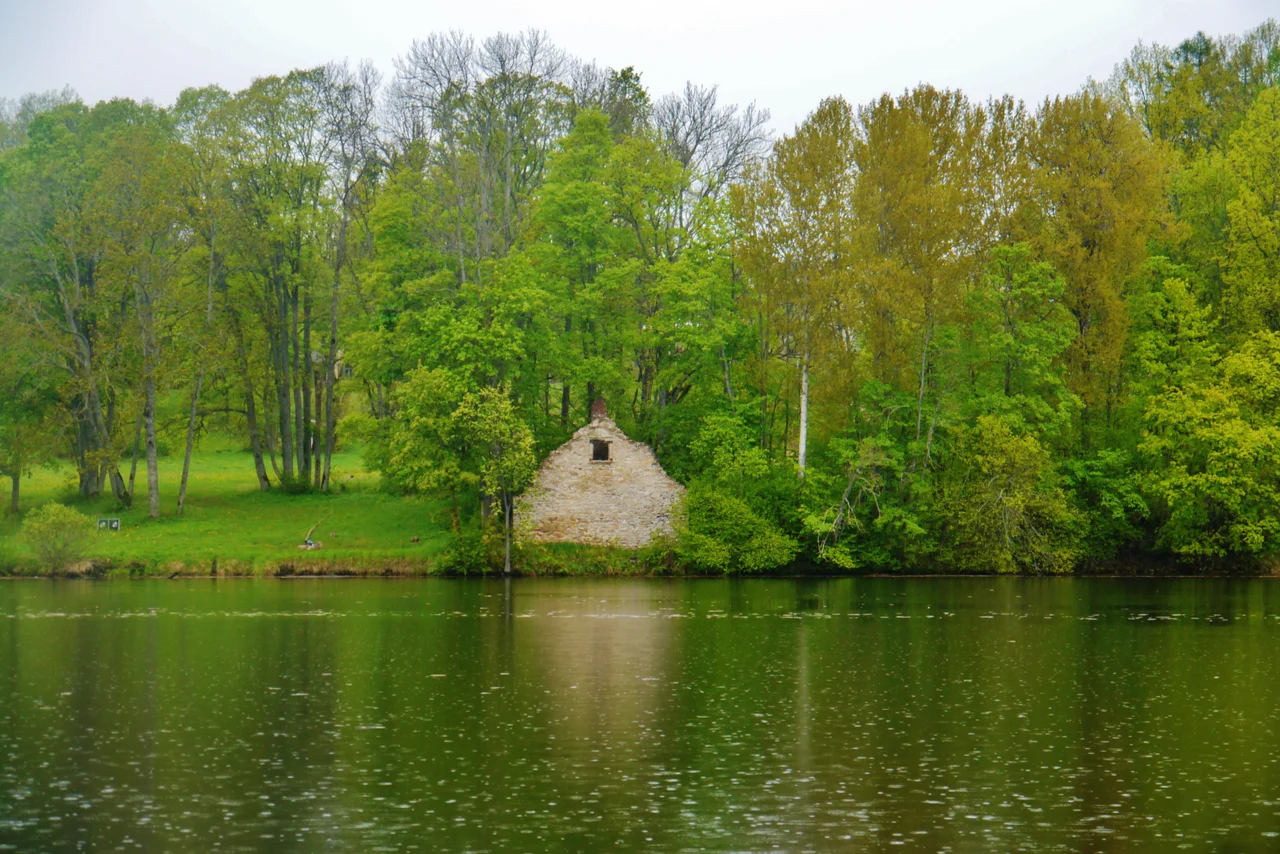

Koknese Castle
For more than seven centuries Koknese Castle stood on a high bluff above the Daugava River, looking down over a valley of waterfalls and limestone cliffs that travelers came from across Europe to see. In 1965 the Soviet government finished the Pļaviņas Hydroelectric Power Station downstream, and the reservoir filled the valley. The waterfalls disappeared. The cliffs disappeared. The castle, blown up by retreating Saxon troops in 1701 and a ruin ever since, ended up at the water's edge, the bluff itself drowned, the ruins reduced to a low promontory poking out into a flat artificial lake. What you see today is a castle stripped of the landscape it was built to command.
Bishop Albert's Stone Fort
Before the crusaders arrived, Koknese was a wooden hill fort of the Balts, ruled by a prince named Vyachko. In 1208 Vyachko burned his own castle rather than let it fall to the Sword Brothers. Bishop Albert of Riga ordered a stone replacement built on the same site in 1209 and named it Kokenhusen. The first 50 years it was purely military, a frontier outpost on the Daugava trade route running between the Baltic and the upper Dnieper. By 1277 enough population had gathered around the walls for the settlement to receive city rights. Koknese joined the Hanseatic League, the merchant network that ran the Baltic, and the castle became something more than a fort: an administrative center for the Archbishopric of Riga and a stop on one of medieval Europe's important rivers.
Three Centuries of Siege
From the 16th century onward, Koknese became a place that armies kept fighting over. Polish forces, Swedish forces, Russian Tsarist forces all wanted control of the Daugava trade route, and the castle changed hands again and again. The native Latvian inhabitants endured what the chronicles describe in flat terms: periodic slaughter, capture, and famine. The Polish-Swedish War of 1601 brought a Swedish attempt that failed; the Swedes finally took the castle in 1621 and rebuilt it more strongly. In 1636 Koknese was made a town of Swedish Livonia alongside Riga, Pärnu and Tartu. The Second Northern War brought Russian Tsarist troops in 1656, who built warehouses for Russian exports around the walls. The Swedes took it back in 1661. Behind every change of flag were people who lived there, planted crops, raised children, and watched the next army arrive.
Colonel Bose's Order
On 17 October 1700 Saxon troops captured Koknese during the opening campaign of the Great Northern War. They held it less than a year. By July 1701 the Russian army was advancing and the Saxons knew they couldn't hold the position. On 25 July, Saxon Colonel Bose ordered the two western towers blown up, scorched-earth demolition meant to deny the castle to whoever came next. The walls came down. The castle was never rebuilt. It sat unattended for two hundred years, slowly weathering into picturesque ruin, until the 19th century brought serfdom's abolition, a railroad station, and a new economy. In 1900 a park was laid out around the ruins. Koknese became a popular summer resort, drawing visitors who came for the scenic Daugava valley and its waterfalls.
The Reservoir
In 1965 the Soviet government completed the Pļaviņas Hydroelectric Power Station downstream at Aizkraukle. The dam was an engineering achievement, the largest hydroelectric project in the Baltics at the time, and it made electricity for industry that the planners in Moscow wanted to expand. It also drowned the valley. The reservoir flooded the entire length of the Daugava upstream to the town of Pļaviņas, submerging waterfalls, cliffs, lookout points and the town's natural setting. There had been protests. Latvian intellectuals and artists wrote and pleaded for the valley to be preserved, knowing that what was about to be lost was irreplaceable. The dam was built anyway. Koknese Castle, once high above the river, now sits at water level on a small spit of land, the ruin still there but the landscape that gave it meaning gone forever beneath the lake.
What Remains
Visit Koknese today and you'll see weathered red sandstone walls rising from low grass, the remnants of towers and curtain walls outlining what was once a substantial fortress. The reservoir laps quietly at the foot of the ruin. Across the water lies the new park created after the flooding, with a memorial path called the Garden of Destinies built in honor of Latvians who died in the 20th century's wars and deportations. Standing on the castle stones you can imagine the bluff that used to be there, the rapids you used to be able to hear, the river valley falling away below. You can also see the new lake, calm and useful, generating power for the grid. Both things are true at once. The castle is what's left of one Latvian story; the reservoir is the residue of another.
From the Air
Koknese Castle sits at 56.638 degrees north, 25.418 degrees east, on the south bank of the Daugava River in central Latvia, about 100 km southeast of Riga. From altitude, look for the small wooded promontory jutting into the wide flat reservoir, with the red-brown ruined walls visible at its tip. Riga International Airport (EVRA) lies roughly 95 km west-northwest. The contrast between the artificial lake's straight shoreline and the original river course can be picked out clearly from 3,000 to 5,000 feet.
Nearby Stories
- Latvian War of Independence 5.4 km away
- Lielvārde Castle 7.9 km away
- Biržai Castle 28 km away
- Battle of Cēsis (1919) 42 km away
- Gaujiena Castle 67 km away
- Daugavpils Fortress 67 km away
- Daugavpils Ghetto 89 km away
- Dinaburga Castle 97 km away