.jpg)
Białystok Ghetto
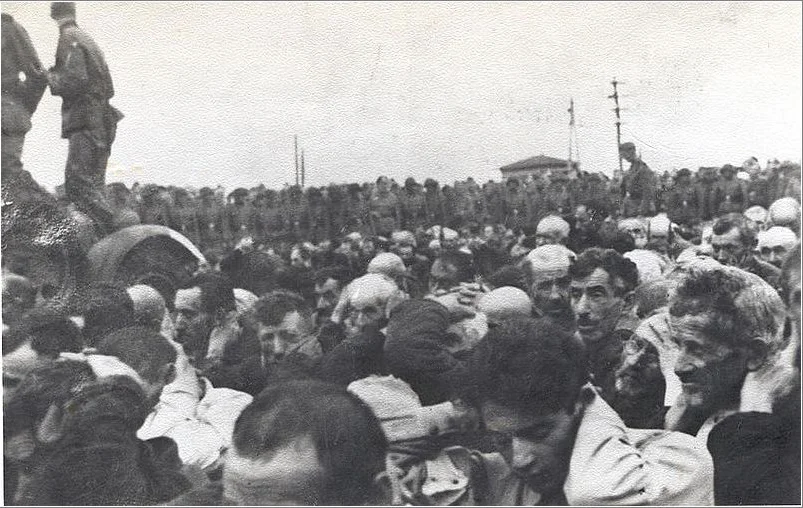
On February 5, 1943, ten thousand Jews from the Białystok Ghetto were marched to the trains. Two thousand more, too sick or too weak to keep up, were shot where they fell. The destination was the Treblinka extermination camp. Riva Shinder, who survived to testify, called the ghetto a place of 'humiliating oppression, shootings, and hangings.' She also remembered, before the killings began, that there were two Jewish cinemas in Białystok and a library with more than ten thousand books, and that cultural life was 'booming.' Both things are true. The Białystok Ghetto was a place where about fifty thousand people tried to live ordinary lives until they could not, and then a place where some of them chose how to die.
Before the Wall Went Up
Białystok had been a Jewish city for centuries, with a population that was roughly half Jewish before the war. When the Germans invaded the Soviet Union on June 22, 1941, and reached the city five days later, that life was already under threat from a different direction. On June 27, 1941, Police Battalions 309 and 316 herded around eight hundred Jews into the Great Synagogue and burned them alive. Around three thousand died that day. Heinrich Himmler had visited Białystok on June 30, 1941, to oversee the formation of the new Bezirk Bialystok district, and to authorize what came next. On July 12 and 13, members of police battalions 316 and 322 shot approximately four thousand Jews in the Pietrasze Forest. The ghetto, established between July 26 and early August, was almost a relief by comparison. It at least promised survival, for now.
Life Behind the Wall
About fifty thousand Jews from Białystok and the surrounding district were squeezed into a small area on the city's northwestern side, bordered by Lipowa Street, Sienkiewicza Street, and Poleska Street. The Biała River ran through it, dividing the ghetto in two. A wooden wall topped with barbed wire enclosed the rest. Three gates controlled movement, manned by the Jewish Ghetto Police under German oversight. Most inmates were put to work in textile, shoe, and chemical factories that produced for the German war effort. The Judenrat, the Jewish council the Germans installed to administer the ghetto, grew to four thousand officials by June 1942, fed and clothed better than the rest of the population. Ordinary food rations were cut from 500 grams of bread per day to 300. Smuggling food from outside was punished by death. Hunger was constant. So was something the rations could not measure: the daily insistence on living, on keeping families together, on teaching children, on remembering who you were.
The Resistance
In December 1941, a Jewish resistance organization formed in the ghetto. It was led at various points by Tadeusz Jakubowski and Niura Czerniakowska, with Riva Shinder as secretary. They listened to outside radio broadcasts, wrote and printed communiques on a duplicating machine, and carried out sabotage in the factories where they worked. By 1943, the underground had unified under Mordechai Tenenbaum, a Zionist activist sent from Warsaw, where he had helped found the Jewish Fighting Organization that led the Warsaw Ghetto Uprising. His deputy was the communist Daniel Moszkowicz. They had one machine gun, a few rifles, several dozen pistols, Molotov cocktails, and bottles filled with acid. They had no illusions about winning. The plan was to break the German cordon and let as many Jews as possible escape into the Knyszyn Forest.
The Uprising and the Trains
On the night of August 16, 1943, the Germans moved to liquidate what was left of the ghetto. SS units reinforced by Ukrainian, Belarusian, and Latvian auxiliaries known as Trawniki men surrounded the walls. The fighters launched the second-largest ghetto uprising of the war, after Warsaw's. They held out for about five days. On August 20, with the situation hopeless, Tenenbaum and Moszkowicz killed themselves rather than be captured. The remaining inhabitants were loaded onto Holocaust trains. About ten thousand went to Treblinka, Majdanek, and Auschwitz. A telegram preserved in the archives records the last transport from Białystok: thirty-five freight cars to Treblinka on August 18, 1943, the last shipment that camp received before its closure.
Who Was Saved, What Remains
Only a few dozen Jews escaped from the ghetto to join Soviet partisan groups in the surrounding forests. A handful more survived in hiding inside Białystok itself, sheltered by Polish neighbors at risk of immediate execution. Yad Vashem has recognized the Skalski, Smolko, Burda, and Czyżykowski families, along with Jan Kaliszczuk, as Righteous Among the Nations for their rescue work. Henryk Buszko was murdered by the Germans for the same. The Red Army reached Białystok in August 1944. By then most of the ghetto's buildings had been destroyed in the fighting and the German burning of the city. Some streets, Smolna and Chmielna and Górna among them, simply disappeared. A postwar housing block called the Sienkiewicza District covers part of the site today. Of about fifty thousand people who lived behind the wall, only a few hundred lived to see the war end.
From the Air
The Białystok Ghetto site lies at 53.13 N, 23.15 E in northeastern Poland, in the northwestern part of central Białystok. Best viewed at 4,000 to 6,000 feet to take in the modern Sienkiewicza District covering the former ghetto, the Biała River that once divided it, and the surrounding city. Białystok-Krywlany Airport (EPBK) is about 5 km south. Warsaw Chopin (EPWA) is roughly 180 km west.
Nearby Stories
- Osowiec Fortress 26 km away
- Battle of Grodno (1939) 31 km away
- Treblinka Extermination Camp 43 km away
- Old Grodno Castle 59 km away
- Treblinka Uprising 67 km away
- Brzesc Ghetto 91 km away
- Brest Fortress 101 km away
- Stutthof Concentration Camp 241 km away