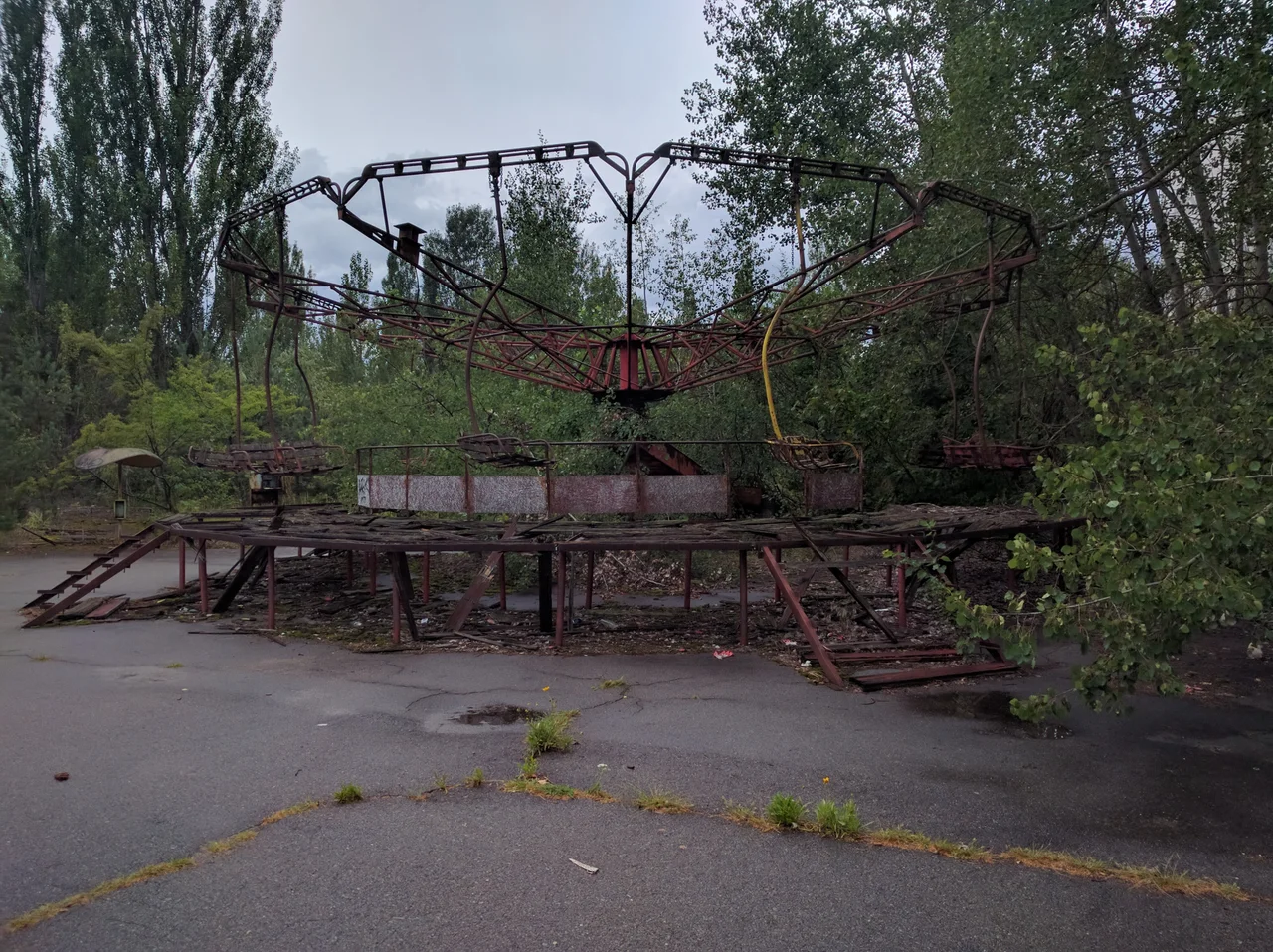

Pripyat amusement park
The Ferris wheel was supposed to start turning on May 1, 1986. The opening was timed to May Day, the Soviet Union's biggest civic holiday, when families would have walked from the apartment blocks of Pripyat to ride the new attractions: the bumper cars, the swing boats, the paratrooper ride called Chamomile. The ride operators had probably already practiced. The bumper cars sat in their painted bays. The Ferris wheel, twenty-six meters tall, dominated the park's skyline. Five days before the opening, on April 26, Reactor No. 4 of the Chernobyl Nuclear Power Plant exploded a few kilometers away. By the afternoon of April 27, every child who would have lined up for a ticket was on a bus out of the city. The wheel never officially turned. It is still standing.
Opened or Not
There is a persistent story that the park was hurriedly opened for a few hours on April 27, before evacuation was announced, supposedly to distract residents from the catastrophe unfolding at the plant. Wikipedia notes that these claims are largely unsubstantiated. Former residents do not consistently remember it that way. There was no panic at the time, the population was being told the situation was under control, so there would have been no obvious need to manufacture distraction. What is certain is that by 14:00 on April 27, buses were rolling. The park, planned and scheduled and ready, never had its grand opening.
Built by the Same Company That Built Yours
The amusement park was a standard Soviet Park of Culture and Rest, the kind of facility most large Soviet cities built in the postwar decades. The rides were manufactured by a firm based in Yeysk, on the Sea of Azov, which built attractions for amusement parks across the USSR. The successor company is reportedly still producing largely the same Ferris wheel design as recently as 2017. Drive past a small Russian or Ukrainian city's recreation park today and you may see a near-identical wheel turning over picnic tables and ice cream stands. The Pripyat wheel is exceptional only in that it never carried a paying passenger.
Where the Helicopters Landed
Radiation levels in the park vary in ways that record what happened after the disaster, not before. Soviet liquidators used the park grounds as a landing strip for helicopters carrying radioactive materials away from the reactor. The contamination washed into the soil. Concreted areas, regularly hosed down, are now relatively clean. Areas where moss has grown undisturbed for decades concentrate the contamination, in some places emitting up to 25,000 microsieverts per hour, among the highest readings anywhere in Pripyat. Visitors on permitted tours are warned not to step off the paved areas near the bumper cars. The wheel's base is safer than the grass twenty meters away.
The Wheel That Means Chernobyl
Of all the abandoned objects in Pripyat, the Ferris wheel is the most photographed. Drone footage circles it in dozens of documentaries; it appears in the video games S.T.A.L.K.E.R.: Shadow of Chernobyl, Call of Duty 4: Modern Warfare, Counter-Strike: Global Offensive, and the survival game Chernobylite, where players can walk under it digitally. The HBO miniseries Chernobyl, filmed in Vilnius in 2019, recreated the wheel for a sequence about the city's last hours. In September 2017, Polish tourists climbed up and turned the wheel mechanically, briefly, the first deliberate motion since 1986; they returned it to its original position before leaving. The image is so famous it functions as visual shorthand for the entire disaster.
The Children Who Did Not Ride
Pripyat in 1986 was a young city. The average age of residents was 26. The schools held over 11,000 children. Of the city's 49,400 inhabitants, a substantial fraction were under ten. Those children would have ridden this wheel on May 1. They would have lined up for the bumper cars and the Chamomile, and afterward their parents would have taken them home through the spring evening to apartments they would soon be told to leave for three days, never to return. They are still alive, most of them, scattered across Ukraine and beyond, now in their forties. Many gathered in 2020 for the fiftieth anniversary of Pripyat's founding, the first such return for many. The wheel was photographed again, against the same sky. It still has not turned.
From the Air
The Pripyat amusement park sits at 51.4081 N, 30.0571 E in the center of the abandoned city, within the Chernobyl Exclusion Zone in northern Ukraine, about 110 km north of Kyiv near the Belarus border. From altitude, the Ferris wheel is the most distinctive landmark in the abandoned city: a 26-meter open structure surrounded by visible square plazas. The Chernobyl Nuclear Power Plant lies about 3 km southeast. Boryspil International (UKBB) is roughly 130 km south of Kyiv; Kyiv airspace has restrictions due to the ongoing war. The exclusion zone is permanently restricted airspace; civilian overflight is not permitted.
Nearby Stories
- Russian attacks on civilians in the Russo-Ukrainian war (2022–present) 49 km away
- Kruty Heroes Memorial 110 km away
- Mogilev Ghetto 208 km away
- Battle of Lesnaya 208 km away
- Nesvizh Castle 258 km away
- Olyka Castle 265 km away
- Battle of Holowczyn 297 km away
- Holy Trinity Orthodox Cathedral, Lutsk 335 km away