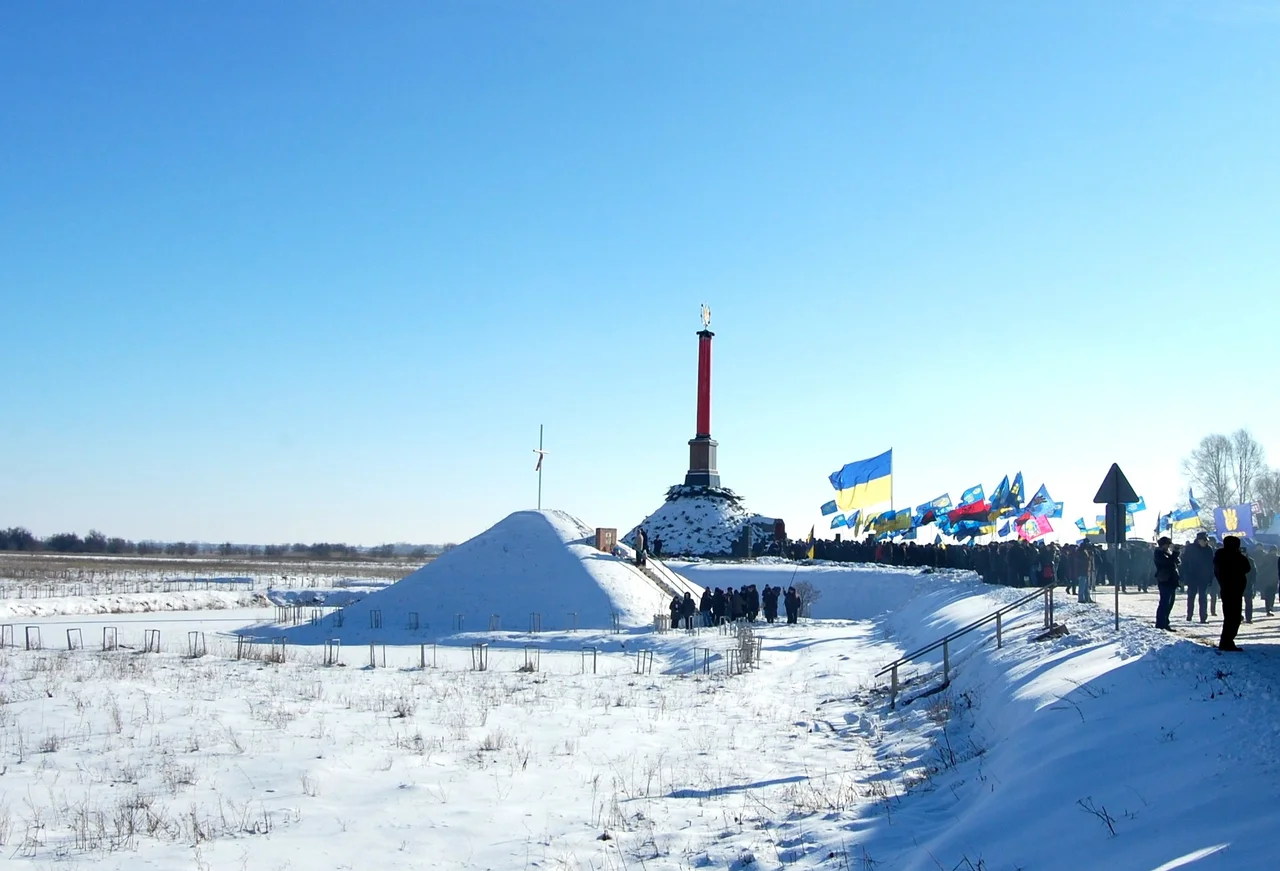

Kruty Heroes Memorial
They were students. Most of them had never fired a rifle until that winter. On January 29, 1918, roughly three hundred volunteers from Kyiv's gymnasiums and the Ukrainian University, hastily formed into a cadet battalion, met a column of Bolshevik troops at a small rail station in the Chernihiv countryside called Kruty. By evening, somewhere between two hundred and fifty and three hundred of them were dead. The Red Army column kept moving toward Kyiv. The Ukrainian National Republic those boys had hoped to defend would not survive the year. Almost a century later, on a low hill above that same field, a tall red column was raised over the place where the boys had bled.
What Happened at the Station
The Ukrainian National Republic had declared independence only weeks before. It had almost no army. When the Bolshevik commander Mikhail Muraviev pushed south from Russia toward Kyiv along the railway, what was sent to meet him was what could be sent: a scratch unit of cadets and students, joined by a handful of regular officers. The encounter at Kruty rail station lasted hours, not days, despite Muraviev's later boasts that he had fought a two-day battle against forces under Symon Petliura. There was no Petliura at Kruty. There were teenagers with bolt-action rifles, and there were professional soldiers with armored trains. Around two hundred and fifty Ukrainian defenders are believed to have died. The captured were shot afterward, and only the names of those captured are known. Muraviev needed two days to repair the rail station and reorganize, then continued his advance.
The Forgotten Decades
Under Soviet rule, the dead of Kruty were not heroes. They were traitors, or they were nothing at all. The bodies had been brought back to Kyiv and buried at Askold's Grave above the Dnieper. The student mounds were flattened, and the ground was paved over and planted as a city park. After the Second World War, Soviet soldiers killed in the battles for Kyiv were buried in the same area, the layered erasure of one war's dead by the next. For seventy years, as President Viktor Yushchenko later put it, Ukrainians were taught to walk past this field without looking. The names of the boys who died at the rail station survived only in family memory and in the Ukrainian diaspora abroad.
Building the Memorial
The first commemoration came after independence, in the early 1990s, when the People's Movement of Ukraine, known as Rukh, raised a wooden cross at the site. In 2000, the architect Volodymyr Pavlenko began designing something more permanent. What rose, by August 2006, was a deliberate piece of remembrance. Anatoliy Haydamaka shaped a hill seven meters high and topped it with a ten-meter red column. The color was not arbitrary. The column echoes the columns of the main building of Kyiv University, the school that had sent so many of the dead. A small chapel sits at the foot of the hill. A lake was dug nearby in the shape of a cross. President Yushchenko dedicated the memorial on August 25, 2006, the eve of Ukrainian Independence Day, and called what the cadets had done a lesson for the living.
A Field That Keeps Being Fought Over
The memorial has not been allowed to be quiet. It was vandalized in 2007, less than a year after the dedication. On March 1, 2022, six days into Russia's full-scale invasion of Ukraine, local officials reported that Russian forces had fired on the monument itself. Fighting moved across the same Chernihiv countryside the cadets had tried to hold a hundred and four years earlier. To stand at the base of the red column now is to stand inside an unfinished argument about who Ukraine belongs to and who gets to decide. Every January 29, schools across Ukraine read the names. The dead are still teenagers. The country they died for is still defending itself.
From the Air
Kruty Heroes Memorial sits at 51.08°N, 32.16°E in Chernihiv Oblast, northern Ukraine, in the village of Kruty between Nizhyn and Bakhmach along the historic Kyiv-Moscow rail line. The red column rises ten meters from a seven-meter hill, visible from low altitudes in clear weather; the cross-shaped lake reads well from above. Nearest major airport: Kyiv Boryspil (UKBB) about 130 km southwest. Approach with awareness of restricted Ukrainian airspace during the ongoing conflict.
Nearby Stories
- Sack of Baturyn 12 km away
- Battle of Bakhmach 16 km away
- Principality of Chernigov 22 km away
- Chernihiv Regional Art Museum 29 km away
- St. Elijah Church, Chernihiv 52 km away
- Zalissia National Nature Park 58 km away
- Pereiaslav 97 km away
- Treaty of Hadiach 104 km away