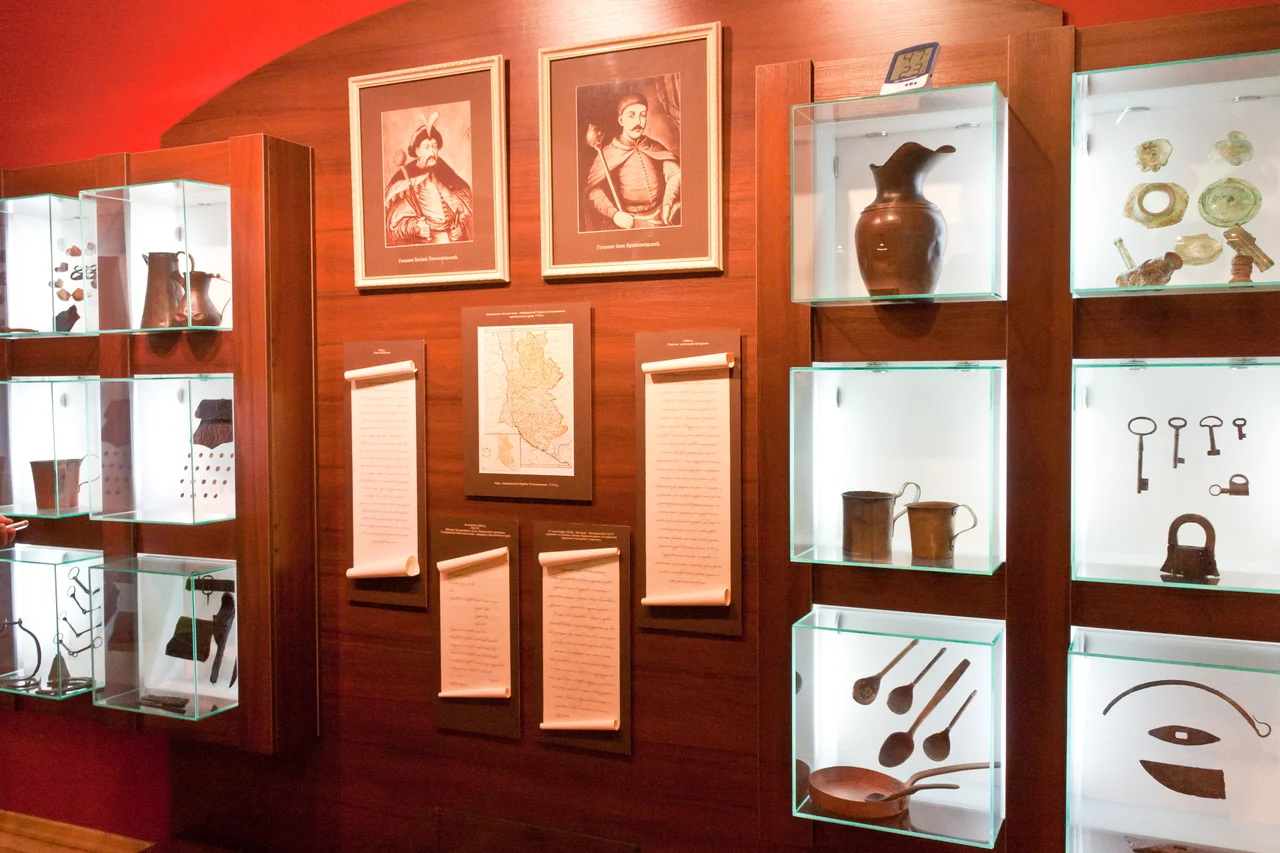

Baturyn Museum of Archeology
Among the artifacts in the Baturyn Museum of Archeology there is a small copper plate, blackened by fire, that once was an icon of the Mother of God with the Infant Christ. The gilding survives in patches, the work of master craftsmen from the Kyiv Pechersk Lavra in the late seventeenth century. Archaeologists found it lying in the grave of an elderly woman with a broken skull. The icon and its keeper were buried together on November 13, 1708, the day Tsar Peter the Great's commander Aleksandr Menshikov destroyed the Hetman's capital. Most of what this museum exhibits is older or younger than that date. But every artifact in every case orbits around it.
A House Older Than the Museum
The museum opened on January 22, 2009, the Day of the Unification of Ukraine, with President Viktor Yushchenko cutting the ribbon. It occupies a brick parish school built in 1904 next to the Resurrection Church, which holds the tomb of Hetman Kyrylo Razumovsky, the last Cossack hetman of the eighteenth century. The school served generations of Baturyn's children, then a Soviet kindergarten, before the National Historical and Cultural Reserve called 'Hetman's Capital' took it over in 2005 and restored the building. The architect of the school is unknown. The building is rectangular, single-story, unpretentious. It is exactly the right scale for what it now contains: not the grand sweep of empire, but the everyday objects of a town that lived, died, and rose again.
Mammoth Bones to Cossack Boots
The first hall, called Ancient Baturyn, holds the bones of mammoths and other animals that lived here ten thousand years ago. Stone tools from the Neolithic share cases with jewelry from Kyivan Rus, the medieval Slavic civilization that gave this region its first script and its first churches. The second hall covers the Lithuanian-Polish and Cossack centuries from the 1300s to 1669. Among its prized objects: a knight's belt set with silver, a silver thaler dated 1622, a pair of Cossack boots, the rough weapons of insurgents, and wooden timbers more than three hundred years old that were dredged from the moat of the Baturyn Citadel. The artifacts are not decorative. They are the residue of a market town that traded across borders and changed hands more than once.
The Hetman's Capital
From 1669 to 1708, Baturyn was the residence of the Hetmans of the Zaporizhian Host, the elected leaders of the semi-autonomous Cossack state called the Hetmanate. Three hetmans ruled from here: Demyan Mnohohrishny, Ivan Samoilovich, and Ivan Mazepa, the most famous and most controversial of them all. Mazepa governed Ukraine for over twenty years as a vassal of Tsar Peter the Great. In 1708, with the Great Northern War going badly for Russia, Mazepa switched sides to King Charles XII of Sweden. The decision had two consequences. The first was Sweden's catastrophic defeat at Poltava in 1709, which doomed Mazepa's gamble. The second was Peter's punishment of Mazepa's capital, which came faster.
November 13, 1708
Aleksandr Menshikov reached Baturyn with Russian troops and orders to make an example. The town was sacked and burned. Estimates of the dead vary; the most cited figure is around 14,000 men, women, and children. The burnt icon in the museum is one fragment of evidence; another is a section of mortar cannon recovered from the fortress walls, and the cracked remnant of a church bell that fell when the bell tower came down. Paintings by contemporary Ukrainian artists Andriy Ivakhnenko and Mykola Danchenko fill in scenes the artifacts can only suggest. For most of the Soviet period, the massacre at Baturyn was a forbidden subject. After Ukrainian independence, it became central to a national memory that rejected the imperial story Russia had written. The museum, opened on Unification Day by a president whose Orange Revolution had refused that imperial story, is part of how Ukraine answers the question of what was lost in 1708 and what is still being reckoned with today.
From the Air
Baturyn sits at 51.34 N, 32.89 E in Chernihiv Oblast, northern Ukraine, on the Seym River about 30 km from the Russian border. Best viewed at 5,000 to 7,000 feet to take in the Seym valley, the rebuilt citadel of Baturyn Fortress on the riverbank, and the surrounding agricultural plain. Kyiv Boryspil (UKBB) is about 200 km south. Note: this region has been heavily affected by the war since 2022; check current restrictions on Ukrainian airspace.
Nearby Stories
- Kruty Heroes Memorial 15 km away
- Chernihiv Museum of Ukrainian Antiquities 71 km away
- Battle of Lesnaya 229 km away
- Mogilev Ghetto 275 km away
- Olyka Castle 497 km away
- Grace Darling 507 km away
- Moscow 557 km away
- The Charge of the Light Brigade: The Most Famous Military Blunder in History 740 km away