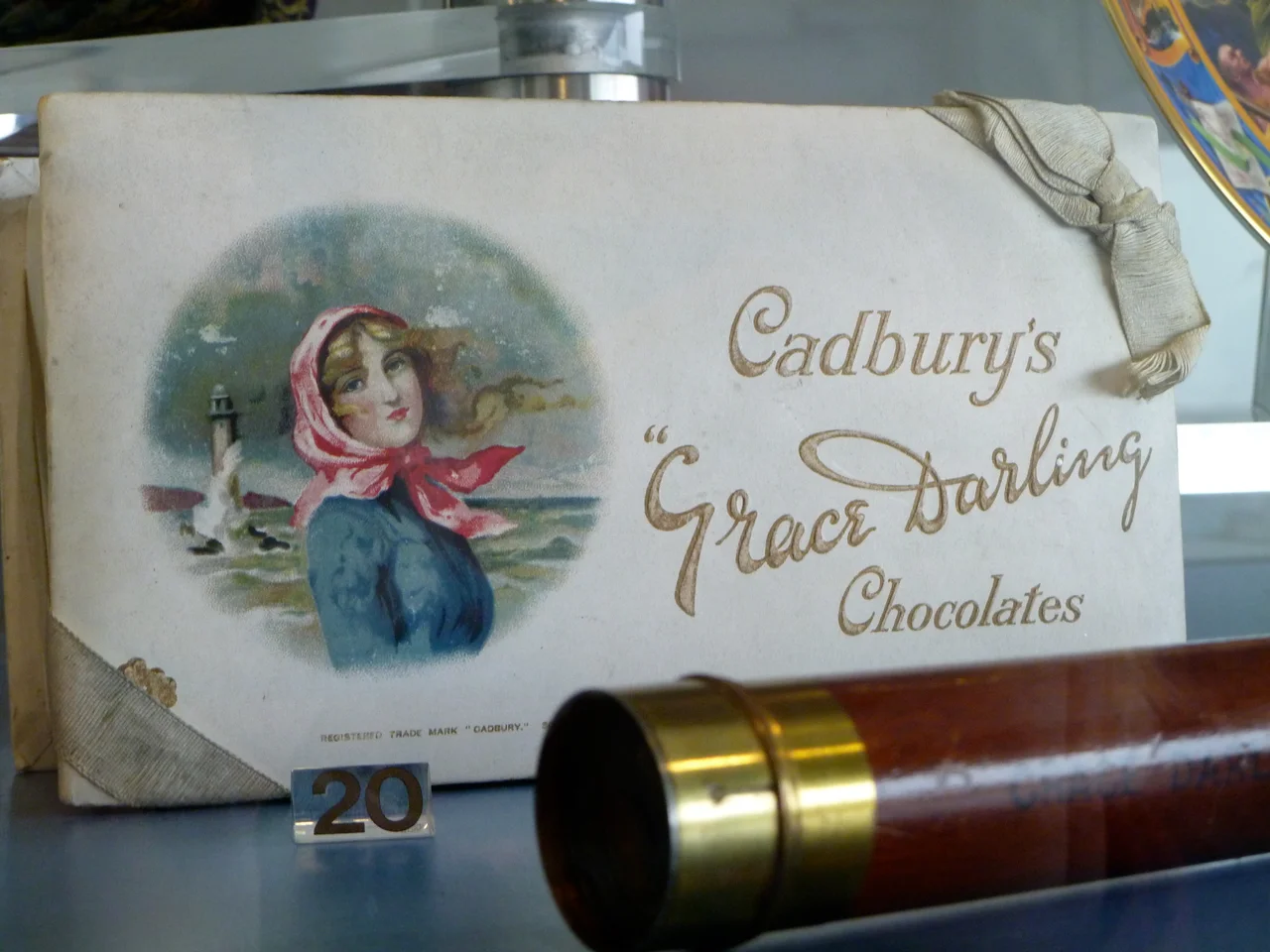

Grace Darling
Grace Darling was looking out of her upstairs window at the Longstone Lighthouse on the morning of 7 September 1838 when she saw what was left of a paddlesteamer breaking up on a low rock half a mile away. The sea was running so hard that the lifeboat from Seahouses, miles down the coast, would not be able to launch. So she and her father did the calculation: they had a 21-foot rowing boat, two pairs of oars, and roughly a one-mile route along the lee side of the islands. They went. By the end of that day, nine people who would otherwise have been dead were alive in the Darlings' lighthouse, and Grace - 22 years old, raised by lamplight on a wet rock in the North Sea - had begun the four years of unwanted fame that would shape and ultimately exhaust the rest of her short life.
Born to a Lighthouse
Grace Horsley Darling was born on 24 November 1815, at her grandfather's house in Northumberland, the seventh of nine children of William and Thomasin Darling. She was only a few weeks old when her parents took her to Brownsman Island - one of the Farne Islands, a stark scatter of low rocks off the coast - where her father kept the lighthouse built in 1795. William earned £70 a year, plus a £10 bonus for satisfactory service, which says everything about the value Trinity House placed on a lighthouse keeper's life. In 1826 the family moved to the newly built Longstone Lighthouse, a taller and better-positioned tower further out. The ground floor served as living room, dining room, kitchen, all in one. A spiral staircase climbed past three bedrooms to the light at the top. Grace grew up watching ships pass, learning to read weather and tide, helping with the lamp. By the time she was 22, she could handle a Northumberland coble in difficult water - which, on the morning of 7 September 1838, mattered.
The SS Forfarshire Breaks Up
The paddlesteamer SS Forfarshire had left Hull on 5 September, bound for Dundee with 62 people aboard. By the night of the 6th she was in serious trouble - her boilers leaking, her engines failing, and a southerly gale driving her toward the Farnes. In the dark hours of the 7th she struck Big Harcar, a low rocky island, and broke in half. The stern section, where most of the passengers were, washed off the rocks almost immediately; nine people in a lifeboat from that section drifted south and were eventually picked up at South Shields. The bow section - which held the survivors who would meet Grace Darling - lodged on the rock with a handful of crew and passengers clinging to whatever they could grip. Among them was Sarah Dawson, a young mother. Her two children, James (7) and Matilda (5), had died in her arms during the long, cold night before dawn.
The Rescue
Grace saw the wreckage from her window at first light. She and her father judged the sea too rough for the Seahouses lifeboat to put out and decided they had to go themselves. The boat was a Northumberland coble - 21 feet, built for inshore fishing, designed to handle the heavy Farne tides. They rowed about a mile, keeping to the lee of the islands, then maneuvered alongside the rock. Grace held the boat steady in surging water while William climbed onto Big Harcar and brought down the survivors one at a time: four crewmen, one passenger - Sarah Dawson, who had to leave the bodies of her children. They could only fit five at first. William and three of the rescued crewmen rowed back for the remaining four while Grace stayed at the lighthouse, tending to the survivors. By the time the Seahouses lifeboat arrived at Big Harcar, the rescue was over; the lifeboat crew - which included Grace's brother William Brooks - took shelter at the lighthouse for three days until the storm broke. Sarah Dawson would later return to the rock to find her children's bodies.
An Uneasy Heroine
The newspapers got hold of the story within days. A young woman, only 22, who had rowed into a North Sea gale to save lives - she fit a Victorian template so perfectly that the country could not stop reading about her. She and her father were awarded the Silver Medal for Bravery by what would become the Royal National Lifeboat Institution. Over £700 was raised by public subscription, including £50 from Queen Victoria. Portrait painters - more than a dozen of them - sailed out to Longstone to paint her. Letters arrived. Marriage proposals arrived. The Duke of Northumberland appointed himself guardian of her funds. The trouble was that Grace had not wanted any of this. The records suggest she was uncomfortable with the attention, embarrassed by the gifts, and never quite at ease in the role the country had assigned her. She kept living at the lighthouse with her family, helped her father, and tried to be the person she had been before.
Death at 26
By autumn 1842 Grace's health was failing. She had contracted tuberculosis - the consumption of Victorian England, killer of so many young people of her generation. She left Longstone for Alnwick in early October to convalesce with relatives. The Duchess of Northumberland visited her in person and arranged better accommodation near Alnwick Castle, sending the ducal physician to attend her. None of it helped. Grace asked to be taken home to Bamburgh, where she had been born. She died there on 20 October 1842, four weeks short of her 27th birthday. She was buried in the churchyard of St Aidan's Church, where her monument - a sleeping effigy of her holding an oar - was deliberately placed at the western edge of the churchyard so that it would be visible to seafarers passing offshore. The original sculpture, weathered by Northumberland's wind and rain, was moved inside the church in 1895.
What Remains
Bamburgh has a Grace Darling Museum, run by the RNLI, where you can see the original coble in which she rowed out to the wreck, along with her possessions and the relics of the rescue. From 1990 to 2020 an RNLI Mersey-class lifeboat at Seahouses bore her name. There is a stained-glass window for her in St Aidan's church and a memorial in St Cuthbert's chapel on Inner Farne. Henry Bennett bred a tea rose called 'Grace Darling' in 1884. A theatre play was running in Shoreditch within weeks of the rescue. Hotels in Melbourne are named for her; songs by the Strawbs and Duke Special have set her story to music. But the most honest memorial is Longstone Lighthouse itself, still operating, still marking the same dangerous rocks - and the upstairs window from which a 22-year-old looked out one September morning and saw what the sea had done.
From the Air
Longstone Lighthouse is on Longstone Rock in the outer Farne Islands, roughly at 55.64°N, 1.61°W on the Northumberland coast (the catalog coordinate of 38.63°E appears to be an unrelated data point - the actual site is off Northumberland). Cruising altitude FL050-FL080 in clear weather offers stunning views of the Farne Islands' bare rock scatter, Bamburgh Castle's looming outline on the mainland, and Lindisfarne further north. Big Harcar - where the Forfarshire broke up - is one of the low rocks just southwest of Longstone. Nearest airports: Newcastle (EGNT) about 75 km south, Edinburgh (EGPH) about 100 km north. This stretch of coast has notoriously variable weather; sea mist can blank out the islands entirely even on otherwise clear days.
Nearby Stories
- Moscow 66 km away
- Trinity Lavra of St. Sergius 126 km away
- Saint George Cathedral, Yuryev-Polsky 150 km away
- Perimilovsky Heights 155 km away
- Cathedral of the Nativity of the Theotokos, Suzdal 188 km away
- Battle of Kursk 347 km away
- Kursk 360 km away
- Tanais 823 km away