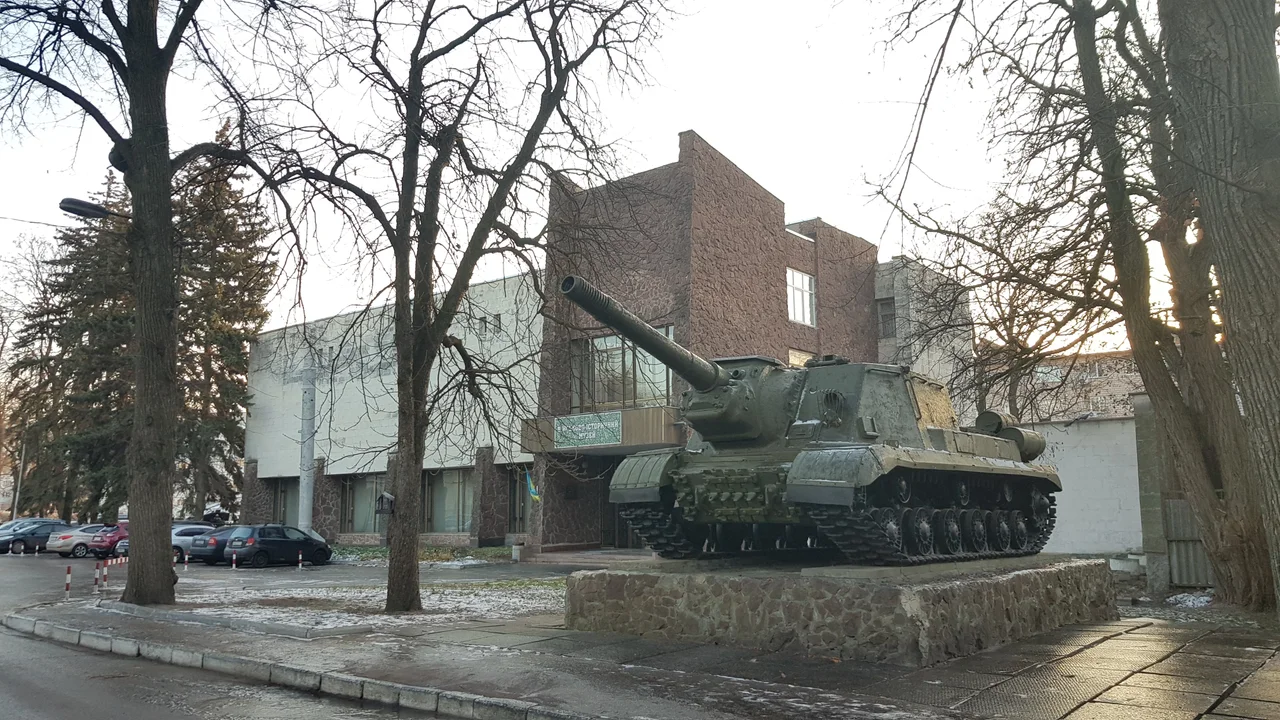

Chernihiv Military History Museum
Leonid Brezhnev personally cut the ribbon on the Chernihiv Museum of Battle Glory on May 9, 1981, Victory Day in the Soviet Union. The museum he opened that day told the story of the 1st Guards Army's path through the Great Patriotic War, the Soviet name for the war against Nazi Germany. Forty years later, on May 9 in 2022, the museum could not hold a Victory Day ceremony. Two months earlier, on March 13, 2022, Russian shelling had damaged the building's facade and part of its exhibition. The museum that the Soviet leader had opened to commemorate Soviet victory had been damaged by a Russian invasion of independent Ukraine. There are few buildings in Chernihiv where the country's twentieth-century history is so visibly compressed.
From Soviet Veterans' Project to National Museum
The museum was first proposed and built with the active participation of veterans of the former 1st Guards Army, a Soviet formation that had fought through Ukraine and into Central Europe in 1944 and 1945. It was constructed as a non-profit project on land specifically allocated for it. The first exhibition, marking the fortieth anniversary of the Soviet victory in 1985, focused on the army's combat path. In 1986 it was reorganized as a department of the Chernihiv Regional Historical Museum named after V. V. Tarnovsky. After the dissolution of the Soviet Union, the museum's identity shifted. On June 21, 1996, President Leonid Kuchma signed a decree elevating it to national status. The institution had to negotiate the change. Its founding mission honored Soviet veterans and a Soviet army; its new mission was to tell the military history of Ukraine, including the parts the Soviet narrative had erased.
Two Halls, Many Wars
The museum is organized in two main sections. The first, The Battle Path of the Former 1st Guards Army, was built in 1985 and substantially re-curated in 1999. It still tells the story the founders intended to tell. The second, Military History of Chernihiv Region, was built in 1988 and has been continually expanded since independence. New themes added over time include Military Construction of the Era of the Ukrainian Revolution, the Battle of Kruty (the 1918 engagement in which a small force of Ukrainian students and cadets died trying to slow the Bolshevik advance on Kyiv), participation of Chernihiv residents in late twentieth-century conflicts, the creation of the Army of Independent Ukraine, and the work of the Chernihiv Border Detachment. Permanent exhibitions include Glory of the Ukrainian Cossacks, Liberation of Chernihiv Region from Nazi Invaders, and one called Ukraine on Our Shoulders, dedicated to Chernihiv residents who fought in the Anti-Terrorist Operation in eastern Ukraine that began in 2014.
Thirteen Thousand Items
The museum's holdings exceed 13,000 items, the majority connected to the German-Soviet war. The collection includes documents, photographs, weapons, awards, military equipment, personal belongings, and tools. There are also smaller collections covering the First World War, the Ukrainian Revolution of 1917 to 1921, military construction in the 1920s and 1930s, and the participation of Chernihiv residents in the cleanup of the Chernobyl accident, the so-called Liquidators. Roughly 2,500 items are on permanent display. The Chernihiv Higher Military Aviation School of Pilots, which trained Soviet pilots, is also documented in the collection. In the open air to the right of the building, the museum displays larger pieces of military equipment from the Second World War alongside, in recent years, captured or destroyed Russian armor from the war in eastern Ukraine, including a Russian tank knocked out after 2014.
March 13, 2022
Russia invaded Ukraine on February 24, 2022. Russian forces encircled Chernihiv within two weeks. The siege of Chernihiv lasted from late February through early April. By the time it ended, roughly 700 civilians had been killed in the city and surrounding region, residential blocks had been flattened, and several cultural sites including the museum had been damaged or destroyed. On March 13, Russian shelling struck the Chernihiv Military History Museum. The facade was damaged. Part of the exhibition was hit. The museum staff had moved a portion of the collection into safer storage in the early days of the war, a decision that almost certainly saved irreplaceable material. UNESCO subsequently included the museum on its list of damaged Ukrainian cultural sites verified during the war.
What a Military Museum Means in Wartime
The museum has continued to operate, though with reduced capacity, while restoration work proceeds. Its symbolism has shifted again. A museum founded by Soviet veterans of the war against fascism, opened by Brezhnev, now stands damaged by the Russian state that claims to be the heir of that Soviet tradition. The 1st Guards Army hall sits not far from the new exhibits documenting Russian armor destroyed by Ukrainian soldiers in 2022. Outside, the Russian tank captured in eastern Ukraine sits in the same yard as a Soviet T-34 from 1943, both placed there by the same museum staff making sense of the same century from very different sides of it. The story the museum was built to tell turned out not to be the last story. It is, increasingly, the museum that records what is happening to Ukraine right now.
From the Air
The Chernihiv Military History Museum sits at 51.50N, 31.32E in northern Chernihiv, Ukraine. The closest international airport is Kyiv Boryspil (UKBB), about 145 km south. Chernihiv's own Chernihiv-Shestovytsia airport (UKKL) is roughly 12 km southwest. Chernihiv lies about 75 km from the Belarusian border and 230 km from the Russian border, which made it a primary axis of attack during the 2022 invasion. From the air, the city is built along the Desna River, which curves to the southeast of the historic core. As of 2026 Ukrainian airspace remains restricted because of the ongoing war with Russia.
Nearby Stories
- Kruty Heroes Memorial 14 km away
- Battle of Chornobyl 52 km away
- Baturyn Museum of Archeology 63 km away
- Battle of Lesnaya 207 km away
- Mogilev Ghetto 225 km away
- Olyka Castle 363 km away
- Holy Trinity Orthodox Cathedral, Lutsk 432 km away
- Grace Darling 575 km away