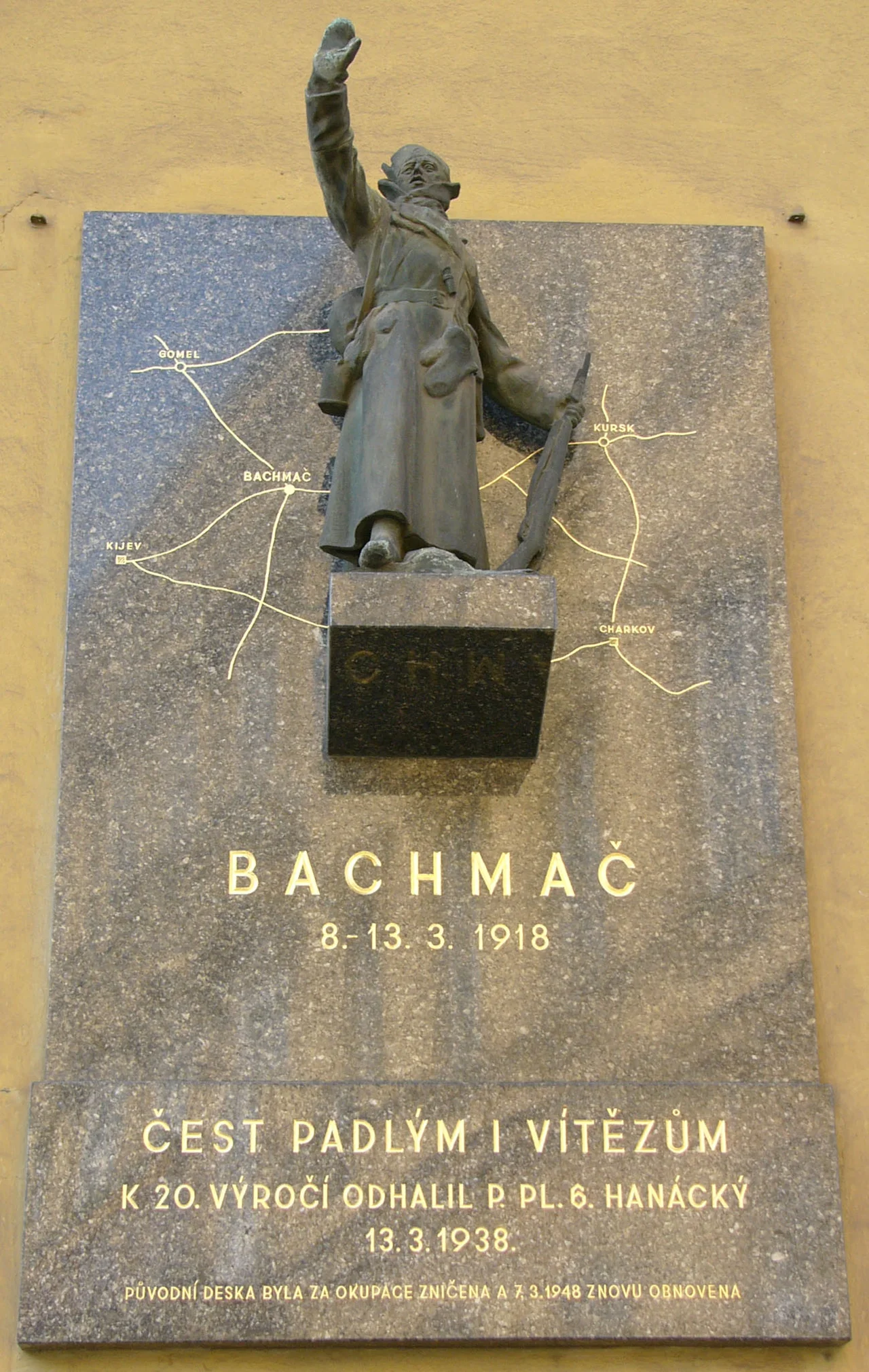

Battle of Bakhmach
The strangest part of the Battle of Bakhmach is the geography. The men fighting were Czechs and Slovaks, citizens of Austria-Hungary who had defected to the other side. They were now in Ukraine, holding a railway town against the German army, with the goal of reaching Vladivostok — a port on the Pacific Ocean, six thousand miles east of where they wanted to end up. Czechoslovakia, the country they were fighting for, did not yet exist. They were going to ride the Trans-Siberian Railway around the world to get home.
How They Got Here
The Czechoslovak Legion was the largest military force ever raised by a national independence movement that had no country. About 40,000 strong by early 1918 and growing toward 60,000, the Legion was made up of Czechs and Slovaks who had been conscripted into the Austro-Hungarian army, captured by the Russians on the Eastern Front, and then volunteered to fight against the empire that had drafted them, in the hope of bringing into being a Czech-Slovak state. Tomáš Masaryk, the future first president of Czechoslovakia, was their political organiser and recruiter; the Allied powers, particularly France, sponsored them as a symbolic free Czech force. Then in March 1918 the Bolsheviks, having seized power in Russia, signed the Treaty of Brest-Litovsk and pulled out of the war. The Legion's situation became suddenly impossible. They were a foreign army on Russian soil, with no country to retreat to and an Eastern Front that no longer existed. The plan they devised was simple, and almost certainly insane: ride the Trans-Siberian east to Vladivostok, sail across the Pacific, cross North America, and rejoin the Western Front from the Atlantic side.
The Junction
Bakhmach is a small Ukrainian town northeast of Kyiv whose only real distinction is its railway. It sits at a major junction on the line that runs east toward the Volga, and through the Volga toward the Trans-Siberian. For the Legion, Bakhmach was the door. Get through it, and the railway took them home the long way. Lose it, and they were trapped in a country whose new government had just made peace with their old one. The German army arrived at Bakhmach on March 8, 1918, advancing under the terms of Brest-Litovsk to occupy Ukraine. They threatened to encircle the Legion, which was a particularly grim threat because captured legionnaires were treated as deserters from Austria-Hungary and summarily shot. The Czechs and Slovaks who held Bakhmach knew exactly what defeat looked like. The 6th and 7th Rifle Regiments and the Assault Battalion of the Czechoslovak Army Corps dug in and waited.
Five Days
The fighting ran from March 8 to March 13. The Legion was up against the German 91st Infantry Division and elements of another, well-equipped, well-fed, well-supplied. The legionnaires were none of those things. They had what the Russian army had left behind on its way out of the war. They also had the advantages of motivation — the very specific motivation that came from knowing what would happen if they were captured — and of fighting on a railway they understood, with Stanislav Čeček commanding the defense of the junction itself and other units holding the bridge over the Desna River at Doch. The climax came on March 10. The Germans, after several days of unsuccessful assaults, agreed to negotiate a truce. Under its terms, Czechoslovak armoured trains were allowed to pass freely through Bakhmach junction toward Chelyabinsk and the Trans-Siberian. The Bolsheviks formally protested the German action as a violation of Brest-Litovsk and stood symbolically alongside the Czechs, but their support was almost entirely rhetorical. The Germans then quietly resumed their occupation of the rest of Ukraine.
The Cost
Legion casualties were 145 killed, 210 wounded, and 41 missing. German losses are estimated at around 300 dead and several hundred more wounded. These are not large numbers by First World War standards, but each of those 145 Czech and Slovak names belonged to a man who had survived Austro-Hungarian conscription, the Russian front, captivity, the long political process of organising into a Legion, and the chaos of the Russian collapse — only to die at a railway junction in Ukraine fighting for the right to ride a train home. Bakhmach is one of three battles, along with Zborov in 1917 and the Siberian anabasis that followed, that became the foundational military memory of the Czechoslovak state when it finally came into being in October 1918. The legionnaires who survived sailed from Vladivostok over the next two years, some by way of America. They arrived home to a country that had not existed when they left it.
What Came After
The Siberian anabasis, the Legion's two-year fighting retreat across Russia, became one of the great improbable stories of the era — Czech armoured trains battling Red and White Russian forces alike, taking and losing cities, controlling for a time most of the Trans-Siberian Railway, even briefly seizing the Tsarist gold reserve at Kazan. Bakhmach was the small battle that made the long journey possible. In the Czech Republic and Slovakia it is remembered with the same gravity Americans reserve for the Alamo or the Australians for Gallipoli — a defining engagement that did not, by itself, change the war, but that proved a national army existed before there was a nation. The town of Bakhmach is still there, still a railway junction, in a country now called Ukraine that has its own complicated relationship with empires and exits.
From the Air
Bakhmach lies at 51.183°N, 32.827°E in Chernihiv Oblast, northeastern Ukraine, about 200 km east-northeast of Kyiv. The terrain is flat steppe, with the Desna River winding to the south. From the air, the town's dominant feature is still its railway junction — multiple lines converging in a fan pattern visible from cruising altitude. Kyiv Boryspil (UKBB) lies about 200 km southwest, Kyiv Zhuliany (UKKK) about the same distance west. Best viewed from medium altitude in clear weather.
Nearby Stories
- Kachanivka Palace 22 km away
- Kruty Heroes Memorial 22 km away
- Mezine 37 km away
- Hlukhiv 40 km away
- Sedniv 56 km away
- Siege of Hlukhiv 61 km away
- Treaty of Hadiach 80 km away
- Oster 103 km away