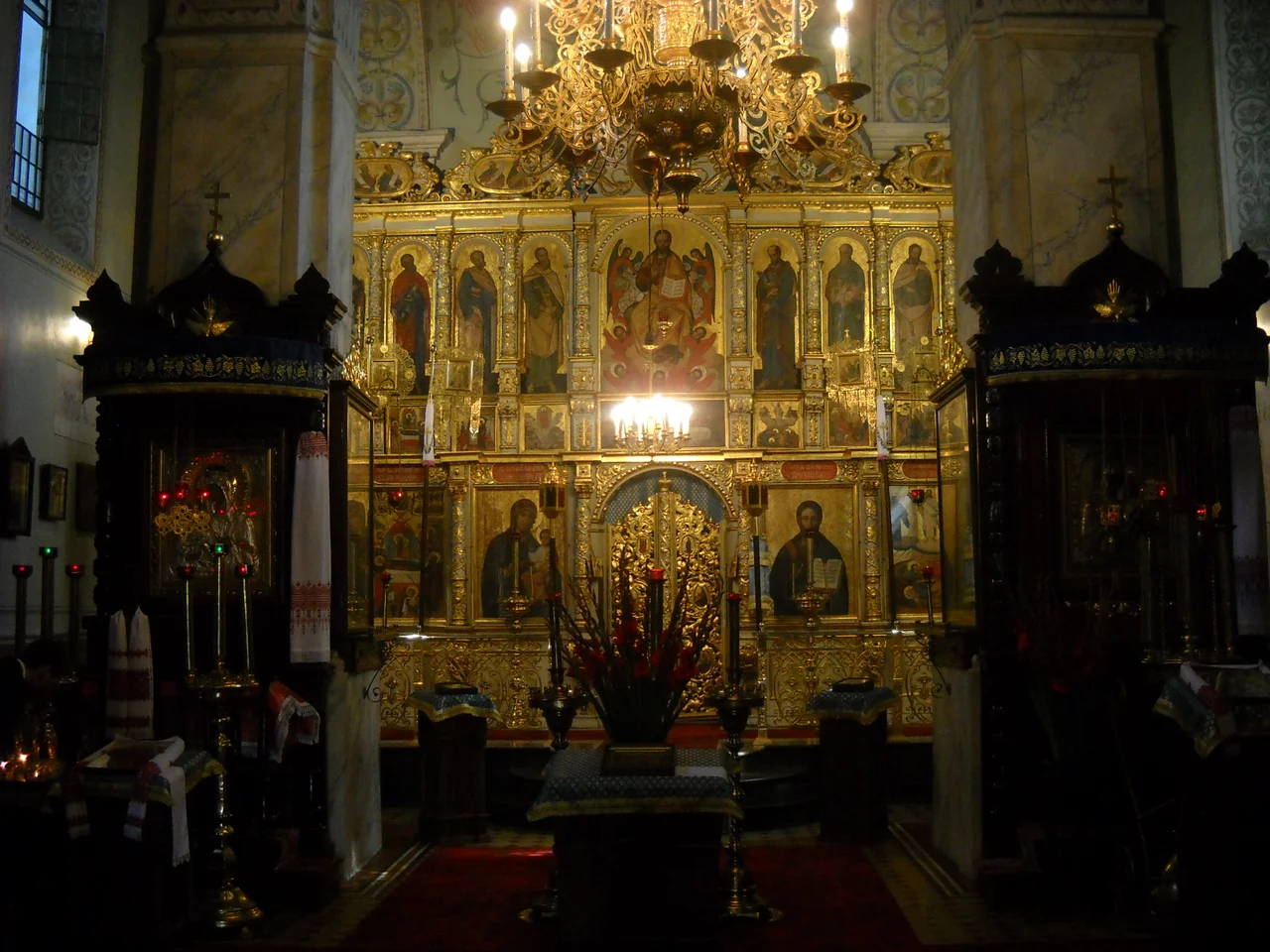

Cathedral of the Transfiguration, Lublin
Ruska Street in Lublin runs along the eastern edge of the old town. The name itself, Ruthenian Street, is a memory of who used to live here. For most of Lublin's history this Polish, Catholic city had an Orthodox minority, mostly Ruthenian and later Ukrainian, who worshipped at a church on this street. The current Cathedral of the Transfiguration, the brick building that has stood here since 1633, was dedicated by Petro Mohyla of Kyiv, one of the most consequential Orthodox theologians of the seventeenth century. Its history is the history of Polish-Orthodox relations across four centuries: contested ownership, forced conversions, ethnic cleansing in the 1940s, and a parish that very nearly disappeared.
Ancient Foundations
Documentary evidence puts the first Orthodox church in Lublin no later than 1390, and possibly much earlier. A fourteenth-century chronicle attributed to Wincenty Kadlubek mentions Daniel of Galicia building both a castle and an Orthodox church here in the thirteenth century, though some historians dispute that account. A 1390 document references the murder of two women from Kolechowice as they walked to Lublin for what the document calls the schismatic Feast of the Savior, the Orthodox Feast of the Transfiguration. That phrasing, hostile as it is, confirms the church existed and was known. By the sixteenth century there is no doubt about an active Orthodox parish in Lublin worshipping at the site of the present cathedral. The wooden building burned. Only the iconostasis was saved. A replacement church was built in the early seventeenth century but deteriorated quickly; in 1607 the Lublin Orthodox brotherhood began work on a new masonry church.
Petro Mohyla's Dedication
Petro Mohyla, the Metropolitan of Kyiv from 1633 to 1647, was traveling from Krakow back to Kyiv when he stopped in Lublin on March 15, 1633, and dedicated the new brick Church of the Transfiguration. Mohyla was a major figure: a Moldavian aristocrat by birth, founder of the Kyiv-Mohyla Academy, the most important Orthodox theological school of its century, and the author of the Orthodox Confession of Faith that shaped Eastern Orthodox doctrine for generations. His personal blessing of a small parish church on a contested frontier of Catholic Poland was a deliberate act. Ownership of the church was bitterly disputed in the Lublin tribunal between Orthodox and Uniate (Greek Catholic) factions. The Uniate side won permanent control in 1695, and for the next 180 years the building was used by the Uniates, with steady Latinization of its interior: organs were installed, side altars were added in the western Catholic style, and sermons were given in Polish.
Returned to Orthodoxy by Imperial Force
The Russian Empire, after acquiring this part of Poland in the partitions, abolished the Uniate Eparchy of Chelm in 1875 by tsarist decree and military pressure. Throughout the eparchy, Uniate parishes were forcibly converted to Russian Orthodoxy. The Lublin parish came back into Orthodox hands on May 11, 1875. The reestablished parish initially had only 80 members. Over the following decades the church received gifts that signaled its new prominence: Patriarch Damian I of Jerusalem sent a copy of an icon and a fragment of the True Cross from the Church of the Holy Sepulchre. The future Patriarch Tikhon, the same St. Tikhon who later served at Vilnius and became Patriarch of Moscow, served briefly here as Bishop of Lublin in 1897 and 1898. After Polish independence in 1918, Orthodox Christians in Lublin lost nearly all their churches; the Transfiguration and the Orthodox cemetery were among the only properties they kept.
The Vanishing of a Community
By 1939 the parish had grown to about 850 members, including Ukrainian emigrants and former soldiers of the short-lived Ukrainian People's Republic, and Russians who had stayed in Lublin after the First World War. The Second World War, and what followed it, almost ended the parish entirely. Between 1944 and 1946, Polish authorities expelled most of the remaining ethnic Ukrainian population from southeastern Poland to the Soviet Union as part of the postwar population transfers. Polish Orthodoxy in the Lublin and Chelm region collapsed: more than 160 parishes closed because there were no longer any faithful to attend them. The Lublin parish was one of only six in the entire region permitted to remain open, alongside parishes in Chelm, Wlodawa, Hrubieszow, Biala Podlaska, and the monastery in Jableczna. Bishop Timothy of Lublin made the case to government authorities that the remaining Orthodox population still needed somewhere to worship.
The Cathedral Today
After the war the church reopened in October 1945 and was restored partly with funding from the Polish Ministry of Reconstruction and donations from the Bialystok diocese, where Polish Orthodoxy was strongest. In time, the Church of the Transfiguration was elevated to cathedral status, becoming the seat of the Orthodox diocese of Lublin and Chelm. In 2016 it was visited by Patriarch John X of Antioch; in 2018 by Metropolitan Tikhon of the Orthodox Church in America and Patriarch Theodore II of Alexandria. The seventeenth-century iconostasis still stands inside, partly assembled from older sixteenth-century icons. During the annual Week of Prayer for Christian Unity, the cathedral hosts an ecumenical service, an unusual gesture in a city where Orthodox-Catholic relations have a long, hard history. The building was registered as a Polish historic monument under number A/227. To stand on Ruska Street today is to stand on a street whose name memorializes a community that almost disappeared, in front of a church that almost did too.
From the Air
The Cathedral of the Transfiguration sits at 51.25N, 22.57E on Ruska Street in central Lublin, Poland, just east of the medieval old town. The closest airport is Lublin Airport (EPLB) at Swidnik, about 10 km southeast; Warsaw Chopin (EPWA) is roughly 175 km northwest. From the air, the cathedral lies in the central historic district, immediately northeast of the better-known Lublin Castle on its limestone outcrop. The Lublin old town spreads in a tight cluster of red roofs west of the cathedral. The terrain across this region of southeastern Poland is gently rolling, with the Bystrzyca River winding through Lublin to the southwest of the historic core.
Nearby Stories
- Poniatowa Concentration Camp 8 km away
- Sobibor Museum 11 km away
- Zamość Fortress 29 km away
- Damachava Ghetto 39 km away
- Battle of Komarow 68 km away
- Brest Castle (Belarus) 93 km away
- Battle of Warsaw (1831) 113 km away
- Krakow 186 km away