
Battle of Warsaw (1831)
When Frederic Chopin learned that Warsaw had fallen to the Russians, he was in Stuttgart, broke and far from home. He had left Poland just weeks before the November Uprising began, planning to come back. Now there was nothing to come back to. He sat down at a piano and wrote what would become the Etude in C minor, Op. 10 No. 12, a furious cascade of left-hand triplets under a melody that tries again and again to rise above them. Posterity called it the Revolutionary Etude. He had originally intended to title it the Etude on the Bombardment of Warsaw. The title is significant because of what it suggests about how this defeat was felt at the time and afterward: not just as a military setback, but as a death in the family of European liberty, the first long sentence in the disappearance of Poland from the map.
A Year of European Revolutions
1830 had been a year of uprisings across Europe. The July Revolution in France had thrown out the Bourbons. Belgium had broken away from the Netherlands. Smaller revolts had flared in Italy. The Russian tsar Nicholas I, who saw himself as the chief defender of the European order established at the Congress of Vienna, was preparing to send his army to crush the Belgian revolt when Polish cadets rose in Warsaw on the night of 29 November 1830. The Polish Sejm formally deposed Nicholas as king of Poland on 25 January 1831. For the next year, the Polish army fought a difficult but stubborn war against Russian invasion forces, winning at Stoczek and Wawer, holding their ground at Grochow, slowing the Russian advance through the spring and summer. Cholera ravaged both armies; the first Russian commander in chief, Field Marshal Diebitsch, died of it. His successor, Ivan Paskevich, decided to do what Diebitsch had failed to do and surround Warsaw from the west.
The Walls of Wola
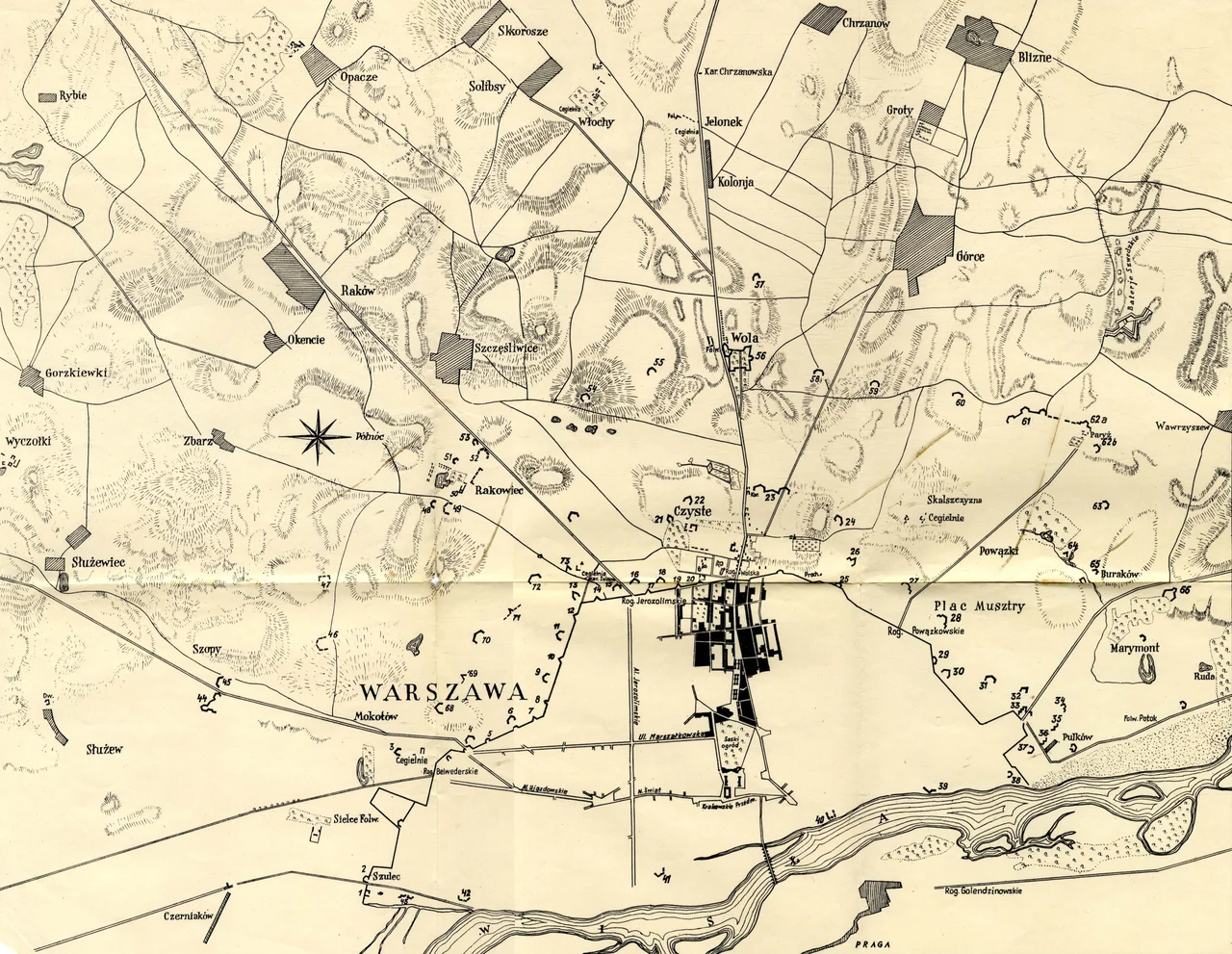
By the late summer of 1831, Warsaw was the center of what remained of independent Poland. The city had three lines of earthwork fortifications, ramparts and dry moats reinforced with palisades and trous-de-loup. The strongest of the outer forts was Fort 56 in the western suburb of Wola, built around the old church of St. Lawrence. On the morning of 6 September, Paskevich threw 78,500 men and 392 cannons against the Wola fortifications. The Polish defenders numbered about 40,000 in and around the city, of whom only perhaps 5,300 infantry held the western line under General Jan Krukowiecki, the new and conservative Polish commander in chief. The Russian artillery began at dawn. By morning, the smaller Forts 54 and 55 had fallen. Fort 54 went into legend: the gunpowder magazine exploded under the Russian assault and killed more than a hundred of the attackers, including a Russian colonel. The defending lieutenant who lit the fuse, Julian Konstanty Ordon, was thought to have died in the explosion; he survived and lived another half-century, but the Polish romantic poet Adam Mickiewicz had already written him into a poem called Reduta Ordona, Ordon's Redoubt, that schoolchildren in Poland still read.
Sowinski at the Church
Fort 56 itself was held by General Jozef Sowinski, a one-legged veteran of the Napoleonic wars who had lost the leg fighting under Bonaparte at Borodino almost twenty years earlier. He was fifty-four years old and stood his ground beside the cannons in the courtyard of the church. As Russian forces from the elite Moscow and Siberian regiments stormed the inner walls, the wooden leg made him conspicuous; he was offered surrender and refused. He was killed at the church, alongside most of his garrison. The wounded who tried to surrender were massacred where they stood. Of about 1,660 defenders of Fort 56, perhaps 500 made it back to the Polish lines. By midday on 6 September, Wola was lost, and Russian artillery was within range of the western boroughs of the city itself. Sowinski's death made him a Polish national hero almost immediately; the poet Juliusz Slowacki wrote Sowinski w okopach Woli, "Sowinski in the Trenches of Wola," which became part of every Polish schoolchild's reading list. The two greatest Polish romantic poets, Mickiewicz and Slowacki, both wrote the battle directly into the literature of a nation that was losing its political existence.
The City Surrenders
On 7 September the Russian artillery shelled the city itself. The Polish authorities, weighing what continued resistance would cost the civilian population, remembered the Russian massacre of Praga in 1794 when General Suvorov had let his Cossacks loose on the city's eastern suburb and killed perhaps twenty thousand civilians. Krukowiecki opened negotiations. On the night of 7 September, Polish forces evacuated the city. The remainder of the Polish army withdrew north to the fortress of Modlin and from there, as the November Uprising collapsed in the following weeks, across the borders into Prussia and Austria, going into the long exile of the Great Emigration. The French foreign minister, Count Sebastiani, reported the news to the French Chamber of Deputies in a single chilling line: "L'ordre regne a Varsovie." Order reigns in Warsaw. The phrase, intended as a kind of dry diplomatic euphemism, was perceived across Europe as cynicism, and it stuck. It became one of the most famous epitaphs in nineteenth-century history.
What Was Lost
After the November Uprising failed, Russia abolished the Polish constitution, the Polish army, and most Polish institutions. The Congress Kingdom became, in practice, a Russian province. Polish independence would not return until November 1918, eighty-seven years later, after a world war and three empires had finished collapsing. In those eighty-seven years, generations of Poles grew up speaking Polish at home and Russian or German at school, fighting in conscript armies for empires they did not love, watching their cultural memory being slowly tilted into something other peoples would tell about them. The Battle of Warsaw cost about 8,000 Russian and roughly the same number of Polish casualties over the two days, numbers that look small beside Leipzig or Borodino. But the political consequences ran much further than the battle itself. The fall of Warsaw began the longest interruption in the political existence of any European nation in modern history. Walking through the city today, where the rebuilt Old Town stands above its destroyed-and-rebuilt-again history and the Wola district has become the central business district full of glass towers, you can still find the small monuments: Sowinski's, the wall of the church where he fell, the cemetery where the Russian soldiers killed at Fort 54 were buried in a shell-hole. They are not large monuments. The story they mark is large enough.
From the Air
Located at 52.23N, 21.01E in central Poland on the western bank of the Vistula River. The 1831 battlefield concentrated on the western approaches to the city, in what is now the Wola district of modern Warsaw. Visible from cruising altitude as the dense urban core of the Polish capital sprawling along both banks of the Vistula. Nearest major airport is Warsaw Chopin (EPWA) about 8km southwest of the central city, with Warsaw-Modlin (EPMO) about 30km northwest.
Nearby Stories
- Treblinka Uprising 42 km away
- Treblinka Extermination Camp 56 km away
- Lodz Ghetto 70 km away
- Soldau Concentration Camp 79 km away
- Lubartów Ghetto 101 km away
- Poniatowa Concentration Camp 123 km away
- Osowiec Fortress 154 km away
- Stutthof Concentration Camp 241 km away