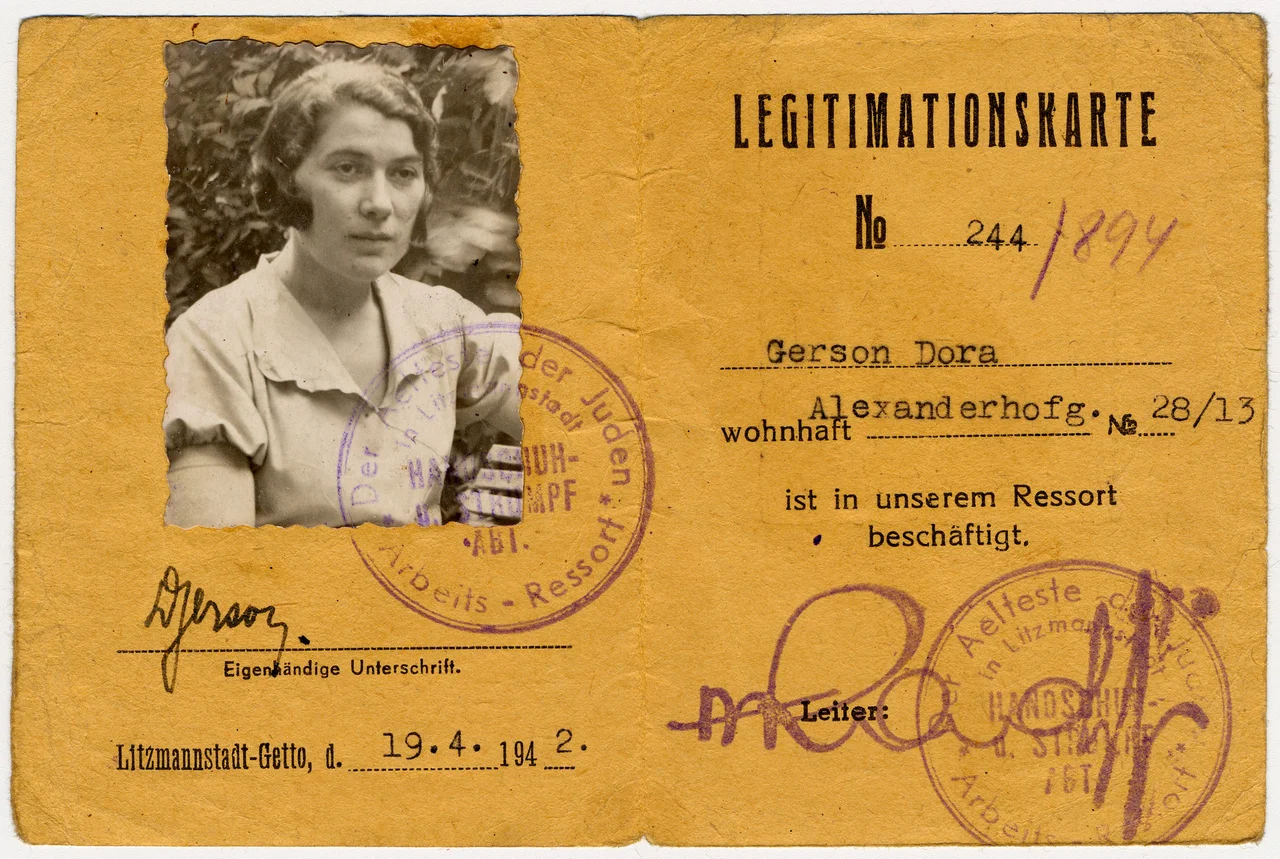

Lodz Ghetto
On 4 September 1942, in a square in front of the fire station on Lutomierska Street, the chairman of the Lodz Ghetto's Jewish Council stood on a wooden platform and asked the parents in front of him to give him their children. "Brothers and sisters," Mordechai Chaim Rumkowski said in Yiddish, "a grievous blow has struck the ghetto. They are asking us to give up the best we possess — the children and the elderly. I never imagined I would be forced to deliver this sacrifice to the altar with my own hands. In my old age I must stretch out my hands and beg: Brothers and sisters, give them to me. Fathers and mothers, give me your children." Over the following eight days the Germans took roughly 15,000 children under ten and elderly people from the Lodz Ghetto and sent them to be gassed at the Chelmno extermination camp.
Litzmannstadt
Lodz was the textile capital of pre-war Poland, a city of red-brick mills and a Jewish community of about 233,000 — roughly a third of the population. The Germans entered on 8 September 1939, renamed the city Litzmannstadt after a German general of the First World War, and on 8 February 1940 sealed off the northern district of Baluty as a ghetto. Around 164,000 Jews were forced inside an area of 4.13 square kilometres. They were joined the following year by 20,000 more Jews deported from Germany, Austria, Luxembourg, and the Czech lands, plus 5,000 Roma from Burgenland. The ghetto was sealed tighter than any other in occupied Poland. It had its own currency — the Rumki, named after Rumkowski — its own postage stamps, and its own police force. Almost no smuggling was possible. Almost no escape was possible.
The Shop, the Strategy, the Argument
Rumkowski's calculation was that productivity would mean survival. By 1943 the ghetto held 117 factories — Ressorts in the German bureaucratic vocabulary — sewing Wehrmacht uniforms, making boots, weaving carpets, repairing parachutes. Roughly 80,000 people worked. The strategy bought time. It did not buy life. The food rations were starvation rations; people died of hunger and tuberculosis at rates that made even the work irrelevant. The historian and ghetto chronicler Oskar Rosenfeld noted in his diary the slow biological collapse of his neighbours. The teenager Dawid Sierakowiak kept a diary in five small notebooks, recording the death of his mother in September 1942 and his own slow starvation; he died in the ghetto on 8 August 1943 at age nineteen. His diary survived because someone found it after the liberation in an abandoned room.
The Children
The Sperre — the September 1942 deportation — is the moment around which everything in the ghetto's history bends. The Germans demanded 20,000 deportees, specifically the children under ten and the very old, the inhabitants who could not work. The Jewish Council was offered the choice between assembling the lists themselves or letting the SS conduct the selection. Rumkowski took the lists. He believed that if the children and elderly were sacrificed, the working population — and his own family — might survive. Parents hid children in attics, in laundry baskets, behind false walls. Some families killed themselves rather than be separated. The ghetto's German police, the Sonderkommando, eventually went house to house. About 15,000 people were taken in eight days. None survived. There is no defending what Rumkowski did. There is also no defending the people who put him in a position where there was nothing to defend.
The Witnesses
Henryk Ross was a photographer for the ghetto's statistical department. His official assignment was identification photographs and propaganda images of productive labour. In his off-hours he photographed everything else: the deportations, the corpse carts, the starving children, the smiling weddings of the people he knew. In 1944, with the ghetto being liquidated, he buried his negatives in a wooden box at 12 Jagielonska Street. He survived. After liberation he dug them back up. About half were ruined by groundwater. The rest — three thousand images — are now at the Art Gallery of Ontario and form the most complete photographic record of any ghetto in Nazi Europe. When the Red Army entered Lodz on 19 January 1945, 877 Jews were alive in the ghetto, 12 of them children, kept by the Germans to clean up. Of the 223,000 Jews who had lived in Lodz when the war began, perhaps 10,000 returned. The Polish midwife Stanislawa Leszczynska, who hid Jewish families and provided forged documents until her arrest, was deported to Auschwitz, where she went on to deliver more than 3,000 babies in the camp itself.
From the Air
The former ghetto sits in the Baluty district of northern Lodz, centred near 51.80 degrees north, 19.44 degrees east. The Jewish Cemetery on Bracka Street formed the easternmost section of the ghetto and remains the largest Jewish cemetery in Europe — about 230,000 burials including the unmarked graves from the ghetto years. The Radegast train station, from which most deportations to Chelmno and Auschwitz departed, is preserved as a memorial at the ghetto's northeast edge. Nearest airport is Lodz-Lublinek (EPLL), 10 km southwest of the city centre.
Nearby Stories
- Warsaw Ghetto Museum 69 km away
- Fragments of the Ghetto Walls in Warsaw 84 km away
- Warsaw Concentration Camp 104 km away
- 1997 Central European flood in Wrocław 143 km away
- Poniatowa Concentration Camp 145 km away
- Krakow 163 km away
- Battle of Leuthen 169 km away
- Gorzów Wielkopolski 265 km away