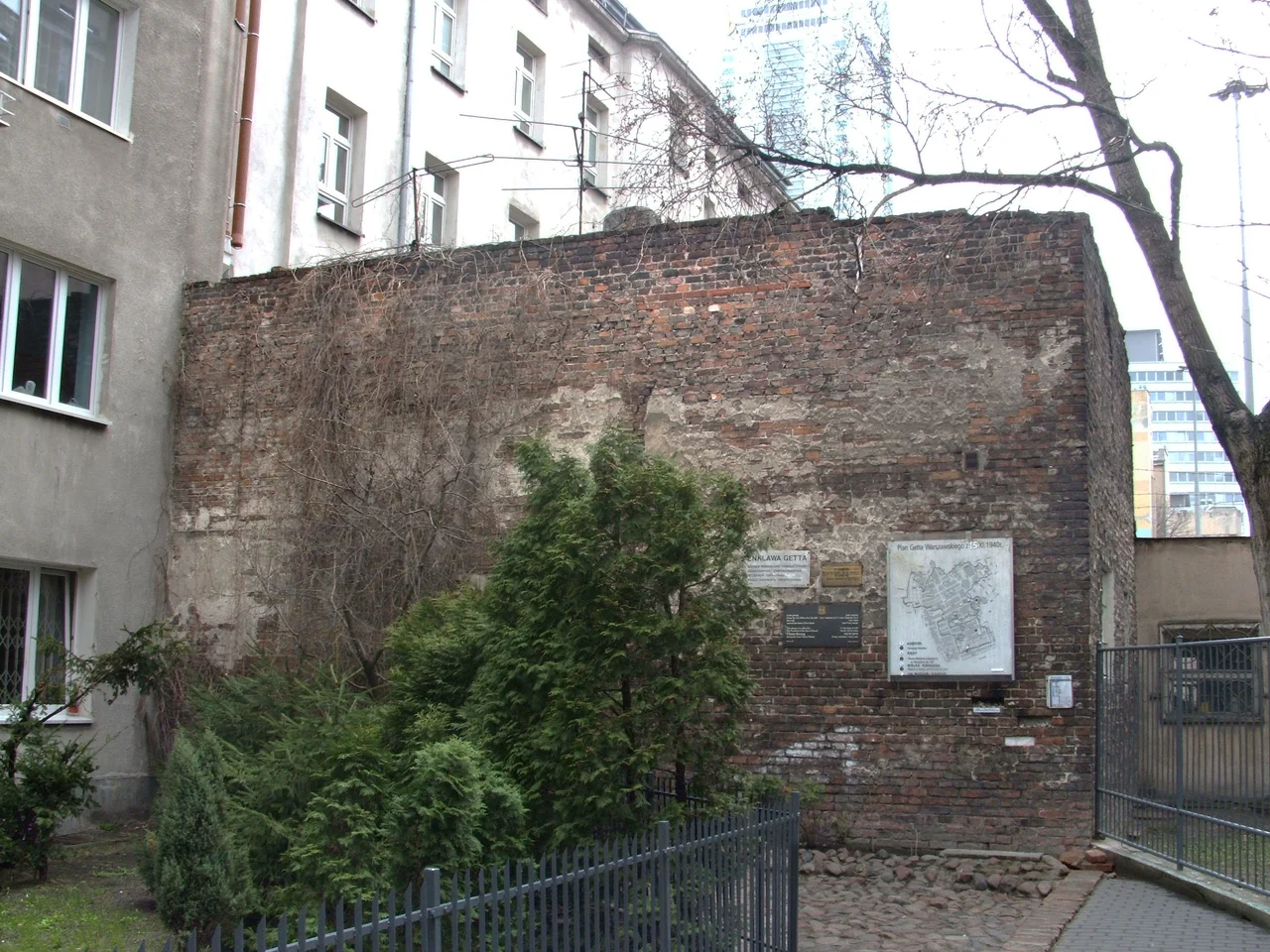

Fragments of the Ghetto Walls in Warsaw
You can walk past the wall on Sienna Street without seeing it. A high school playground presses up against one side. A residential courtyard absorbs the other. The brick is mottled, ordinary, the kind of pre-war wall that survives in a thousand European cities. A small plaque tells you what the bricks are. From November 1940 until the spring of 1943, this wall divided the living from those the German occupiers had decided would be killed. Inside it, in an area of just 3.4 square kilometers, lived as many as 460,000 Jewish men, women, and children, sealed off from the city around them.
Eighteen Kilometers of Brick
The Warsaw Ghetto wall, when it stood complete, ran for about eighteen kilometers through the city. Some sections were purpose-built; others used the side walls of pre-war tenements, factory walls, and the perimeter of the Jewish cemetery on Okopowa Street. The Germans paid Jewish forced laborers to build it, charged the Jewish community for the materials, and then sealed the population inside on November 15, 1940. Disease and starvation began their work immediately. By the summer of 1942, when the deportations to the Treblinka extermination camp began, perhaps 100,000 had already died of typhus and hunger. Three months of trains took roughly 254,000 more. Most were murdered within hours of arrival. The buildings of the ghetto were systematically demolished after the 1943 Uprising, and the Warsaw Uprising of 1944 finished what was left. The walls came down with the rest of the rubble. What survived was almost accidental.
What the Plaques Don't Say
There are perhaps a dozen identifiable fragments left in the modern city. The most visited is on Sienna Street, where a three-meter section of pre-war brick stands between two courtyards. Two of its bricks are missing; they were taken in 1989 to the United States Holocaust Memorial Museum in Washington, where a replica of this section now stands. The wall on Zlota Street, six meters tall, was unveiled by Israeli President Chaim Herzog in 1992. Bricks from it traveled to Yad Vashem in Jerusalem, and to museums in Houston and Melbourne. At 10 Stawki Street, behind a school, a fragment marks the boundary of the Umschlagplatz, the loading square where families were forced into the freight cars bound for Treblinka. Janusz Korczak walked through that square in August 1942 with the children of his orphanage, refusing offers of personal escape. He went with them to the train and from there to Treblinka, where they were all murdered.
The People Who Lived Behind It
Names matter here. Marek Edelman, twenty-three years old in 1943, helped lead the Ghetto Uprising and somehow survived to spend the next sixty years as a cardiologist in Lodz, telling the story until his death in 2009. Mordechai Anielewicz, twenty-four, commanded the Jewish Combat Organization and died in the bunker at 18 Mila Street as the SS closed in. Emanuel Ringelblum and his Oneg Shabbat collective buried thousands of pages of documents, diaries, and testimonies in milk cans and metal boxes beneath the ghetto, determined that the world would know what had happened here. Two of the three caches were recovered after the war. A third remains buried somewhere under modern Warsaw, location unknown. Ringelblum himself was murdered with his family in 1944 after being denounced in his hiding place on the Aryan side.
How the City Remembers
Warsaw rebuilt itself almost entirely after 1945; the old ghetto district is now an unremarkable neighborhood of apartment blocks and offices. The boundary of the ghetto is traced today by a line of bronze plaques set into the pavement, and a glass-and-bronze sculpture marks the site of the Umschlagplatz. The fragments of wall are deliberately understated. They are not monuments built to be impressive. They are the actual brick that actually stood there, with all the ordinariness of brick. The 2017 renovation of the Sienna Street wall opened the site to school groups; the new POLIN Museum of the History of Polish Jews, a few blocks away, fills in the wider story. The walls themselves do something the museum cannot. They are physical evidence in a city that was rebuilt to forget.
The Voices Saved
The Ringelblum Archive, recovered from beneath the ruins in 1946 and 1950, is now housed at the Jewish Historical Institute in Warsaw. It contains drawings by ghetto children, ration cards, underground newspapers, last letters, photographs, and the careful sociological surveys Ringelblum's team conducted while everything around them collapsed. The collection is on the UNESCO Memory of the World register. It exists because a group of historians, librarians, and ordinary people decided, with the gas chambers running, that documentation was a form of resistance. The ghetto walls fell. The voices, in some measure, did not.
From the Air
Warsaw city center at 52.23 degrees N, 21.00 degrees E. Warsaw Chopin Airport (EPWA) lies about 7 km to the southwest. The historic ghetto area sits north and west of the Vistula River in the Wola and Srodmiescie districts; the Palace of Culture and Science is the most visible landmark from altitude. Berlin (EDDB) is approximately 525 km west.
Nearby Stories
- Treblinka Uprising 42 km away
- Treblinka Extermination Camp 56 km away
- Lodz Ghetto 70 km away
- Soldau Concentration Camp 79 km away
- Lubartów Ghetto 101 km away
- Poniatowa Concentration Camp 123 km away
- Osowiec Fortress 154 km away
- Stutthof Concentration Camp 241 km away