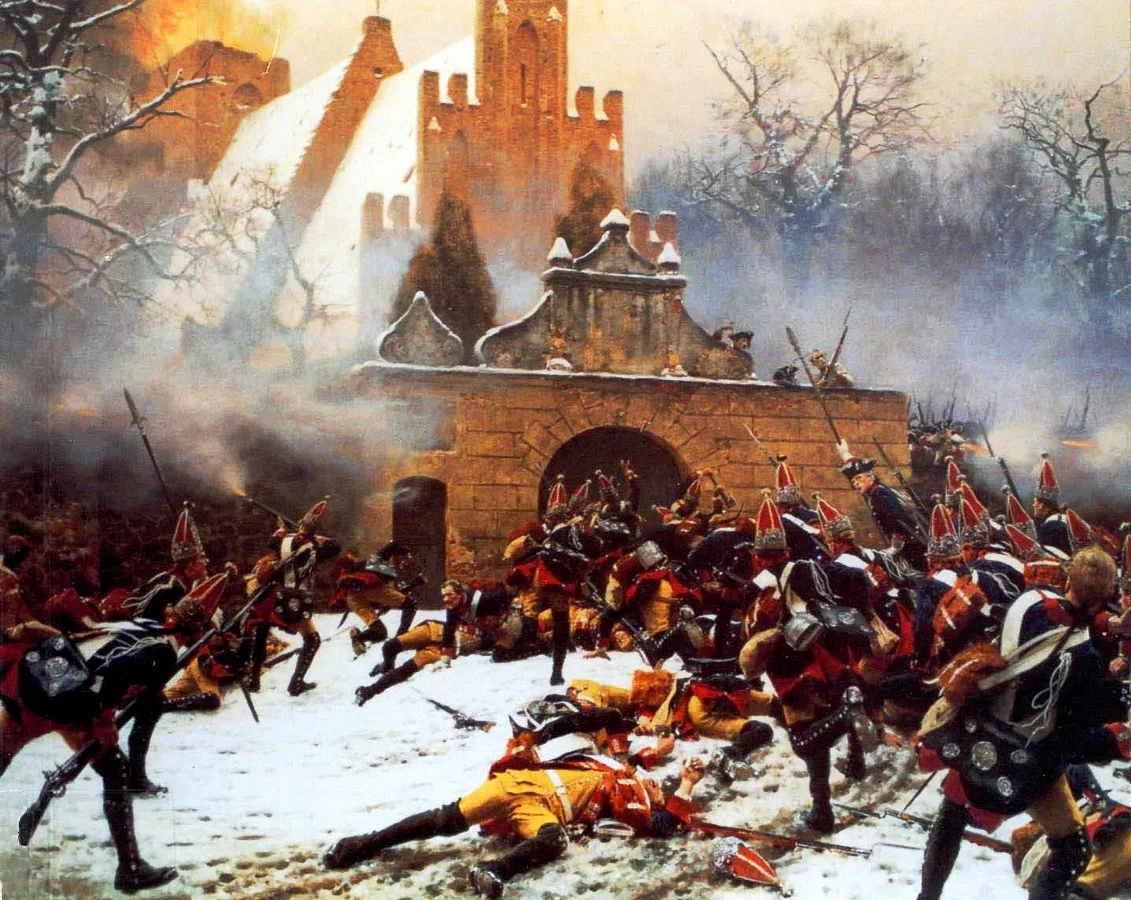

Battle of Leuthen
Napoleon, who was not generous with praise for the work of other commanders, called it "a masterpiece of marches, maneuvers, and resolution." He told his marshals it should be studied by every soldier who hoped to understand the art of war. He was talking about a winter day in Silesia, 5 December 1757, when an outnumbered Prussian king accomplished one of those rare battles that ends not with a hard-won decision but with the wholesale erasure of an enemy army from the field. Frederick II of Prussia had marched his troops 274 kilometers in twelve days through the December cold to reach Leuthen. He arrived to find an Austrian army nearly twice the size of his own waiting on a front of eight kilometers. Within seven hours, the Austrian army had effectively ceased to exist as a fighting force.
The Long Road from Rossbach
Just one month earlier, on 5 November, Frederick had crushed a French and Imperial army at Rossbach in ninety minutes, with most of his infantry never having shouldered their muskets at all. The victory had bought him time but cost him territory: while he was beating the French in central Germany, the Austrians had quietly retaken Silesia, the prosperous province he had stolen from Empress Maria Theresa fifteen years earlier and never given back. The fortress city of Schweidnitz fell, then Breslau itself, the provincial capital, which surrendered on 22 November. If Frederick was going to keep his kingdom together, he had to march his exhausted veterans east immediately. He covered the distance in twelve days through bitter weather, picked up the survivors of the Breslau garrison along the way, and reached Leuthen with about 33,000 men and 167 cannons. Waiting for him on the rolling plain northwest of Breslau were 66,000 Austrians and Saxons under Prince Charles of Lorraine and Field Marshal Daun.
The Knolls and the Trick
Leuthen was a small village on a rolling plain dotted with low hillocks, none higher than thirty meters. Frederick had hunted across this country in his youth and knew it the way you know the woods behind your house. The Austrians did not. At four in the morning, his army moved out in four columns toward the Austrian right, with the lone column of cavalry on his far left visible to the enemy. Prince Charles, watching from a height, took the bait completely: he assumed the visible cavalry meant the main attack was coming at his northern flank, and ordered his entire reserve to march north to meet it. While he was doing that, Frederick was using the low hills as a screen to slide his actual main body off to the south, around to the unprotected Austrian left flank. By midmorning the Austrian army was strung out across a ten-kilometer front facing the wrong direction, and most of its reserves were still out of position. The first wave of Prussian infantry, advancing in the famous oblique order, came on the Austrian left with 60 rounds per man and the speed and discipline that made the Prussian infantry the best on the continent. The Wurttemberg Protestant troops in the first line held briefly, then ran. By midafternoon, fighting had moved into the village of Leuthen itself, where the Austrians were packed thirty to a hundred ranks deep around the church and cemetery. The killing in those narrow lanes was savage. A young Austrian captain named Charles-Joseph de Ligne, who would survive to become a famous memoirist, wrote afterward that out of his battalion of about a thousand men, fewer than two hundred came out of the village alive.
The Cavalry Finishes It
When the Austrian commander finally tried to move cavalry from the north to break Frederick's flank, the Prussian general Hans Joachim von Zieten was waiting with forty squadrons. Driesen brought thirty more. The Bayreuth Dragoons hit the Austrian flank; the Puttkamer Hussars hit the rear; the Austrian cavalry commander Lucchessi was decapitated by a cannonball mid-battle. The Austrian infantry behind Leuthen, already battered and out of formation, broke. As darkness fell on the short December afternoon, Prussian columns were sweeping across the field and the Austrian army was streaming east toward the river they called the Black Water, abandoning fifty-one regimental colors and 116 cannons. Frederick himself rode into the small castle at the village of Lissa, which was crowded with stunned Austrian officers who had not expected to be hosting a Prussian king that night. He greeted them politely. "Good evening, gentlemen, I dare say you did not expect me here. Can one get a night's lodging along with you?"
Now Thank We All Our God
The Prussians had won, but it was not cheap. Frederick lost 6,344 men: 1,141 dead, 5,118 wounded, 85 captured. Two of his generals fell. The Austrians lost roughly 22,000 killed, wounded, or captured, and entire regiments dissolved on the field. After the battle, the story passed down by Frederick's army says, the surviving Prussians began singing the Lutheran hymn Nun danket alle Gott, "Now Thank We All Our God," written more than a century earlier during the Thirty Years' War. The melody was taken up by regiment after regiment until it filled the cold Silesian dusk. Whether this happened exactly as remembered or grew with the telling, the Leuthen Chorale became a fixed point in Prussian and later German military memory, sung at Frederick's funerals and battlefield commemorations for the next two centuries. Within forty-eight hours, Frederick had laid siege to Breslau, which surrendered on 19 December. Silesia was Prussian again. Maria Theresa relieved Prince Charles of his command, and after Leuthen and Rossbach, Frederick was no longer just the King in Prussia. He was now spoken of, even by his enemies, as Frederick the Great.
The Forgotten Field
Lutynia today is a small village in southwestern Poland, the German name Leuthen mostly forgotten by everyone but military historians. The 1854 monument that marked the battle was dynamited at the end of the Second World War; only ruins of its pedestal survive, restored in 2011. The fields where Frederick made his oblique-order march are mostly farmland again, gently rolling, sometimes wet underfoot. The villages still carry their old shapes around the road that led from Borne to Leuthen to Lissa, then on to Breslau, which is now Wroclaw, the largest city in western Poland. Stand on one of the low hillocks on a cold December afternoon and look across to where the Austrian line once was, and you can see the shape of the day: how a small army can become a large one if it knows the ground, and how being looked at the wrong way can ruin everything for an army nearly twice your size.
From the Air
Located at 51.15N, 16.75E about 27km west of Wroclaw (formerly Breslau) in Lower Silesia, southwestern Poland. The battlefield is a gently rolling plain of fertile farmland between the Oder River and the foothills of the Sudeten Mountains, dotted with low hillocks no higher than 30 meters. Visible from cruising altitude as agricultural country with scattered villages. Nearest major airport is Wroclaw-Copernicus (EPWR) about 25km east of the battlefield.
Nearby Stories
- Krzeszow Abbey 11 km away
- Czocha Castle 61 km away
- Stalag Luft III 67 km away
- Sudetenland 115 km away
- Lusatia 139 km away
- Nazi War Crimes in Occupied Poland 143 km away
- Auschwitz: The Site of Industrialized Murder 164 km away
- Lodz Ghetto 174 km away