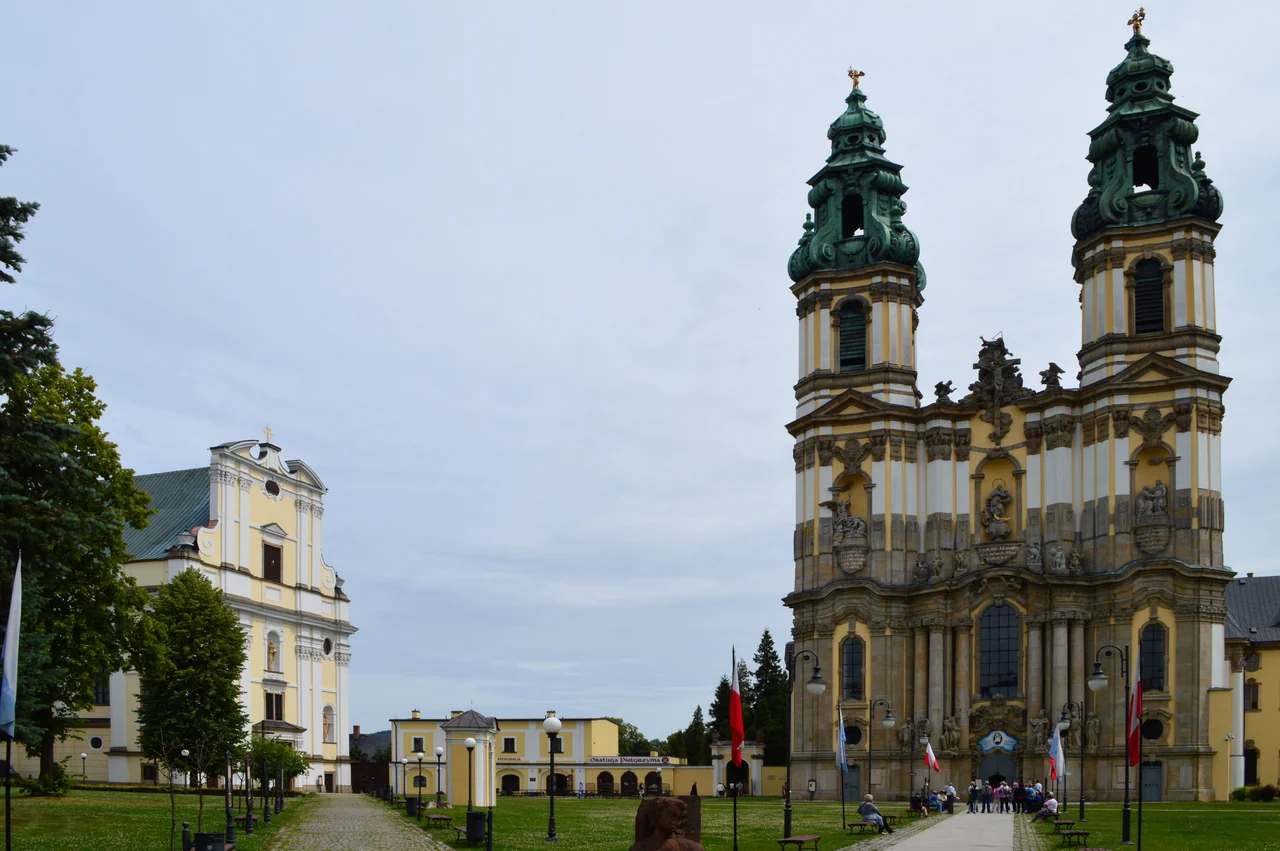

Krzeszow Abbey
In 1946, a convoy pulled up to the abbey at Krzeszow and quietly loaded thousands of musical manuscripts into trucks. Among the cargo: roughly a quarter of all the music Mozart ever wrote, in his own handwriting. Beethoven autographs. Bach scores. The convoy then disappeared, and most of what it carried has not been seen by the public since. The Berlin State Library had hidden the manuscripts at this remote Silesian monastery during Allied bombing raids, trusting that the abbey's red-roofed twin towers in a quiet Sudeten valley would never draw a B-17. The trust was rewarded - the buildings survived the war intact - but the precaution had its own ironic consequence. The collection, known today as the Berlinka, became one of the most contested troves of looted art in Europe, scattered between Krakow's Jagiellonian University and various locations no one will fully confirm.
A Widow's Foundation
The abbey's origin story is a grief story. On 9 April 1241, Duke Henry II the Pious of Poland died at the Battle of Legnica trying to stop the first Mongol invasion. His widow Anna of Bohemia founded Krzeszow the following year, on 8 May 1242, settling Benedictine monks from the Bohemian abbey of Opatovice in a forested corner of Lower Silesia. The monastery was meant as both a place of prayer and a quiet kind of memorial. Anna's grandson, Duke Bolko I of Swidnica, transferred the lands to the Cistercians in 1289, and three years later the monks consecrated the new Assumption of Mary church. The Świdnica Piasts adopted Krzeszow as their dynastic burial place, and the abbey's basilica still contains the mausoleum where their bones lie - a chain of dukes whose Polish line ran out before the medieval grandeur did.
Baroque Splendor
Krzeszow burned in the Hussite Wars and again in the Thirty Years' War, and twice the monks rebuilt it. The version that visitors see today rose after 1728, when the abbey church was reconstructed in High Baroque - a swirl of frescoes, gilt, and white stucco crowned by twin towers visible across the valley. The Bohemian sculptor Ferdinand Brokoff carved figures for it. The Czech painter Petr Brandl and the Silesian master Michael Willmann supplied altarpieces. The Silesian mystic Angelus Silesius, whose religious poetry shaped German baroque devotion, was deeply associated with the place. By the early 18th century Krzeszow had become one of the great Cistercian foundations of Central Europe - rich enough to commission the best artists in three languages, secluded enough to remain almost a secret outside the order.
Empires Reach In
Frederick the Great's Prussia conquered most of Silesia in 1742, taking Krzeszow with it. The abbey survived as a Catholic island in an increasingly Protestant kingdom until the Napoleonic Wars, when the secularization decree of 1810 expelled the Cistercians. The basilica became a parish church. The conventual buildings passed to the Prussian state. After World War I, German Benedictines who had been forced out of Prague's Emmaus Abbey resettled at Krzeszow in 1919; Pope Pius XI raised it to abbey status again in 1924. Then came 1940, when the Nazi regime suspended the community and turned the buildings into a detention camp. Two years later, with Berlin under bombardment, the State Library began moving its rarest treasures here for safekeeping - the Mozart and Beethoven autographs that would later disappear into the postwar fog.
Two Expulsions
When the Potsdam Agreement transferred Silesia to Poland in 1945, the German Benedictines were expelled in May 1946 along with the rest of the region's German population. They eventually settled in Bad Wimpfen in southwest Germany, founding a successor community that called itself Grussau Abbey - a name that preserved their lost home in German memory. Krzeszow itself was not abandoned. In 1947 Polish Benedictine nuns, themselves expelled from Lwow when eastern Poland was annexed by the Soviet Union, took possession of the empty buildings. Two communities of monastics, both refugees of the same war, ended up displaced by it in opposite directions. The abbey today is one of Poland's official national Historic Monuments, designated in 2004, and the basilica is open for liturgy and tours - though the manuscripts that once sheltered here remain scattered across two countries and several disputes.
From the Air
Located at 50.73 degrees N, 16.07 degrees E in the Sudeten foothills of Lower Silesia, about 70 km southwest of Wroclaw. The twin Baroque towers of the Basilica of the Assumption are visible from low altitudes against the wooded ridges that rise toward the Czech border. Nearest major airports: EPWR (Wroclaw-Copernicus) about 80 km north-northeast, EDDP (Leipzig/Halle) about 280 km west-northwest. Best viewed mid-morning when sun fills the valley.
Nearby Stories
- Czocha Castle 13 km away
- Jizera Dark-Sky Park 17 km away
- Battle of Leuthen 25 km away
- Lubiaz Abbey 46 km away
- 1997 Central European flood in Wrocław 56 km away
- The Defenestration of Prague: The Thrown Men Who Started a Thirty Years' War 86 km away
- Auschwitz: The Site of Industrialized Murder 196 km away
- The Battle of Vienna: The Cavalry Charge That Saved a Continent 247 km away