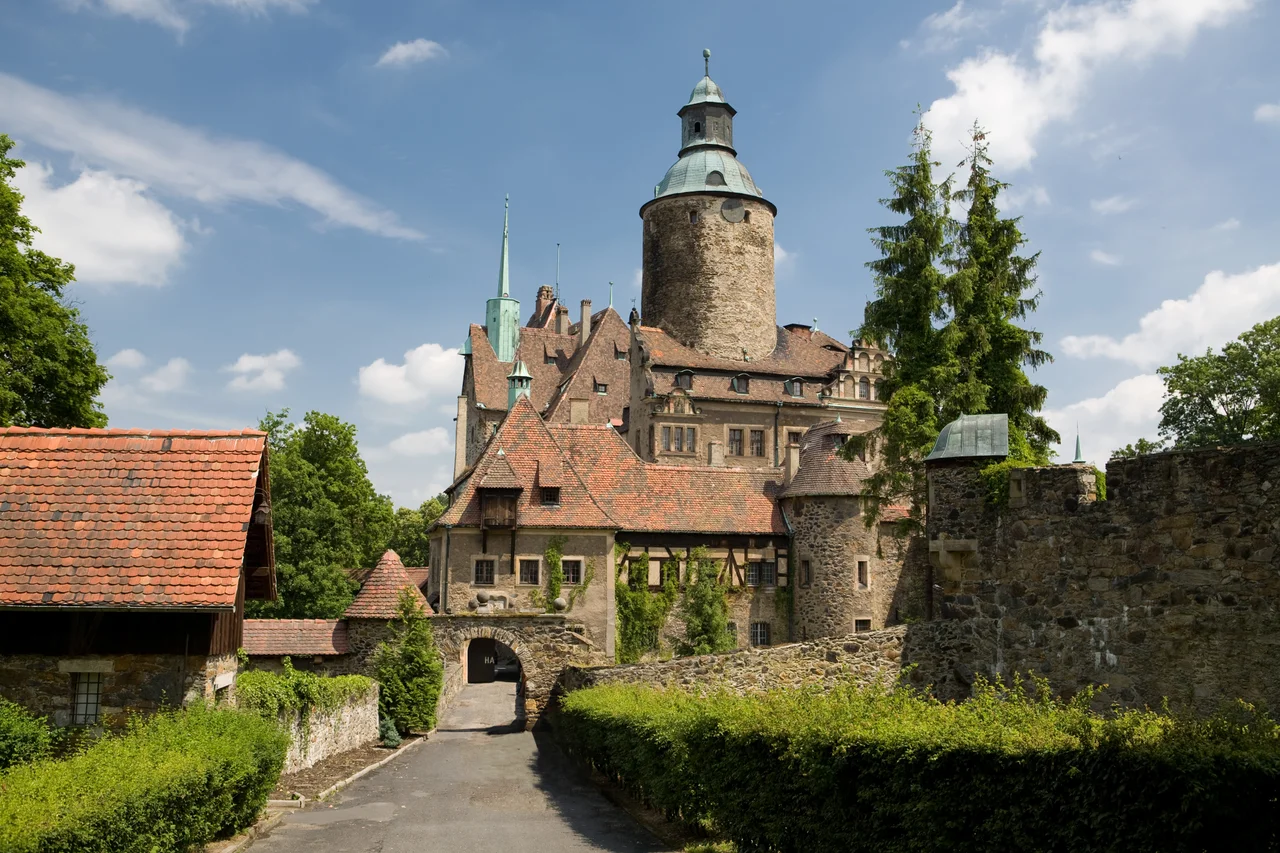

Czocha Castle
The name keeps shifting depending on who held the keys. Tzschocha to the Germans who ruled Lower Silesia for centuries, Czocha to the Poles who arrived after 1945 and never left. The castle itself sits on a knuckle of gneiss rock above Lake Lesnia, where the Kwisa river bends through what was once the Bohemian-Lusatian frontier. Wenceslaus I of Bohemia ordered the first stronghold raised here in the 1240s to watch a contested border, and for the next 800 years the watching never really stopped.
A Border That Kept Moving
The first stone keep dates to 1329, but Czocha's history is really a chronicle of who owned this corner of Europe in any given century. Bohemian kings, the Bishop of Meissen, the Silesian princes Henry I of Jawor and Bolko II the Small, then Charles IV himself when he united the Holy Roman Empire under his crown. The Hussites stormed and held it in 1427 during their long religious war against the Catholic empire. The Nostitz family bought it in 1453 and kept it for 250 years, reinforcing the walls so thoroughly that Swedish armies failed to take it during the Thirty Years' War. Then in 1703, on the eve of the Saxon golden age, it passed to a courtier of Augustus II the Strong - linking this remote keep to the same Wettin dynasty that turned Dresden into the Florence of the Elbe.
The Cigar Baron's Folly
On August 17, 1793, the whole complex burned. For more than a century the ruins sat above the lake, picturesque and useless. Then in 1909 a Dresden cigar manufacturer named Ernst Gutschow bought it. Gutschow had money and ambition and a deep affection for old Russia, and he hired the Berlin architect Bodo Ebhardt to rebuild Czocha based on a single 1703 painting of the original. The result is what visitors see today - a Romantic-era reconstruction that looks more medieval than the medieval castle ever did. Gutschow filled it with treasures and entertained White Russian emigres who had fled the Bolsheviks, an aging cosmopolitan world that lasted until March 1945, when he packed what he could carry and ran ahead of the advancing Red Army.
The Hidden Years
What happened after Gutschow left is the part of the story Czocha keeps quietest. Soviet soldiers ransacked the castle. Polish settlers from the lost eastern Kresy, deported west into what the Communists called the Recovered Territories, picked through what remained. For a few years in the late 1940s the rooms housed Greek refugees fleeing their own civil war - Communists who had lost a different fight to a different empire. Then in 1952 the Polish Army took the castle, used it as a military vacation resort, and quietly erased it from official maps. There are persistent legends that the German Abwehr ran a wartime radio station from these towers, training spies and intercepting Allied transmissions. The Discovery Channel devoted an episode of Expedition Unknown to the rumors. The Polish military's interest in keeping Czocha off the maps for forty years suggests something there was worth hiding.
Wizards in the Towers
The map came back in 1996, when Czocha opened to the public as a hotel. In 2012 readers of National Geographic Poland voted it one of the New Seven Wonders of Poland. Then in 2014 the castle gained an unlikely second life: it became the setting for College of Wizardry, a live-action role-playing game where guests in robes wander the corridors enacting their own Harry Potter-adjacent stories. The LARP nearly collapsed in 2019 amid disputes within the founding organization, but a crowdfunding campaign saved it, and the wizards returned. In 2023 Paradox Interactive hosted the Grandest Lan here, filling the keep with strategy gamers and laptops. The same stones that watched Hussite armies and sheltered fleeing Russians now watch teenagers cast spells and conquer Europe in pixels - which is a softer kind of border war than the ones Czocha was built for.
From the Air
Czocha Castle sits at 51.03 N, 15.30 E in Lower Silesia, southwestern Poland, perched on gneiss bedrock above Lake Lesnia where the Kwisa river bends. From 4,000-6,000 feet on a clear day the castle's reconstructed silhouette and red roofs are visible against the surrounding forest, with the lake providing a strong reflective marker. The closest major airport is Wroclaw (EPWR), about 130 km east; Dresden (EDDC) lies 90 km west across the German border. The terrain west toward the Sudetes rises gradually - watch for low cloud in the valleys.
Nearby Stories
- Herrnhut 5.6 km away
- Liberec 18 km away
- Krzeszow Abbey 19 km away
- Lusatia 24 km away
- Stalag Luft III 30 km away
- Ksiaz Castle 41 km away
- Ústí Massacre 53 km away
- Nazi War Crimes in Occupied Poland 232 km away