
Ksiaz Castle
Beneath the floors of Ksiaz Castle, somewhere in the warren of tunnels the Nazis began carving in 1943, parts of the complex have never been fully mapped. Project Riese - 'Giant' - was the SS code name for an enormous underground construction effort in the Owl Mountains, and Ksiaz was its showpiece. Forced laborers and inmates from the Gross-Rosen subcamp called Furstenstein blasted galleries directly under the medieval foundations, removing tons of rock from a building that was already, above ground, the third-largest castle in Poland. What the tunnels were meant to be - a Hitler headquarters, a V-weapon factory, a redoubt - the SS never wrote down clearly enough to settle. What they cost in human lives is better documented. The castle above is now a tourist attraction. Some of the tunnels are open for guided tours. Others are still off-limits, and the Polish Academy of Sciences uses one branch for gravimeter measurements where vibration is measured in millionths of a gravitational g.
A Duke's Eyrie
The first fortress on this rock above the Pelcznica river was destroyed by Bohemian forces in 1263. A generation later, the Silesian duke Bolko I the Strict began a new castle here between 1288 and 1292, taking up residence and adding 'Lord of Ksiaz' to his titles. The site is dramatic in a way that medieval lords prized: a cliff edge above a wooded gorge, with views down the valley and good defensive geometry. After the Świdnica Piast line died out in 1368, the castle passed through Bohemian and then Habsburg hands, and in 1466 Hans von Schellendorf received it from the Bohemian crown and renamed it Schloss Furstenstein. For most of its German history it would carry that name - the German aristocracy treating it as a piece of inherited furniture rather than a castle of state.
The Hochbergs and Daisy
From 1509 the castle belonged to the Hochberg family, who held it for more than four centuries. They expanded it relentlessly: the Baroque additions in the early 18th century, the neo-Gothic tower in the 19th, the great east wing in the early 20th. By 1909 Ksiaz contained over 400 rooms across roughly 11,000 square meters, surrounded by terraced gardens scaled to a hereditary self-importance the Hochbergs never seem to have doubted. The most famous resident was Mary Theresa Olivia Cornwallis-West - Princess Daisy of Pless - the British-born wife of Hans Heinrich XV. Daisy was a memoirist, a confidante of Edward VII, and during World War I a Red Cross nurse who criticized German conduct in print. She died in Wałbrzych in 1943, mostly impoverished, having watched her family's empire dissolve and her castle be requisitioned by the very regime she had warned against.
Project Riese
In 1941 the Nazi state effectively confiscated Ksiaz from the Hochbergs. By 1943 the SS had begun the Project Riese excavations beneath it. The forced laborers who did the work were prisoners of the Furstenstein subcamp of Gross-Rosen - among them Italian, Polish, Hungarian, and Jewish men deported from the death camps when their labor was deemed more valuable than their immediate murder. Mortality was severe; the documentation that survives describes bodies removed quietly to mass graves. Above ground, Albert Speer's architects modified the castle interiors for what was reportedly intended as a Fuhrer headquarters; entire floors were stripped and rebuilt. The work was not finished when the Red Army arrived in 1945. The Soviet occupation that followed completed what the Nazis had begun in destruction, looting the interiors and burning much of what could not be carried off. A communist-Polish memorial today marks the site of the subcamp where the laborers died.
Restoration and the Coin
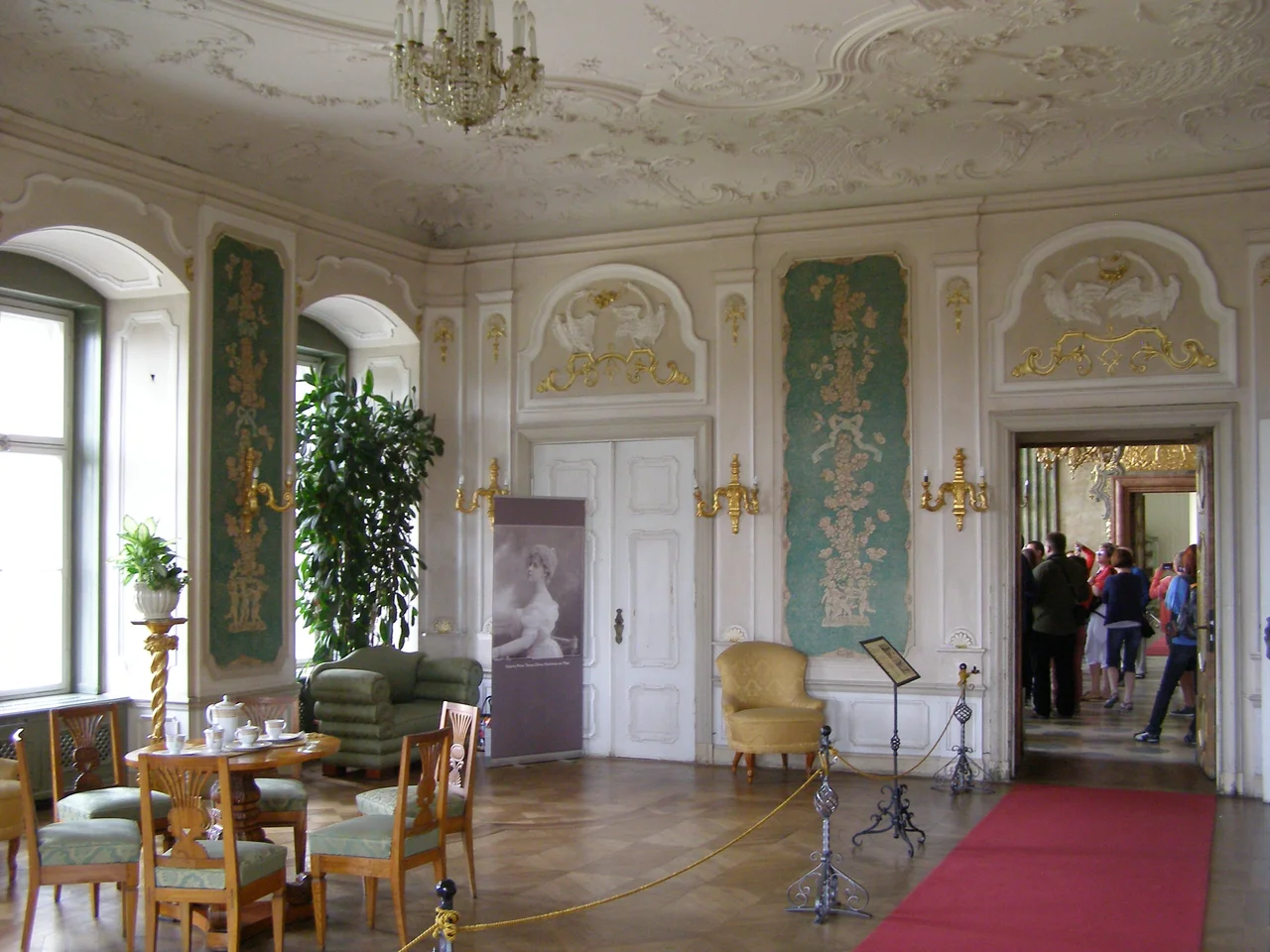
The Polish state took over Ksiaz after the war and slowly began restoring it. The interiors had to be reconstructed almost from photographs - the Maximilian Hall, the Baroque Salon, the Chinese Room - using craftspeople whose grandfathers had worked the original surfaces. A 2014 attic fire destroyed nearly 500 square meters of roof and slowed the work again. But the castle today draws over 300,000 visitors a year, and in 2021 the National Bank of Poland minted a special 5-zloty coin featuring it as part of a 'Discover Poland' series. The Pelcznica gorge below is preserved as Ksiaz Landscape Park, the Sudeten foothills behind it visible from any high window. Walk the grounds early enough and the view is what Bolko I the Strict bought it for - a defensible rock over a winding river - the rest, all 400 rooms and seven and a half centuries of additions, an accumulation.
From the Air
Located at 50.84 degrees N, 16.29 degrees E above the Pelcznica gorge in the Sudeten foothills, immediately north of Walbrzych in Lower Silesia. The castle complex is large enough to be visible from medium altitudes; the main tower and the white facades stand out against the surrounding forest of Ksiaz Landscape Park. Nearest major airports: EPWR (Wroclaw-Copernicus) about 65 km north-northeast, EPKT (Katowice) about 175 km east. Morning light favors the south-facing courts; afternoon brings out the gorge geometry.
Nearby Stories
- Lubiaz Abbey 15 km away
- 1997 Central European flood in Wrocław 27 km away
- Jizera Dark-Sky Park 33 km away
- Zgorzelec 57 km away
- The Defenestration of Prague: The Thrown Men Who Started a Thirty Years' War 117 km away
- Nazi War Crimes in Occupied Poland 175 km away
- Auschwitz: The Site of Industrialized Murder 177 km away
- Krakow 263 km away