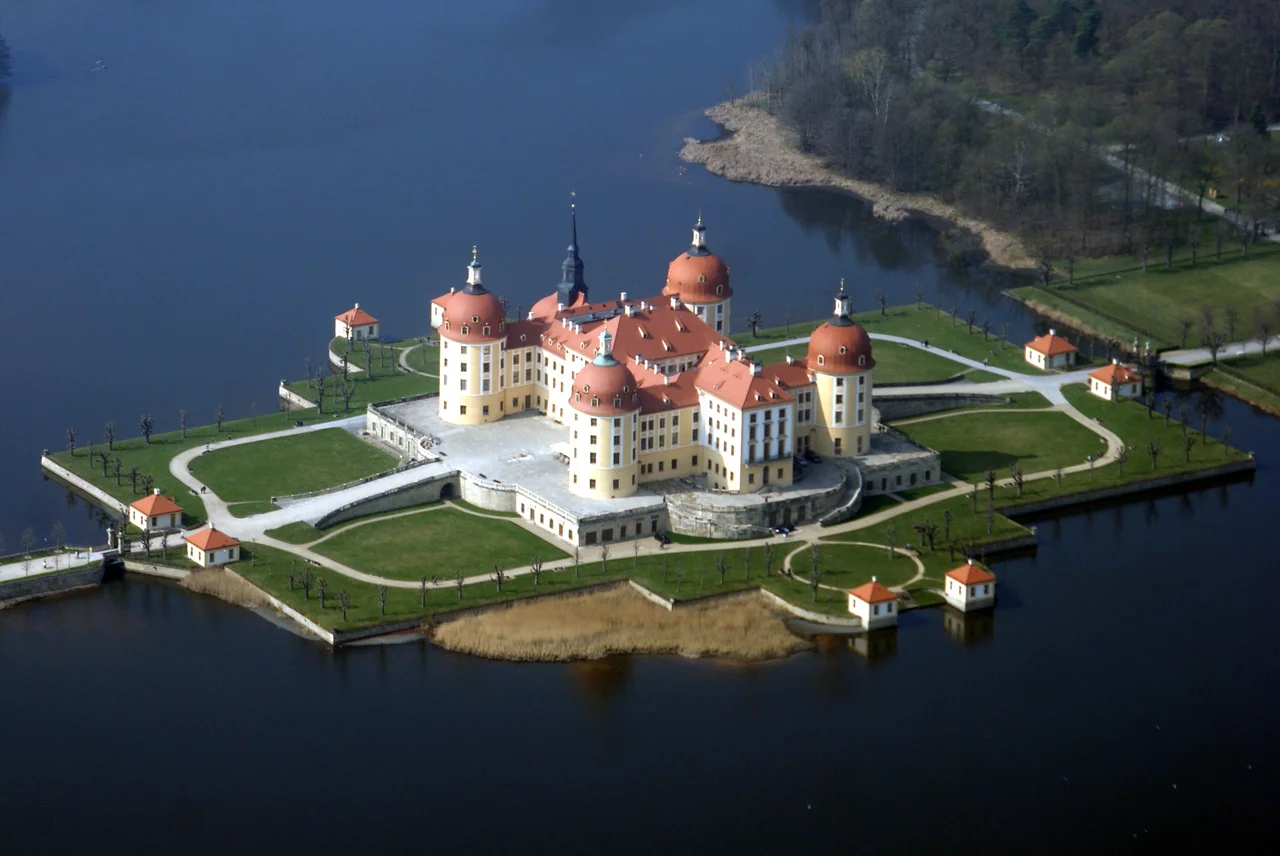

Moritzburg Castle
Augustus the Strong, Elector of Saxony and King of Poland, acquired a four-poster bed in 1723 with approximately one million peacock, pheasant, guinea hen, and duck feathers woven into the canvas as the weft. The feathers were not glued or tied. They were threaded through, the way wool would be threaded into cloth. Augustus had the curtains turned into wall hangings and named the room the Federzimmer, the feather room. After a nineteen-year restoration the bed and hangings have been on display at Moritzburg since 2003. They sit in a pink and yellow castle on its own square island in an artificial lake. The drive from Dresden takes about twenty minutes. The atmosphere has not changed in three hundred years.
From Hunting Lodge to Stage Set
Duke Moritz of Saxony built the original lodge here between 1542 and 1546 as a place to hunt deer and boar in the Friedewald, the dense forest north of Dresden. It was a working lodge with thick walls and a chapel added by John George II in the 1660s, designed by Wolf Caspar von Klengel in the new baroque style filtering up from Italy. Then Augustus the Strong got hold of it in the early eighteenth century and rebuilt it as a country residence for the Saxon court. The four round towers, the symmetrical island plan, the formal park to the north, all date from the 1720s. Augustus did not live to see his French gardens completed; he died in 1733. The half-finished gardens are the gardens you walk in now.
Inside the Apartments
The Porzellanquartier displays Chinese, Japanese, and Meissen porcelain, much of it depicting the hunting scenes the castle was originally built around. The Augsburg-made silver furniture in the apartments was styled after Louis XIV's silver at Versailles, which the French king famously melted down for war finance. Eleven rooms are still hung with painted leather wallpaper from the seventeenth century, kept dim to slow the fading. Eleven monumental paintings on leather by Louis de Silvestre line the Billiardsaal, named for a billiard table that no longer survives. A collection of royal carriages occupies the entrance hall, lined up as if waiting for a hunting party that will not return.
The Star of Alleys
An eight-arm star of alleys was cut through the Friedewald to the north of the castle, designed for royal fox hunting with hounds. The Hellhaus, built in 1787 at the intersection, sits on a raised point above the paths. From its roof the so-called swan keeper would raise flags to signal the direction of fleeing game to the hunting parties below. The building is in ruins now, but you can still walk to it and stand where the swan keeper stood. One alley runs straight east 2.5 kilometers to the Fasanenschlosschen, the Little Pheasant Castle, with the Well of Venus, one of the largest baroque fountains in Saxony, a short way beyond. The alleys of the Friedewald are some of the few formal hunting landscapes in Europe still legible on the ground.
The Little Pheasant Castle
Elector Frederick Augustus III had the shell-pink Fasanenschlosschen built in the 1770s on the foundation of an earlier pavilion by Johann Christoph Knoffel. Johann Daniel Schade, his royal architect, designed it in Rococo with deliberately Chinese touches: the high ogee roof, the open cupola topped with a pair of figures under a parasol. The few rooms inside are furnished with their original silk, straw, pearl, and feather decorations, restored between 2009 and 2013 by the Ostdeutsche Sparkassenstiftung and the World Monuments Fund. A double staircase leads down to a miniature harbor on a small lake, with a 21.8-meter brick lighthouse painted to look like stone. The harbor was built so the elector could stage naval battles for his own amusement, including a re-enactment of the Battle of Chesma from 1770 with miniature castles representing the Dardanelles. The lake is now too low to float the ships.
Cinderella in the Snow
Most German-speaking visitors of a certain age recognize Moritzburg instantly, because the 1973 Czech-East German co-production of Three Wishes for Cinderella was filmed here. The film's Christmas television showings have become a tradition across Germany, the Czech Republic, Slovakia, Norway, Sweden, and Poland; the Norwegian dub in particular still draws audiences in the millions every December. The castle's pink-and-yellow facade in winter, mirrored in the frozen lake, became one of the most familiar fairy-tale images in central European cinema. The carp ponds in the Friedewald, dating from the sixteenth century, are still drained periodically to harvest the fish, the same way they have been worked for almost five hundred years. Some of what makes Moritzburg what it is has nothing to do with Augustus the Strong.
From the Air
Located at 51.17 N, 13.68 E about 13 km northwest of Dresden, set on a square artificial island in a lake surrounded by the Friedewald forest. The four round corner towers and bright yellow-pink walls make the castle unmistakable from the air. Dresden (EDDC) is the nearest airport, about 15 km southeast. Best viewed from the west or south, with the Little Pheasant Castle visible 2.5 km to the east at the end of a straight forest alley.
Nearby Stories
- Bastei 1.1 km away
- Torgau 6.3 km away
- Freiberg Cathedral 15 km away
- Karl Marx Monument, Chemnitz 17 km away
- Colditz Cock 19 km away
- Bautzen 26 km away
- 2001 American Memorial 27 km away
- Wendish-German double church 31 km away