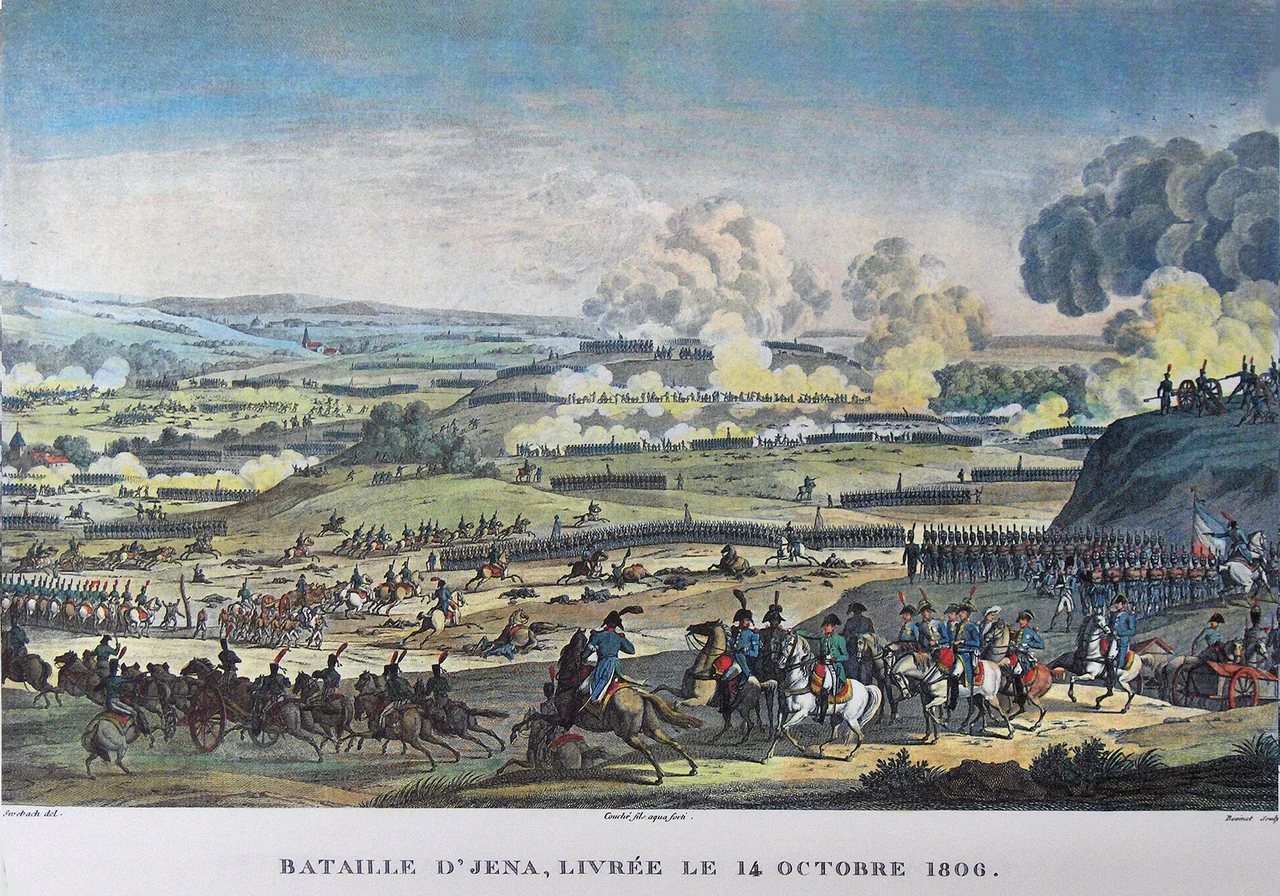

Battle of Jena-Auerstedt
When the philosopher Hegel watched Napoleon ride through the streets of Jena the day after the battle, he wrote to a friend that he had seen "the world soul on horseback." The phrase captured something dizzying about what had just happened on the rolling Thuringian plateau west of the Saale River. In a single day, on 14 October 1806, the army that had been built and burnished by Frederick the Great a half-century earlier had been broken by a French force half its size at one battlefield, and broken again by a French force a third its size at another. Two battles, fifteen kilometers apart, fought almost simultaneously in mist and gunsmoke. By nightfall the Kingdom of Prussia, which had imagined itself the equal of any power in Europe, had effectively ceased to exist as a military force.
An Army Frozen in 1757
The Prussian soldiers who marched out to meet Napoleon were not bad men, and many of them were brave. But they had been trained according to drill manuals their grandfathers might have memorized. Their muskets were the 1754 model, which one contemporary called "the worst in Europe." Their commanders, the Duke of Brunswick and the Prince of Hohenlohe-Ingelfingen, were elderly men devoted to the memory of Frederick the Great, and they planned battles the way Frederick had planned them, with rigid lines and methodical maneuvers. The army's chief-of-staff position was held by three different officers at once, none of whom fully agreed with the others. There was no functioning courier system to carry urgent orders. When Prussia declared war on France that autumn, it took the army more than a month to settle on a final order of battle. By the time Napoleon's 180,000 men came thrusting through the Franconian Forest, the Prussians were still arguing about which of five different plans to follow.
Napoleon at Jena
On the morning of 14 October, fog lay heavy on the heights west of Jena. Napoleon had only 40,000 men engaged at first, against Hohenlohe's 38,000, but he commanded the high ground and reinforcements were marching toward him at speed. Marshal Ney, ever impulsive, attacked without orders and nearly got himself encircled. Napoleon sent Lannes to bail him out, weakened his own center to do it, and then plugged the hole with his Imperial Guard. By one o'clock the fog had lifted, the French flanks were pushing forward, and Hohenlohe, who had spent the morning unsure of where the enemy actually was, watched his army disintegrate. Ten thousand Prussians were killed or wounded; another 15,000 were marched away as prisoners. Napoleon was so pleased with himself that he assumed he had just defeated the entire Prussian army.
Davout at Auerstedt
He had not. The main Prussian army, 64,000 men under the Duke of Brunswick himself with the king of Prussia in attendance, was fifteen kilometers north at Auerstedt, marching south toward what they thought would be a quieter sector. Blocking their path was a single French corps of 27,000 men under Marshal Louis-Nicolas Davout, a stern, near-sighted disciplinarian who was generally underestimated by his colleagues. The Prussians outnumbered him more than two to one. Davout deployed his troops with cool precision around the village of Hassenhausen and made them hold. The Duke of Brunswick was shot in the face during a frontal assault and died of his wounds; the divisional commander Schmettau was mortally wounded beside him. With both senior commanders down, Prussian command broke apart. Blücher's cavalry charged and was repulsed by Davout's infantry squares. By midday the king himself had ordered a retreat, and what began as a withdrawal became a rout. When Napoleon first received Davout's report he refused to believe it. "Your Marshal must be seeing double," he said, alluding to Davout's poor eyesight. He came around quickly. Davout would soon be Duke of Auerstedt, and he would be given the honor of leading his exhausted men into Berlin.
After the Day
The collapse that followed was almost total. Within two weeks, more Prussian armies surrendered after the merest pressure: at Erfurt, at Prenzlau, at Pasewalk. Blücher fought on for a month, leading his shrinking force north toward the Baltic, until he was cornered at Lübeck and forced to surrender on 7 November. Napoleon entered Berlin on 27 October. Among the Prussian officers who survived the catastrophe were younger men who would carry its memory into the next decade as a kind of fuel. Carl von Clausewitz, who would later write On War, was there. So were Scharnhorst, Gneisenau, and Boyen, the architects of the Prussian military reforms that would eventually help break Napoleon at Leipzig and Waterloo. The Prussian state that would emerge after 1813 was not the same state that had marched out so confidently on this October day. Jena-Auerstedt taught it, painfully, that veneration of past glory was no substitute for adapting to a changed world.
The Plateau Today
The plateau west of the Saale is still mostly farmland, gently rolling, the villages much as they were. Near the village of Cospeda, a small museum tells the story of the battle, and hiking trails climb the ridges that Napoleon used as a screen for his deployment. Every five years, on the anniversary, the local association "Jena 1806" stages a reenactment with hundreds of participants. In Paris, the Pont d'Iena still spans the Seine; when the Prussians occupied Paris in 1815, they wanted to blow the bridge up out of national pride, and only Talleyrand's quick footwork in temporarily renaming it after the Grande Armée saved the structure. The metro station next to it carries the same name today, a reminder that the consequences of one foggy October morning still reach across two centuries and a continent.
From the Air
Located at 50.95N, 11.575E in central Thuringia, on the rolling plateau west of the Saale River. The battlefield lies between Jena and Apolda, with the Auerstedt portion fifteen kilometers north near the modern village of Bad Kösen. Visible from cruising altitude in clear weather as patchwork farmland with wooded ridges. Nearest major airports are Leipzig/Halle (EDDP) about 80km northeast and Erfurt-Weimar (EDDE) about 35km west.
Nearby Stories
- Memleben Abbey 14 km away
- Bad Dürrenberg burial 18 km away
- Opfermoor Vogtei 32 km away
- Horch 41 km away
- Dejudaization Institute Memorial 41 km away
- The Defenestration of Prague: The Thrown Men Who Started a Thirty Years' War 184 km away
- Zwingenberg Castle 189 km away
- The Anschluss: When Austria Vanished Overnight 320 km away