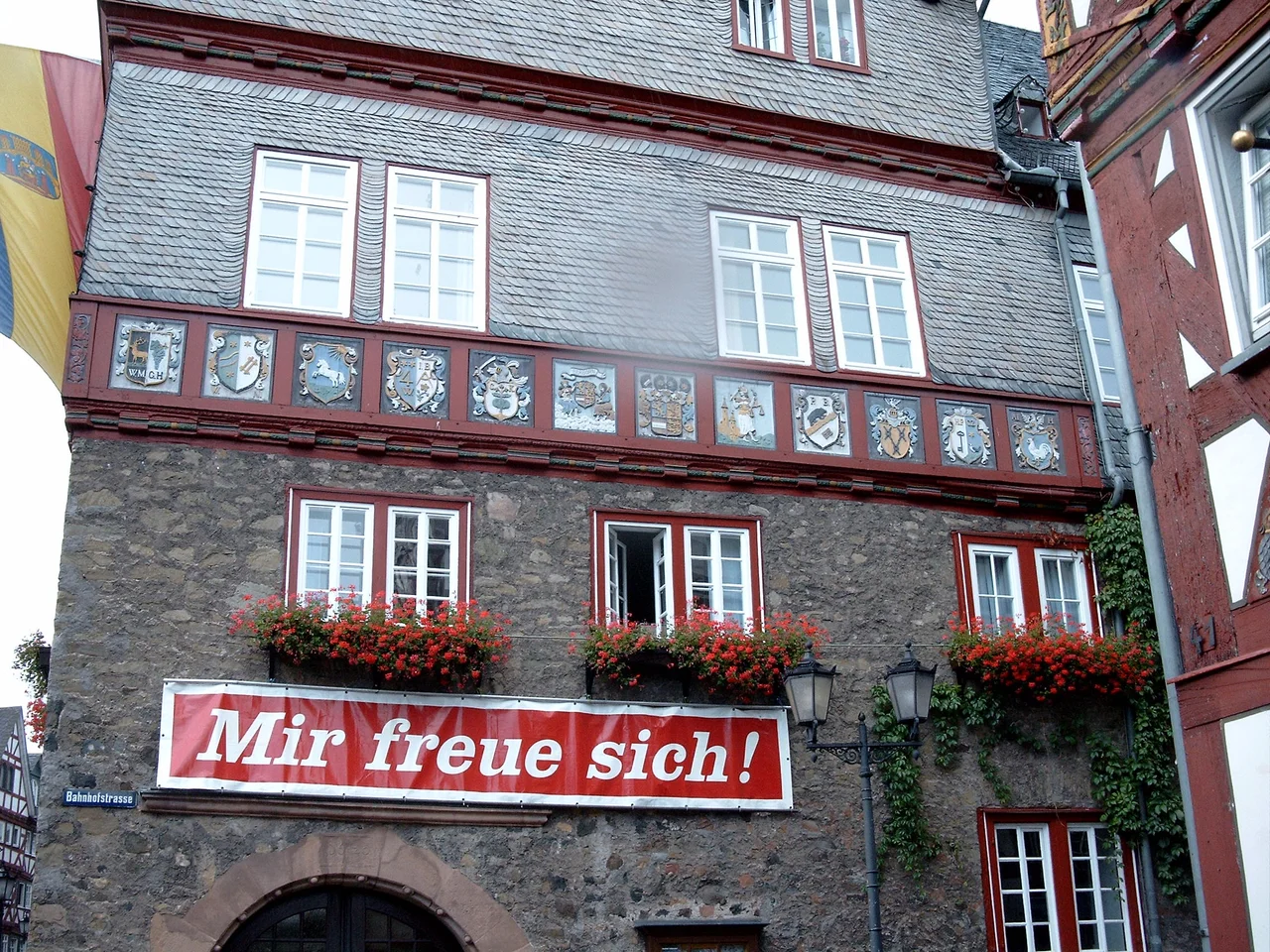

Herborn, Hesse
Before the First World War, Germans gave Herborn an unusual compliment. They called it Nassauisches Rothenburg, the Rothenburg of Nassau, putting this small Hessian town in the same breath as the famous medieval jewel of Bavaria. Walk the cobbles around the Marktplatz today and the comparison still holds. Six or seven centuries of half-timbered houses lean toward each other across narrow lanes, the oldest dated to 1445. Beneath the painted beams is a town whose mascot is a bear and whose history is improbably layered for a place of just over 20,000 people.
A Town Named in 1048
Herborn appears in the written record in 1048, then receives its city privileges from the Counts of Nassau in 1251. The Stone Gate at the edge of the old town still marks that founding moment. The original town wall survives in fragments, with the Witch Tower, the Dill Tower, the Speck Tower, and others still standing watch over an old town that fire and accident have shaped as much as design. In 1626 a stray spark in soldiers' quarters destroyed 214 houses; the survivors rebuilt almost in place, which is why so many of the present buildings date from the late 1620s and 1630s. The fire was followed, almost inevitably for the period, by a wave of witch trials. The Witch Tower in the town wall is a stone reminder of that grim chapter, not a charming tourist gimmick.
Lazarettstadt
Near the end of the Thirty Years War, the townsfolk took in fifty wounded Swedish soldiers. The Swedish army returned the favor by extending protection over Herborn. From that moment on the town carried an informal title, Lazarettstadt, the field-hospital town, which held until the Second World War. It is a small accident of kindness that became an identity. While other towns burned through that war, Herborn kept its houses. It is a large reason why those 1445 timbers still stand. A second occupation came centuries later when an American military garrison spent much of the Cold War based in the constituent community of Seelbach, a quiet coda to Herborn's long acquaintance with foreign uniforms.
The Memory of 1942
Herborn was mostly spared by Allied bombers in the Second World War. The town was not spared what came from within. In 1942 its Jewish community was obliterated, deported and murdered in the death camps of the east. Many patients of the local psychiatric clinic were also taken away and killed under the Nazi T-4 program. There is no way to walk through Herborn without that fact being part of the air. The half-timbered streetscape that survived the bombs survived because a community was lost. The town remembers them at memorial plaques set into the old town's walls, names where neighbors used to be.
The Night of 7 July 1987
Herborn returned to national news on the evening of 7 July 1987 in a way no town would choose. A tanker truck carrying about 34,000 liters of fuel lost its brakes on the descent into town, ran through the old streets, and crashed into a building that housed an ice cream parlor and a pizzeria. The fuel poured into the sewers, vapor spread under the streets, and the system ignited. Several houses caught fire. Six people died. Thirty-eight were injured. A memorial page maintained by the survivors at herborn1987.de still lists the victims. If you stand at the Hauptstrasse where the truck came down, the geography of the disaster is brutally legible. The town rebuilt, again, in the same place, with the same careful timber and lime mortar.
Bears, Fountains, and Strawberry Sunday
The bear on Herborn's seal turns up everywhere once you start looking. It crowns the market fountain from 1730. It glares from the frieze around the town hall, which was first built in the 16th century and then rebuilt after another fire in the 17th. The frieze is the building's main delight, a stone roll call of local family coats of arms reaching up to roof level. Beyond the gates the town hosts a relentless calendar of small festivals. Strawberry Sunday on the first Sunday in July fills the Marktplatz with sweet red baskets. A wine festival follows that weekend. The annual Sommerfest closes July. November brings the Martinimarkt. The Hessentag state festival has come through twice, in 1986 and 2016. Herborn sits on the Deutsche Fachwerkstrasse, the German Timber-Frame Road, which is exactly the route a traveler should take to understand why this town earned that Rothenburg comparison and earned the bear.
From the Air
Herborn is at 50.6825°N, 8.3061°E in the Lahn-Dill-Kreis of Hesse, on the Dill river, with the A45 motorway tracking through the valley. Cruise the Dill corridor at 3,500 to 5,000 ft for a clean view of the old town clustered around its church. Nearest airports: Siegerland (EDGS) about 25 km north, Frankfurt (EDDF) about 80 km south. The Westerwald range rises to the west, the Lahn valley spreads to the south.
Nearby Stories
- Stadtallendorf 21 km away
- Bilstein Castle (Lennestadt) 22 km away
- Battle of Kircheib 22 km away
- Baumwollspinnerei Ermen & Engels 23 km away
- Edersee Dam 30 km away
- Zwingenberg Castle 116 km away
- Basilica of Saint-Pierre-aux-Nonnains 186 km away
- Marmoutier Abbey 206 km away