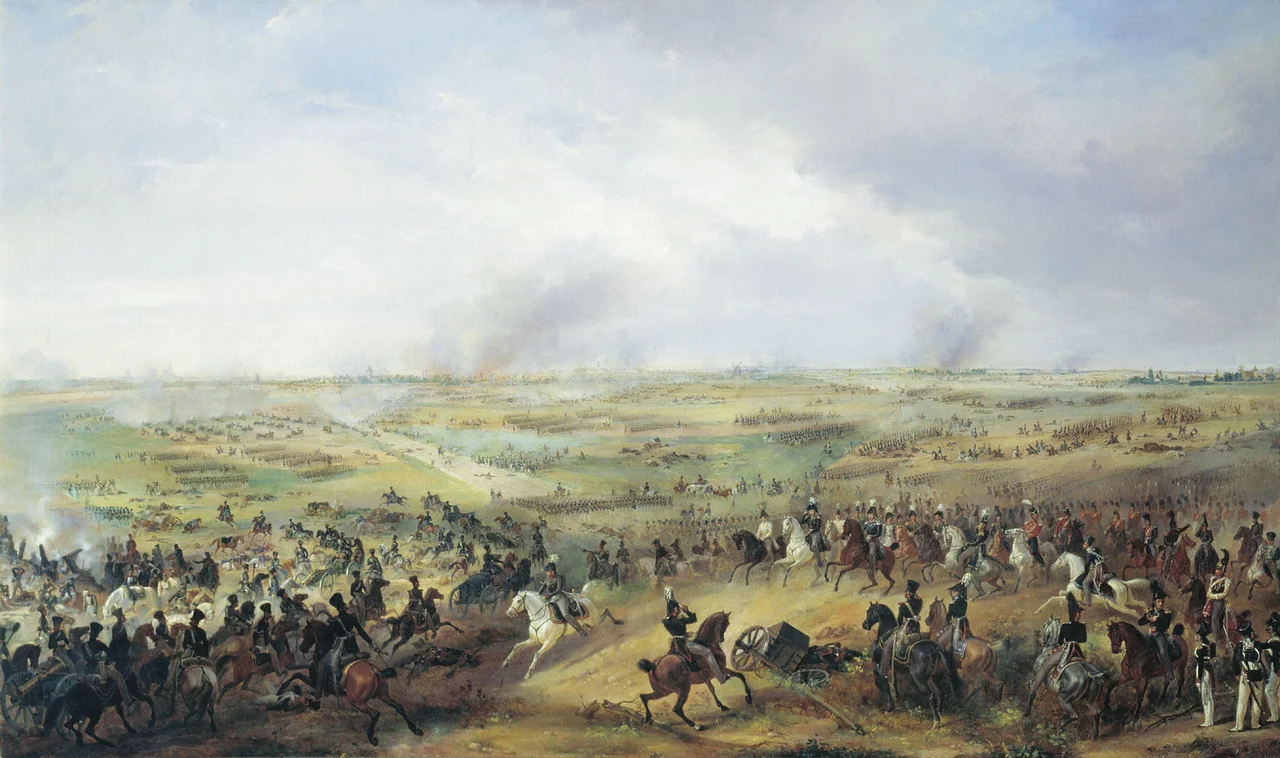

Battle of Leipzig
When the citizens of Leipzig walked out of their houses the morning after the battle ended, the smoke was still drifting across the Saxon plain and the corpses were too many to bury. Four hundred thousand rounds of artillery had been fired in four days. Bodies of men and horses lay in the fields surrounding the city, and locals were still finding remains the following spring. About six hundred thousand soldiers had marched onto these fields from a dozen different countries. Russians, Prussians, Austrians, Swedes, Saxons, French, Italians, Poles, Wurttembergers. About 133,000 of them did not march off again. Nothing on this scale had ever been seen in Europe. Nothing on this scale would be seen again until the First World War, more than a century later. The Germans would call it the Volkerschlacht, the Battle of the Nations, and remember it as the moment when Europe finally turned against the man who had ruled half of it.
The Year of Catastrophes
Napoleon had never recovered from Russia. The 685,000 men he had marched to Moscow in 1812 had come back as ghosts, frostbitten skeletons walking out of a winter that swallowed his Grande Armee whole. He had spent the spring of 1813 building a new army out of teenage conscripts who had no military experience and not much desire to acquire any. He won two hard battles in May, at Lutzen and Bautzen, and then the British defeated his marshals in Spain at Vitoria, and Austria joined the coalition forming against him. By the summer he was outnumbered nearly two to one. The allies had agreed at Trachenberg Castle on a strategy of patience: avoid the emperor himself, beat his marshals where possible, wear him down. They beat his marshals at Grossbeeren, Katzbach, Kulm, and Dennewitz. Bavaria changed sides eight days before Leipzig. Saxon and Westphalian troops were starting to desert in large numbers. By the time Napoleon concentrated his army around Leipzig in October, his supply lines were stretched, his German allies were melting away, and three coalition armies were converging on him from three directions.
Four Days of Killing
The fighting began on 16 October when the Austrian and Russian Army of Bohemia under Schwarzenberg attacked from the south while Blucher's Prussians and Russians struck from the north. Napoleon held his ground that day, even managed a counter-attack that nearly broke through, but neither side could finish what they started. The 17th was relatively quiet; both armies were licking their wounds and Napoleon's couriers were riding for help that mostly did not arrive. On the 18th, the day was decided. Bernadotte's Army of the North arrived from the third direction. Napoleon was now surrounded on three sides by 360,000 men, and he had perhaps 198,000. In the middle of the day, two Saxon brigades fighting on his side simply changed flags and turned their guns on the French. Some Wurttemberg cavalry did the same. By evening, Napoleon knew he could not hold Leipzig and ordered the retreat to begin overnight. The 19th was the worst day of the four. The retreat funneled across a single bridge over the Elster River. The bridge had been mined to blow once the rear guard was clear, but a panicked French corporal lit the fuse too early. Twenty thousand French soldiers were trapped on the wrong side, including Marshal Poniatowski, the prince of Poland, who tried to swim his horse across the river and drowned in the attempt.
The Cost
About 38,000 French were killed or wounded across the four days. The coalition lost 54,000. Napoleon left another 36,000 men behind as prisoners when the bridge blew, along with 325 guns and most of his supply train. Six French generals were killed, twelve wounded, thirty-six captured. The total casualty figures stagger even by the standards of the Napoleonic era: probably 80,000 to 110,000 men killed, wounded, or missing in four days of fighting. Napoleon went home to Paris and, on entering the Senate, said quietly: "A year ago all Europe marched with us; today all Europe marches against us." He had lost half a million men in the German Campaign of 1813. The Confederation of the Rhine, the system of client states he had built across Germany, dissolved within weeks. The coalition armies invaded France in the spring. By April 1814 Napoleon was on his way to exile on Elba. His first reign was over.
The Monument
On the centennial of the battle, in 1913, the city of Leipzig dedicated the Volkerschlachtdenkmal, the Monument to the Battle of the Nations. It is a brutally massive thing, ninety-one meters tall, designed by Bruno Schmitz and built of granite and concrete at a cost of six million gold marks paid mostly by public subscription. Inside its dim crypt, four enormous statues of Totenwachter, Guardians of the Dead, stand watch over the symbolic graves of the men who fell. From the viewing platform at the top, on a clear day, you can see for kilometers across the plain where the killing happened. Across the city, fifty smaller stones called the Apel-stones mark the lines that the French and allied armies held during those four October days. The Russian Memorial Church stands nearby, dedicated in the same year of 1913, in time to be reconsecrated by losses none of its founders foresaw. A year after the centennial, the same plain that had carried 600,000 men in 1813 was emptying out as Europeans marched away to a new war that would dwarf even the Volkerschlacht.
What Remains
Walking through Leipzig today, with its Bach archives and Mendelssohn houses and the chocolate-rich gingerbread cake the locals call Leipziger Lerche, it is hard at first to picture what happened in the surrounding fields two centuries ago. The city itself, an old trade-fair town with a long musical and publishing tradition, has carried on. Modern Leipzig is the second-largest city in eastern Germany, a place of universities and tech firms and the giant book fair held every spring. But on the southern outskirts, where the great monument rises above the suburbs, the weight of those four October days has not entirely lifted. Six hundred thousand soldiers passed through here, and the world that came out the other end was different from the one that went in.
From the Air
Located at 51.31N, 12.41E on the southeastern outskirts of Leipzig in Saxony, central Germany. The battlefield extended in a rough arc around the historic city, with major fighting at Wachau, Liebertwolkwitz, and Mockern. The Volkerschlachtdenkmal monument now stands on the southern part of the field. Visible from cruising altitude as flat to gently rolling agricultural land surrounding the urban area. Nearest major airport is Leipzig/Halle (EDDP) about 15km northwest of the battlefield.
Nearby Stories
- Goseck Circle 7.7 km away
- Freiberg Cathedral 24 km away
- Battle of Mühlberg 26 km away
- Jena 26 km away
- Horch 27 km away
- Eisleben 28 km away
- Lichtenburg Concentration Camp 36 km away
- 2001 American Memorial 63 km away