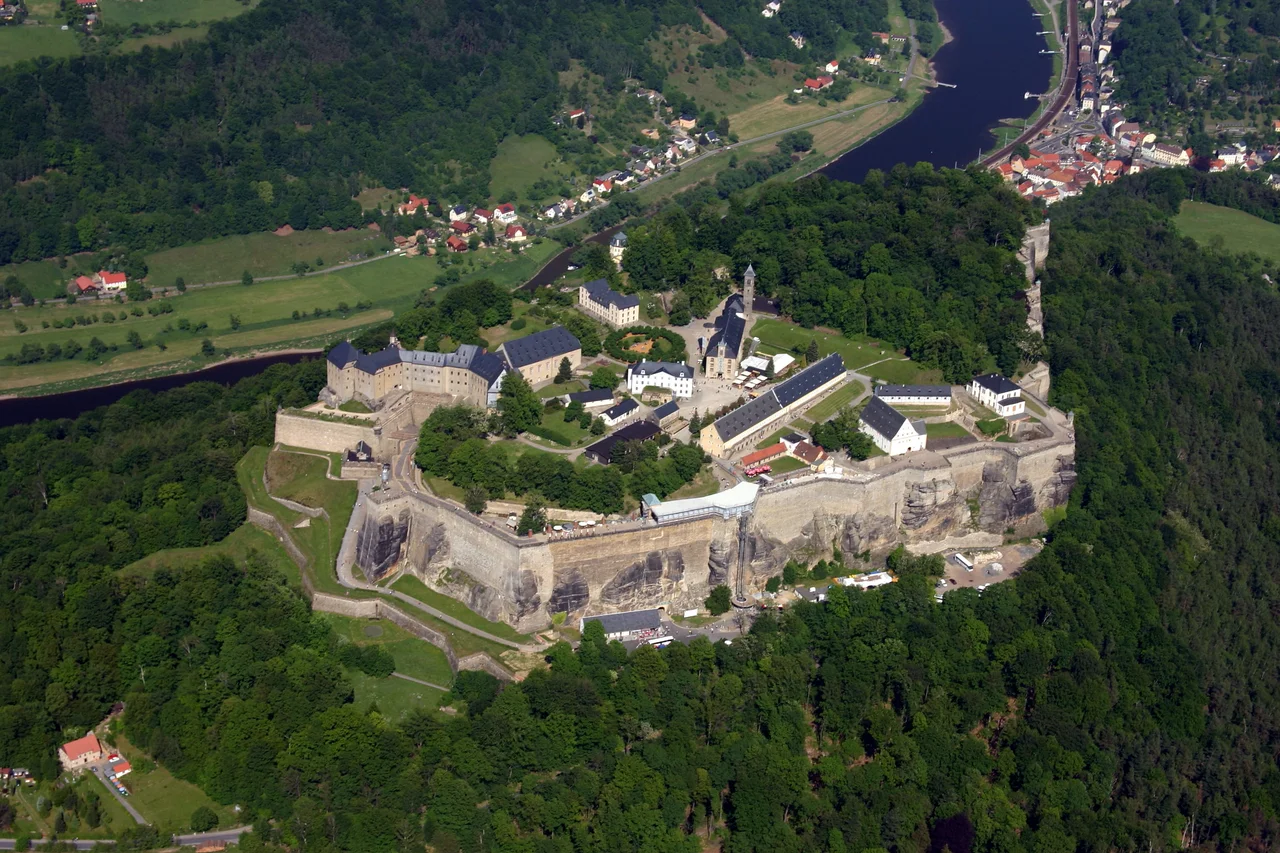

Königstein Fortress
It was never taken. In nearly eight hundred years of recorded history, no army ever climbed the sandstone walls of Königstein Fortress. The Bohemians built the first castle on this table mountain in the 13th century. Saxon prince-electors expanded it. The fortress survived the Seven Years' War, the Napoleonic Wars, both world wars, the GDR, and reunification with its ramparts intact. The only person who ever climbed the cliff walls without permission was a chimney sweep named Sebastian Abratzky, who scaled the south face in 1848 on a dare and immediately surrendered to the surprised garrison. The Saxons sentenced him, then pardoned him. His chimney is still rated grade IV and climbers attempt it today.
The Rock
Königstein is a flat-topped sandstone mesa in the Elbe valley about 30 kilometres southeast of Dresden, in the region called Saxon Switzerland. The plateau covers 9.5 hectares and sits 240 metres above the river. The walls of cream-coloured sandstone rise nearly vertically on every side. From the top, the Elbe winds north toward Dresden in a series of green meander loops, and the strange flat-topped sister mountain called the Lilienstein looms across the valley. The first written reference to a castle here is from 1233, in a deed naming a "Burgrave Gebhard of Stein" as witness. King Wenceslaus I of Bohemia signed a charter on the rock in 1241, calling it in lapide regis — at the rock of the king. The name Königstein, the King's Rock, has stuck for nearly eight hundred years.
Building the Saxon Bastille
After the Saxons finally took Königstein from Bohemia in 1408, the fortress became the strongest stronghold in the Electorate. Prince-Elector Christian I of Saxony rebuilt it between 1589 and 1597 into what people called the Saxon Bastille. The walls run 1,800 metres around the plateau, up to 42 metres high in places. More than 50 buildings still stand on top, some over 400 years old: the gatehouse, the old armoury, the Magdalenenburg, the Friedrichsburg. In 1563 Saxon engineers began boring a well straight down through the sandstone — 152.5 metres deep, the deepest well in Saxony and the second deepest in Europe. They removed eight cubic metres of water a day during the digging, six years of work to reach reliable groundwater. Until then the garrison had collected rainwater in cisterns. After the well, Königstein could withstand any siege.
Where Treasures Hid
Because the fortress was unconquerable, the Saxon kings used it as their strongroom. The state treasury moved in during wars. The art collections of the Dresden Zwinger were evacuated here in 1756 and again in 1813 when Napoleon was loose in Central Europe. The most extraordinary deposit came in the Second World War. In 1939 the Saxon authorities ordered the great paintings of the Dresden state collections moved into the fortress's deep casemates for safety. Among them was Raphael's Sistine Madonna — finished around 1513, one of the most reproduced paintings in Western art, the source of those two cherubs at the bottom that have ended up on a million coffee mugs. The Madonna survived the war in Königstein's tunnels. After 1945 Soviet forces removed it to Moscow, and returned it to Dresden in 1955. It now hangs again in the Gemäldegalerie Alte Meister.
The Prisoners
Königstein was Saxony's most feared state prison. The Crypto-Calvinist Caspar Peucer was held here for twelve years from 1574, accused of religious dissent. Mikhail Bakunin, the Russian anarchist, did a year inside in 1849-50 after being captured during the Dresden uprising — Saxony was about to extradite him to Russia, where he would be sent to Siberia. August Bebel, the founder of German social democracy, served two years from 1872. Johann Friedrich Böttger, the alchemist who accidentally discovered how to make European porcelain in 1707, spent time here too — partly as captivity, partly to keep him from selling his secret to anyone but August the Strong. Königstein is consequently considered the birthplace of European porcelain. In both world wars the fortress served as Oflag IV-B, an officers' prisoner-of-war camp. French General Henri Giraud famously escaped down the cliff in April 1942 using a homemade rope of bedsheets and copper wire — and walked across Germany to safety in Switzerland.
The Open-Air Museum Today
Königstein opened as a military history museum on 29 May 1955 and now welcomes over 700,000 visitors a year. Two lifts climb the cliff face — one built in the late 1960s for 42 passengers, a second panoramic lift opened at Easter 2006 against a vertical wall, both saving knees the long uphill walk. Inside the cellars of the Magdalenenburg sits the giant Königstein wine barrel built between 1722 and 1725 for August the Strong, with a capacity of nearly 250,000 litres — once the largest wine barrel in the world, filled with country wine from the Meissen vineyards before its leaky hoops finally gave out in 1818. Walk the ramparts, look down at the Elbe far below, and try to imagine an army climbing those walls. Eight centuries of armies tried not to.
From the Air
The fortress sits at 50.92°N, 14.06°E above the town of Königstein in Saxon Switzerland, about 30 km southeast of Dresden along the Elbe River. From the air it is unmistakable — a flat-topped sandstone plateau standing 240 m above the surrounding valley with a clear ring of buildings around the rim. Dresden Klotzsche (EDDC) lies 35 km northwest. The neighbouring Lilienstein mesa, 415 m tall, makes a clear navigation pair across the river. The Elbe winds in dramatic curves through the sandstone canyons here, and from low altitude in clear weather the fortress walls and the deep gorge below them stand out sharply against the surrounding pine forest.
Nearby Stories
- Bautzen II 3.3 km away
- Freiberg Cathedral 3.7 km away
- Moritzburg Castle 15 km away
- Oybin 24 km away
- Battle of Mühlberg 33 km away
- The Defenestration of Prague: The Thrown Men Who Started a Thirty Years' War 70 km away
- The Battle of Vienna: The Cavalry Charge That Saved a Continent 300 km away
- Salzburg 314 km away