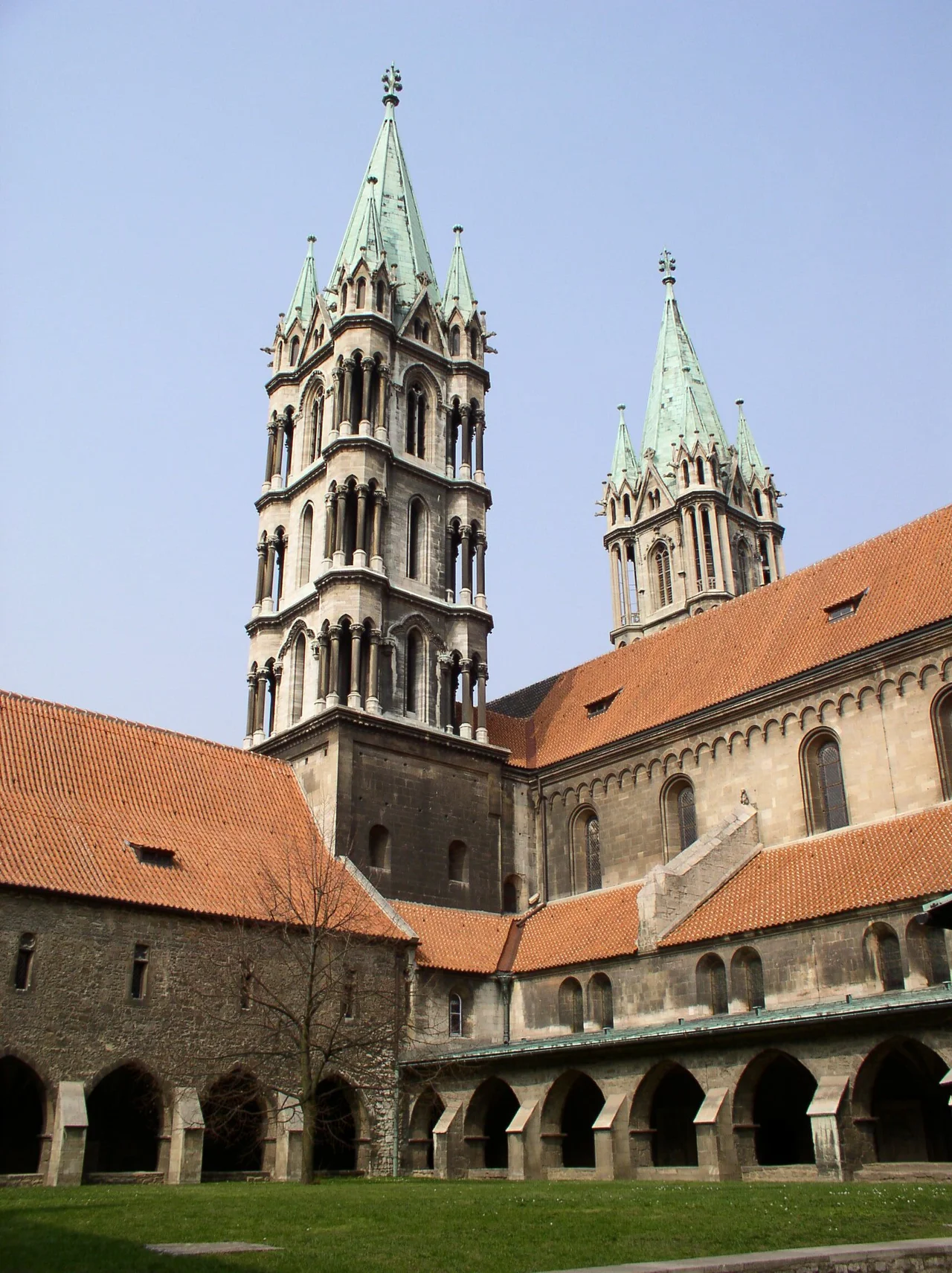

Naumburg Cathedral
Uta von Naumburg has been dead for almost a thousand years. We know almost nothing about her life. She married Margrave Ekkehard II of Meissen sometime in the early eleventh century, she had no children, she died around 1046. Two centuries later, in the 1240s, an artist now known only as the Naumburg Master carved her likeness in limestone for the new west choir of the cathedral above the Saale river. He had probably never seen her face. He gave her one anyway. She stands beside her husband in a fur-trimmed cloak, her left hand drawing the collar across her cheek as if against the cold. Her gaze is direct, faintly skeptical. Umberto Eco, asked which woman from medieval art he would most want to meet, named her without hesitation. Walk into the west choir today and you will understand why.
The Move from Zeitz
The Bishopric of Zeitz had been founded by Otto the Great in 968 as one of the eastern frontier bishoprics, watching the lands of the Polabian Slavs. After repeated Slavic risings made Zeitz impractical, the bishop's seat was moved to Naumburg in 1028, onto the high right bank of the Saale near where the Unstrut joins it. The site was already settled. Margrave Ekkehard I of Meissen, the most powerful man on the eastern border of the Holy Roman Empire, had built a residence here on a 25-meter rock above the river around the turn of the eleventh century, calling it the neweburg, the new fort. Ekkehard was murdered at Pohlde Abbey in 1002, before the castle and its monastery were finished, but his sons had his body and the bones of his ancestors moved to the Georgenkloster at Naumburg once they were ready. The cathedral that rose on the site became, in part, their family memorial.
The Twelve Founders
The west choir houses the twelve Stifterfiguren, donor portraits of the cathedral's founders, all of them long dead by the time they were carved. The Naumburg Master and his workshop produced them around 1245. Uta and Ekkehard II are the most famous, but each of the twelve is fully individual: Reglindis with her broad smile, Hermann with his sharp gaze, Wilhelm of Camburg in mid-protest. The figures stand on consoles around the choir's interior, looking down across the altar from the side walls and out through the rood screen at anyone who enters. They are larger than life-size, painted in their original color scheme of blues, reds, and gold leaf, almost all of which has been preserved. Together they constitute one of the most important cycles of monumental sculpture in medieval Europe, and probably the earliest western European sculptures that read as portraits of specific people.
The Master Himself
Nothing is known about the Naumburg Master beyond what his work tells us. He came from somewhere in the French sphere, probably trained at Reims or in nearby cathedral workshops. His earlier work has been identified at Mainz and Strasbourg. By the early 1240s he was at Naumburg, where besides the founder figures he carved the Westlettner, the western rood screen, with reliefs of the Passion of Christ. His Last Supper, his Judas, his weeping Mary at the foot of the cross are all marked by a startling realism, as if the figures had been observed rather than imagined. He probably died at Naumburg, since the workshop's later commissions tail off after about 1260. The art historian Wilhelm Pinder once said that no name in medieval German art needed less repair than the Naumburg Master, because his sculptures still spoke for themselves.
Reformation, Romanticism, and Pilgrimage
Naumburg adopted Lutheranism in the Reformation, and the cathedral became a Protestant parish church, a status it holds today. The bishopric formally ended in 1564. The west choir was used for Saxon synods rather than Catholic liturgy, but the founder figures survived intact, partly because they had no liturgical function and partly because they were too clearly portraits to be condemned as idols. In the nineteenth century, German romanticism rediscovered them; the philosopher Friedrich Nietzsche, who grew up in Naumburg and whose father was a Lutheran pastor, knew the figures from childhood. Visiting them today still functions as a kind of secular pilgrimage. The early Gothic crypt and the contemporary stained glass by Neo Rauch in the Elisabeth Chapel give the cathedral several centuries of layered art in a single building.
The 2018 World Heritage Listing
UNESCO's World Heritage Committee added Naumburg Cathedral to its list on 1 July 2018, after twenty years of campaigning. The original German nomination included the Saale-Unstrut river landscape around the cathedral, but UNESCO listed only the building itself. German officials were diplomatic about the decision; some were privately frustrated. The cathedral sits on the Romanesque Road, the tourist route that strings together the surviving Ottonian and Romanesque architecture of Saxony-Anhalt, from Magdeburg in the north to Memleben on the Unstrut to Merseburg downstream. Of the buildings on the route, Naumburg holds the most concentrated and most unforgettable medieval portraiture. Stand in the west choir at midday, when the light comes through the high south windows, and Uta will look back at you. Anything you bring to that moment, she has seen before.
From the Air
Located at 51.15 N, 11.80 E on the right bank of the Saale river in southern Saxony-Anhalt, in the small city of Naumburg. The twin western towers and twin eastern towers create a four-tower silhouette that reads clearly from cruise altitude. Leipzig/Halle (EDDP) is about 50 km northeast. Look for the Saale and Unstrut rivers joining about 5 km north of the cathedral; the building sits on the bluff above the Saale just south of the confluence.
Nearby Stories
- Leipzig Meuten 8.3 km away
- Jena 15 km away
- Eisleben 16 km away
- Battle of Frankenhausen 17 km away
- Horch 30 km away
- Teufelsmauer 31 km away
- All Saints' Church, Wittenberg 46 km away
- Dejudaization Institute Memorial 65 km away