
Warsteiner
The receipt has survived. In 1753, a Westphalian farmer in the small town of Warstein paid one thaler and nineteen guilders in tax on beer that he had brewed and sold himself. That single tax record is the oldest documented mention of what would become, two hundred and seventy-three years later, Germany's largest family-owned brewery. Antonius Cramer was not building a beer dynasty when he handed over those coins. He was settling his bill. But nine generations of Cramers later, the company is still in family hands, still brewing inside the Arnsberg Forest Nature Park, and still ranked fifth among Germany's best-selling breweries.
From a Farmer's House
Brewing in Westphalia in the 1750s was not yet an industry. Most farmhouses with a hop garden made beer for their own table and sold the surplus to neighbors when there was any. Antonius Cramer's home brewery would have been one of dozens in the Sauerland hill country. What separates his from the others is that one of his children chose to continue it. His son Johannes Vitus brought the trade into the family house at the center of Warstein, taking advantage of the town's central position to sell to a wider circle. The house stood near what would become the heart of the modern town. The story almost ended in 1802, when a devastating fire reduced much of Warstein to ruins and ashes. The Cramers lost their business in the flames. They rebuilt their house as a guest inn rather than just a brewery, and over the years it became, together with the new St. Pancras Church, the social hub of the town. The original house, the Domschänke, still stands in the historic core of Warstein.
The Reinheitsgebot
Warsteiner brews under the Reinheitsgebot, the German purity law, which is older than the brewery itself by two and a half centuries. The original Bavarian edict of 1516 limited beer ingredients to water, barley, and hops; yeast was later added once people understood what it did. The rule survived political upheaval, two world wars, and the European Union's regular attempts to harmonize away local food laws, and it still governs German beer made for the German market. For Warsteiner that has meant, since the eighteenth century, a particular kind of disciplined product - clean, simple, and aimed at a tradition rather than a fashion.
Premium Verum
The brewery's flagship is Warsteiner Premium Verum, a pilsener with 4.8 percent alcohol by volume. It is exported to more than sixty countries and is, by quite a wide margin, the bottle the brewery is known for outside Germany. The mark of a German pilsener of this style is restraint: a pale, clear gold body, a firm white head, a moderate hop bitterness in the finish, and nothing that does not need to be there. Premium Verum became the brand around which Warsteiner built its national identity in the late twentieth century. Premium Dunkel, a traditional dark beer also at 4.8 percent, sits at the second position in the portfolio, while Premium Fresh - brewed exactly like the Verum and then dealcoholized - serves the German market for non-alcoholic beer, which has grown faster in the last decade than nearly any other beer segment in the country.
Family Ownership in a Multinational Beer World
Most of the world's large breweries have, over the last forty years, been swallowed by a few global drinks companies. Warsteiner has not. Nine generations after Antonius Cramer paid his thaler and his nineteen guilders, the brewery remains in the hands of the Cramer family, a rarity at this scale of operation in the European brewing industry. The family has not been parochial about it. Warsteiner began exporting internationally in the 1980s, founded or acquired shares in international breweries including the Isenbeck brewery in Argentina and operations in Africa, and licensed the Mahou-San Miguel Group in some international markets to brew Warsteiner and Koenig Ludwig under license. All North American Warsteiner products, though, are still brewed and packaged in Warstein itself, then shipped across the Atlantic.
A Brewery in a Forest
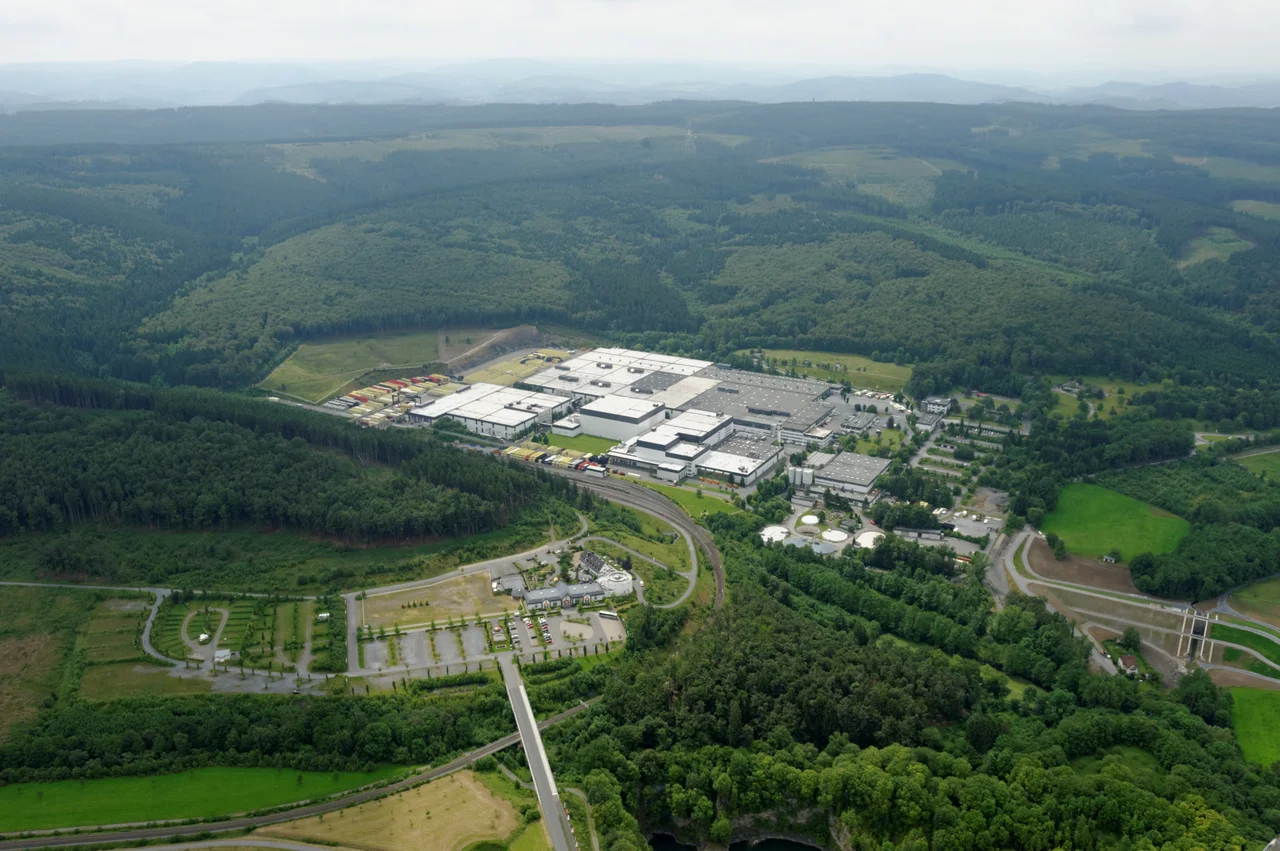
The brewery sits not in town but just outside it, on the edge of the Arnsberg Forest Nature Park, where deep groundwater and easy access to fields and woods provide the raw materials it has always needed. The Warsteiner hot-air balloons, manufactured by the Spanish balloon-builder Ultramagic and emblazoned with the brand mark, drift over the Sauerland hills on summer mornings the way other companies' brand banners hang from city buildings. World War II touched the brewery only lightly - the Rhine valley breweries took most of the bombing damage in the region, and the Warstein plant sustained some, but not catastrophic, harm. The Cramer family came out the other side of the twentieth century still brewing, still independent, and still selling beer made under a five-hundred-year-old law in a forest east of Dortmund.
From the Air
Coordinates 51.4217°N, 8.3544°E, on the northern edge of the town of Warstein in the eastern Sauerland. The brewery complex sits at the boundary of the town and the Arnsberg Forest Nature Park, with the wooded hills of the park rising immediately to the south and west and the open Soest Börde farmland stretching north toward the Hellweg. From the air at 2,000-4,000 ft AGL the modern brewery is a distinct cluster of large pale industrial buildings against the dark forest backdrop. Nearest airfields: Meschede-Schüren (EDKM) about 10 km south-southwest, Arnsberg-Menden (EDKA) about 25 km west, Paderborn-Lippstadt (EDLP) about 30 km north-northeast.
Nearby Stories
- Liesborn Abbey 3.7 km away
- Eresburg 5.8 km away
- Limburg-Hohenlimburg 13 km away
- Nordkirchen Castle 15 km away
- Bilstein Castle (Lennestadt) 18 km away
- Externsteine 23 km away
- Baumwollspinnerei Ermen & Engels 29 km away
- Stadtallendorf 39 km away