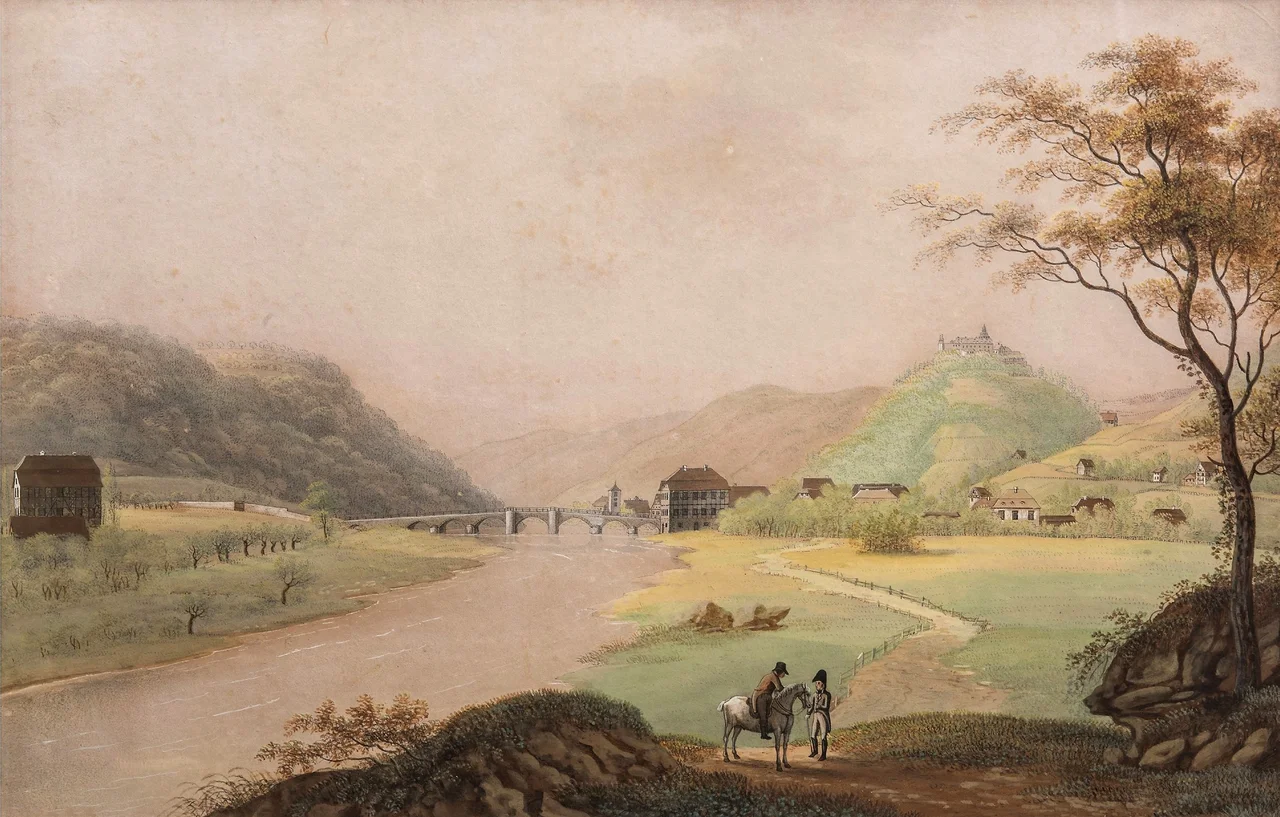

Limburg-Hohenlimburg
In 1246, a man stood on a ridge above the Lenne river, looked at the family disaster behind him, and rebranded himself. His name was Diederik of Isenberg, son of a count who had been broken on the wheel for murdering an archbishop. He could not be Count of Isenberg anymore. So he became Diederik I van Limburg, founded a new lordship from the wreckage of the old, and built his seat on this hill above what is now Hagen. The castle is still up there. The Lenne still curves around the foot of it. And eight centuries later, a prince of the Bentheim-Tecklenburg family still holds the keys.
A Family Salvaged from a Scandal
The Isenberg name had been ruined in 1225 when Count Friedrich of Isenberg ambushed and killed Engelbert of Cologne, the archbishop and regent of the Holy Roman Empire. Friedrich was hunted down, broken on the wheel, and the Isenberg lands were largely seized. His son Dietrich spent decades clawing portions of the inheritance back. By 1246, he was secure enough on this hill above the Lenne to start signing charters as Diederik I van Limburg. Why Limburg? The name connected him to the prestigious Duchy of Limburg far to the west, with no actual legal claim, and it shed the toxic Isenberg label. The Counts of Limburg-Hohenlimburg date their line from that pragmatic christening.
An Inheritance Built for Five
Diederik had three sons and at least two granddaughters who needed to be provided for. The eldest, Hendrik, died young around 1248. The second son, Johan, died before May 1277 and never appears in charters as count. Only the youngest, Everhard, lived long enough to inherit the title outright: he is recorded jointly with his father in 1287 and 1296 as Everhardus comes de Lymburg, and his seal still reads COMITIS EVERARDI LIMBURGENSIS. But rather than a clean primogeniture, Diederik engineered a careful balance. Grandson Diederik II got Stirum castle and lordship as allodial property. Grandson Frederik became a canon in Cologne. Granddaughter Mechteld of Limburg-Stirum married Lord Egbert of Almelo, anchoring the family into Dutch nobility. The arithmetic worked. The family did not collapse into the usual feud.
Two Houses, One River Bend
What Diederik's balancing act created, accidentally or not, were two surviving noble houses. The senior line, the Counts of Limburg-Hohenlimburg, kept this castle and the Westphalian uplands. The cadet line, the Counts of Limburg-Stirum, set up across the Lower Rhine and the Netherlands, and they still exist today as a noble Dutch and German family. Both lines outlasted most of their medieval peers. The Hohenlimburg seat changed hands by marriage and inheritance several times: to the Daun-Falkenstein family in 1511, to the Neuenahr-Alpen in 1542, and at the end of the 16th century to the Counts of Bentheim. Through every transfer the castle on the rock above the river kept its name and its strategic line of sight up and down the Lenne valley.
Iron Below, Walls Above
The town that grew at the foot of the hill, Hohenlimburg, became one of Westphalia's iron-working centres. Cold-rolled steel, drawn wire, and specialty strip steel were rolled and slit here from the early modern period onward; the local industry still exists. From the castle terrace the visitor looks down on what was a working steel town, hammered into shape by the same hydraulic logic that drove the Sauerland forges. The counts grew rich enough on tolls and on the wire trade to keep adding to their seat. The medieval core is buried inside layers of Renaissance and Baroque additions, but the rock the castle sits on is the same rock the first Diederik chose: high enough to see who was coming, low enough to control the road.
The Last Mediation and What Survived
The Holy Roman Empire ended Limburg-Hohenlimburg's sovereignty in 1808, when Napoleon's reorganization swallowed it into the Grand Duchy of Berg, the French satellite state that briefly governed much of the Rhineland and Westphalia. After Napoleon, the territory passed into Prussia. The princes of Bentheim-Tecklenburg, however, kept the castle itself as private property. They still do. Schloss Hohenlimburg is now Hagen's fortress museum, open to visitors, and still recognisably the hilltop strongpoint of a 13th-century count who needed a new name and chose a good one. The Lenne flows past, the iron mills still hum below, and the long view from the keep covers an entire arc of Westphalian history that runs from a murdered archbishop in 1225 to the steel town visible from the parapet today.
From the Air
Schloss Hohenlimburg sits at 51.36°N, 7.57°E, on a rocky spur above the Lenne river in the Hohenlimburg district of Hagen. Best viewed from 2,500-3,500 ft AGL, banking south to catch the castle against the wooded ridge with the steel town directly below. Dortmund (EDLW) is 18 nm northwest; the Sauerland hills rise to the east and south. The Lenne valley running northeast-southwest is an unmistakable natural marker.
Nearby Stories
- Moltkeviertel 3 km away
- Nordkirchen Castle 6.1 km away
- Lembeck Castle 7.4 km away
- Baumberg 11 km away
- Liesborn Abbey 13 km away
- Arnsberg Forest Nature Park 18 km away
- Operation Chastise 21 km away
- Dillenburg 49 km away