
Siege of Mogilev
Late on the night of 26 July 1941, with their ammunition gone, their food gone, and the wounded left behind in the city's hospitals with the doctors who refused to abandon them, the surviving Soviet defenders of Mogilev tried to break out. The order had not come from above. General Fyodor Bakunin had given it himself, in defiance of Stavka, because the alternative was to be killed in place. A small number got through. Most did not. By the time Heinz Guderian's panzers had finished consolidating their hold on the city, German troops reported 35,000 prisoners and 245 captured guns. Soviet propaganda would soon call the place Gallant Mogilev and the Belarusian Madrid. The men who held it for those three weeks earned both names.
Before Barbarossa Crashed Through
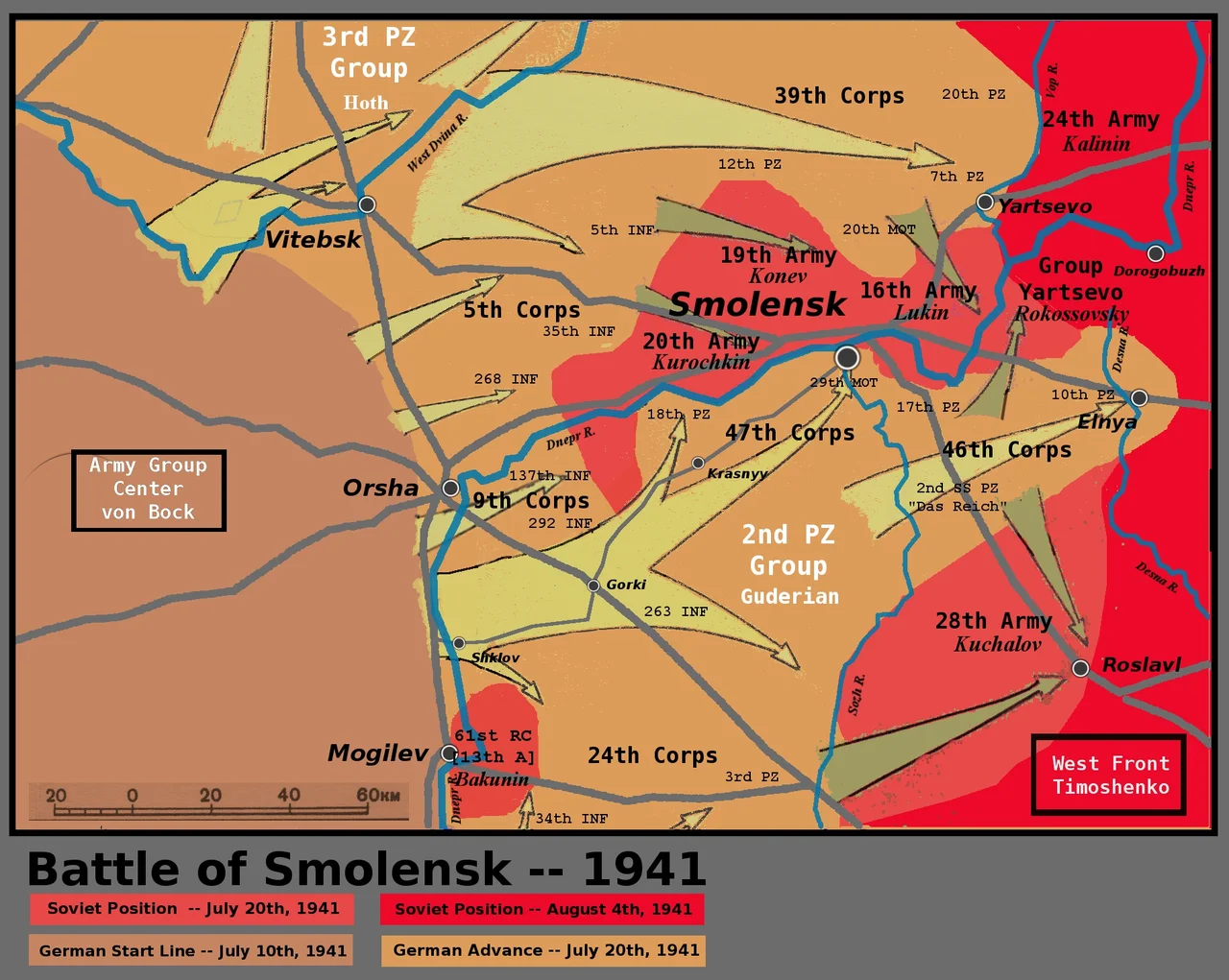
Mogilev sits on a high right bank above the Dnieper River in eastern Belarus, the kind of position that has decided campaigns for centuries. In late June 1941, with Operation Barbarossa already a week old and Soviet armies disintegrating across the western frontier, Red Army troops began fortifying the city. They dug trenches across the approaches, mined the western bank, fortified buildings street by street, and built a defensive perimeter on the Drut River 19 kilometers to the west. When Heinz Guderian's Panzer Group 2 reached the city, the panzer commander made a calculation that would haunt the Wehrmacht's timetable: he ordered his armor to bypass Mogilev rather than reduce it. He sent the XXIV and XXXXVI Motorized Corps racing on toward the Sozh River. The infantry would clean up behind.
The Pocket Closes
On 13 July, the SS Das Reich Motorized Division took blocking positions north of Chausy. The next day the XXIV Motorized Corps drove east from the Bykhov bridgehead. By 15 July, with Chausy and Propoysk in German hands, the encirclement was complete. Inside the pocket sat the 61st Rifle Corps under Bakunin, with the 53rd, 110th, and 172nd Rifle Divisions, parts of the 20th Mechanized Corps, and remnants of half a dozen other formations who had fallen back into the city as the front collapsed around them. The 172nd Rifle Division's commander, Major General Mikhail Romanov, took the heart of the defense - 110th and 172nd Rifle Divisions, fragments of four other rifle divisions, the survivors of the 20th Mechanized Corps, and units of the People's Militia drawn from the city's factory workers.
Ten Days
The German VII Army Corps under Wilhelm Fahrmbacher took over the assault on 20 July, attacking with the 7th and 23rd Infantry Divisions from the west. The first frontal assault was repulsed by Soviet artillery and entrenched riflemen. So the Germans crossed the Dnieper above and below the city, broke through Soviet defenses near Buinichi just 8 kilometers from the center, and brought in the 15th and 78th Infantry Divisions to close the noose. On 21 July, the 9th Regiment of the 23rd Division took a bridge into Mogilev from the southeast after heavy fighting. Bakunin radioed 21st Army headquarters that night reporting that the artillery shells had been used up. Soviet TB-3 bombers tried to airdrop supplies; many of the bundles fell behind German lines, and many of those that reached Soviet hands turned out to be the wrong caliber. The Germans put up barrage balloons to stop the airdrops entirely. By 24 July, four German infantry divisions were grinding into the center of the city in street fighting.
Breakout
Late on 25 July, the defenders had no more ammunition, no more food, and no more fuel. Bakunin gave the order to break out east on the night of 26-27 July. He did this without authorization from higher headquarters; the Stavka had ordered the city held to the last man. Thousands of wounded were left behind with their doctors and nurses, who chose to remain. Some Soviet troops broke through the German lines and reached friendly territory days later. Most did not. Romanov's column tried to slip into a German convoy and was destroyed; he was captured. On 27 July, Western Front commander Semyon Timoshenko reported that Bakunin had been turned over to a military tribunal for ordering the breakout. Romanov was held as a prisoner of war and later killed.
What It Bought
The defense of Mogilev cost the Wehrmacht more than 1,000 dead in the 23rd Infantry Division alone, tied down four German infantry divisions for the better part of two weeks, and prevented the use of the city's bridges across the Dnieper for that whole period. The German Second Army's planned attack on Gomel was delayed more than a week. That delay let Timoshenko bring up reinforcements for the larger Battle of Smolensk, which slowed the German drive on Moscow further still. Stalin's first months of the war are remembered for catastrophe - encirclements at Bialystok, at Minsk, eventually at Kiev that swallowed entire armies whole. Mogilev was the smaller, more stubborn opposite case: a defense that was supposed to collapse on day two and held for ten days, costing the men who held it almost everything but earning the city its postwar name.
From the Air
Located at 53.91 N, 30.34 E in eastern Belarus, on the high right bank above the Dnieper River. Mogilev (Mahilyow in Belarusian) sits about 195 km east of Minsk (UMMS) and 200 km southeast of Vitebsk. Mahilyow Airport (UMOO) lies a few kilometers south of the city. From altitude the Dnieper provides the most prominent landmark: a broad meandering river running roughly north-to-south, with Mogilev perched on the western bluff. The Drut River flows roughly parallel about 20 km west, marking the line of the original 1941 Soviet outer defenses.
Nearby Stories
- Mogilev Ghetto 15 km away
- Battle of Orsha 40 km away
- Battle of Holowczyn 67 km away
- Katyn Commission 89 km away
- Battle of Berezina 101 km away
- Katyn Polish War Cemetery 114 km away
- Battle of Listven 209 km away
- Nesvizh Castle 216 km away