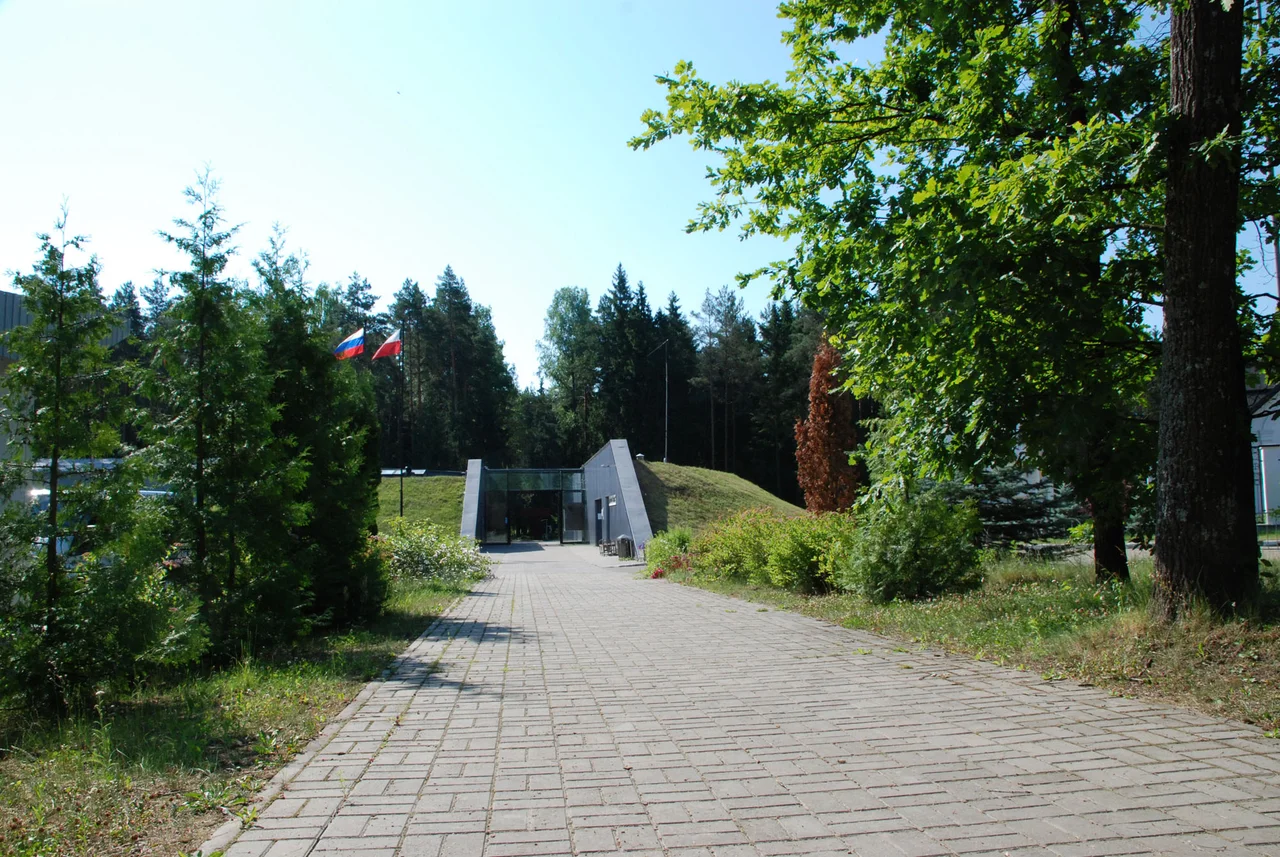

Katyn Polish War Cemetery
The names start at the entrance and continue without pause. Carved on iron plates around a circular alley deep in the Russian forest, they read like the table of contents of a country: officers, doctors, engineers, lawyers, professors, priests, judges. Four thousand four hundred and twelve men of the Polish Army's Kozelsk prisoner-of-war camp. Each killed by a single shot to the back of the head in the spring of 1940. Each buried in one of six mass graves a short walk from where you are now standing. The cemetery occupies twenty-two hectares of pine and birch in a loop of land near the village of Katyn, twenty-two kilometers west of Smolensk. It was officially opened on July 28, 2000—sixty years after the killing.
The Long Wait
For decades the place was a forest with a secret. After German exhumation in 1943 confirmed the bodies were Polish and the killings Soviet, the Soviets reburied the evidence and forbade access. Polish families could not grieve at gravesites their state insisted did not exist. In London, the Polish government-in-exile awarded a Katyn memorial the Virtuti Militari, Poland's highest military honor, in 1976—an honor given when nothing else could be given. Polish writers in the diaspora kept the story alive in books that were smuggled, copied, and passed hand to hand. Inside Poland, mentioning Katyn correctly could end careers and visit the secret police on a family. The truth lived in private kitchens and sealed church homilies, waiting.
What 1990 Made Possible
Mikhail Gorbachev's April 1990 acknowledgment opened the forest. Polish forensic teams returned to Katyn, joined by Russian counterparts, and the work of identification began in earnest. A 1994 bilateral treaty on war cemeteries and memorials gave Poland the legal foundation to build a proper burial ground. Construction began at Katyn and at three other massacre sites: Mednoye in Russia's Tver Oblast, Piatykhatky near Kharkiv in Ukraine, and the Russian section at Smolensk. All four cemeteries opened in 2000, a coordinated act of remembrance for what Stalin had ordered scattered across the western Soviet Union. The Virtuti Militari awarded to the London memorial was carried back to Katyn and laid here.
A Cemetery for Many Faiths
The opening ceremony on a July day in 2000 brought the Polish Prime Minister Jerzy Buzek and his Russian counterpart Viktor Khristenko to walk together along the main alley. The Catholic mass was celebrated by Józef Glemp, the primate of Poland; the Orthodox liturgy was led by Cyril Gundyaev, then Metropolitan of Smolensk and later Patriarch of Moscow. Protestant, Muslim, and Jewish prayers were also offered. The dead included Polish officers of every faith Poland held, and the cemetery refused to honor only some of them. The Russian section of the same memorial complex contains roughly 6,500 victims of Stalin's Great Purge of the 1930s—an acknowledgment, beside the Polish graves, that the same hand had killed many of its own people in the same forest.
The Plane That Did Not Arrive
On April 10, 2010, the Polish President Lech Kaczyński, his wife Maria, and ninety-four other Polish officials—senior military commanders, members of parliament, central bank president, deputy foreign ministers—were flying to Katyn for the seventieth anniversary of the massacre. Their Tu-154 went down about half a mile short of the runway at Smolensk in heavy fog. There were no survivors. A delegation traveling to honor the dead became dead itself. Poland's grief at Katyn now contains two losses, separated by seven decades and bound to the same place. The 2010 crash, and the political controversies that followed it about its causes, has shadowed Polish-Russian relations ever since.
What Remains in the Soil
Walk the main alley today. The mass graves are marked with iron slabs flush with the ground, like dark scars in the pine carpet. At the alley's end stands an altar with a memorial bell housed underground, struck on commemoration days so its sound rises through the earth. The forest is quiet. The wind moves through pine needles the way it moved through them in April 1940 when the trucks arrived from the Kozelsk camp and the killing began. The cemetery does not let you forget that this is not a memorial in some symbolic place. It is a memorial where it happened.
From the Air
The Katyn Polish War Cemetery sits at 54.77°N, 31.79°E, about 22 km west of Smolensk along the road to Vitebsk. The complex is a clearing within continuous pine forest, recognizable from low altitude by its circular and linear alleys. The 2010 crash site lies near Smolensk North airfield, roughly 22 km east of the cemetery. Smolensk (UUOS) is the nearest major airport; Warsaw (EPWA) is about 870 km west-southwest. Visibility in the region is often limited by fog in spring.
Nearby Stories
- Battle of Orsha 65 km away
- Vitebsk Museum of Modern Art 72 km away
- Siege of Mogilev 89 km away
- Vitebsk Regional History Museum 104 km away
- Battle of Lesnaya 121 km away
- Novhorod-Siverskyi 284 km away
- Tchaikovsky State House-Museum 312 km away
- Principality of Novgorod-Seversk 314 km away