
Second Battle of Polotsk
By the third day, much of Polotsk was on fire. Russian artillery had been bombarding the town since the morning of 18 October 1812, and house-to-house combat had reached the streets. Inside the burning town, a Bavarian rear guard fought to keep open a southern road for the retreat of Marshal Saint-Cyr's Franco-Bavarian corps. Outside, General Peter Wittgenstein's Russians - 38,000 of them, against the 15,000 weary French troops still standing - were closing what remained of the encirclement. Two months earlier, Saint-Cyr had won the First Battle of Polotsk with the same forces against the same Russians. The world had changed since then. Napoleon was in Moscow, his Grande Armee freezing, and the northern flank that Polotsk had been built to protect was about to come apart.
The Dwina Line
When Napoleon marched on Moscow in the summer of 1812, he left Marshal Oudinot's corps - later commanded by Laurent Gouvion Saint-Cyr - to hold a defensive bastion at Polotsk on the Dwina River. The position was critical for several reasons. It kept Wittgenstein's Russian army from marching south to threaten the rear of the Grande Armee around Moscow. It protected Vitebsk, one of three massive supply depots Napoleon had stockpiled in Belarus to fuel a winter campaign if Moscow proved indecisive. The other two were at Minsk and Smolensk. Through summer and early fall, the line held. Saint-Cyr fought Wittgenstein to a draw at the First Battle of Polotsk in August, and from Napoleon's perspective, that was a victory: Wittgenstein had been kept north of the Dwina, away from the supply columns and away from the Grande Armee's exposed rear.
The Numbers Shift
By mid-October, Russian reinforcements had transformed the situation. Wittgenstein commanded close to 50,000 men - 31,000 regulars and 9,000 militia at Polotsk itself, plus 9,000 more under General Steingall maneuvering toward the French rear. Against this, Saint-Cyr could field at most 27,000 troops, many of them Bavarians weakened by typhus and exhaustion. Napoleon, by then deep in the burned-out husk of Moscow, had no reinforcements to send. The Russian advantage was no longer marginal; it was decisive. Wittgenstein opened his offensive on 18 October.
Three Days
The first day's fighting was brutal and inconclusive. Russian columns made seven consecutive frontal assaults on the Polotsk defenses while Steingall pressed in from the east. All seven attacks were beaten back by nightfall, but at heavy cost - Russian losses came to 8,000 to 12,000 men, and French losses to about 8,000 of a far smaller force. Saint-Cyr could claim a tactical win on day one. He could not hold the position. Wittgenstein kept up an artillery bombardment overnight, and much of Polotsk burned. Late on 19 October, Steingall closed to within four miles of the town, and Saint-Cyr realized he was being encircled. That night, with the position untenable, he began evacuating across the Dwina. House-to-house fighting filled the streets as the Russians launched their final assault.
The Bavarian Rear Guard
On the morning of 20 October, Saint-Cyr had one immediate problem: Steingall sat astride his line of retreat. He ordered his Bavarian contingent - the same Bavarians who had been worn down by months of garrison disease and combat - to drive Steingall back. They did. The Bavarian counterattack was severe enough to push Steingall into a retreat with heavy casualties of his own, opening the southern road. Saint-Cyr's surviving 15,000 troops escaped encirclement and fell back. Polotsk itself was lost. Two weeks later, Wittgenstein's army captured the supply depot at Vitebsk - the inland reserve Napoleon had been counting on for the winter - and the Dwina Line ceased to exist as a coherent French position.
What Polotsk Set Up
Wittgenstein's victory mattered less for the ground it took than for what it released. With his northern flank gone, Napoleon could no longer count on a defensible line behind which the Grande Armee could winter. The road to the catastrophe at the Berezina opened directly from the wreckage at Polotsk. In late November, three Russian armies converged on Napoleon from separate directions at the Berezina river crossings - Wittgenstein's from the north, Admiral Chichagov's from the south, Kutuzov's main pursuit from the east. The Grande Armee, a third of its strength dead from typhus and frost and Cossack raids since Moscow, lost most of what remained at the crossings. The Second Battle of Polotsk was the first major Russian offensive victory of 1812. It was the moment when the war stopped being something Napoleon was fighting and became something happening to him.
From the Air
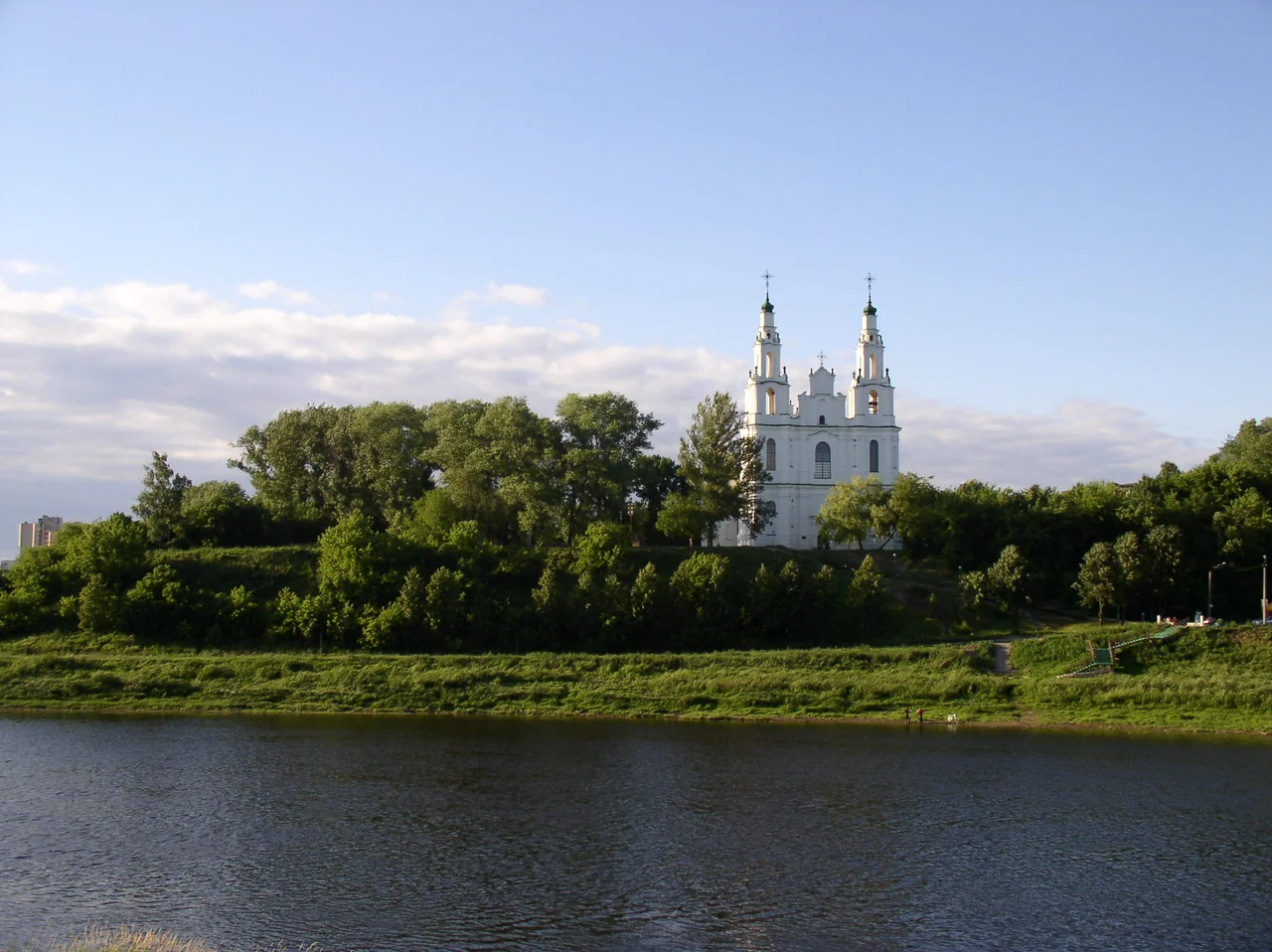
Located at 55.48 N, 28.80 E in northern Belarus, where the Polota River meets the Dvina (Dwina, Daugava) about 100 km west of Vitebsk and 230 km north of Minsk (UMMS). Polotsk sits on the south bank of the Dvina, which runs broadly east-to-west and provides the most prominent landmark from altitude. The town's St. Sophia Cathedral - a much-rebuilt 11th-century foundation - is visible on the bluff above the river. The 1812 battlefield extended along both banks of the Dvina and east toward the Drissa-Polotsk road. The terrain is gently rolling, a mix of fields and pine forest typical of the upper Dvina basin.
Nearby Stories
- Battle of Klyastitsy 19 km away
- Vitebsk Museum of Modern Art 65 km away
- Marc Chagall Museum 70 km away
- Dinaburga Castle 90 km away
- Khatyn Memorial 96 km away
- Battle of Berezina 99 km away
- Daugavpils Ghetto 110 km away
- Pskov Oblast 177 km away