.jpg)
Sapieha Palace, Vilnius
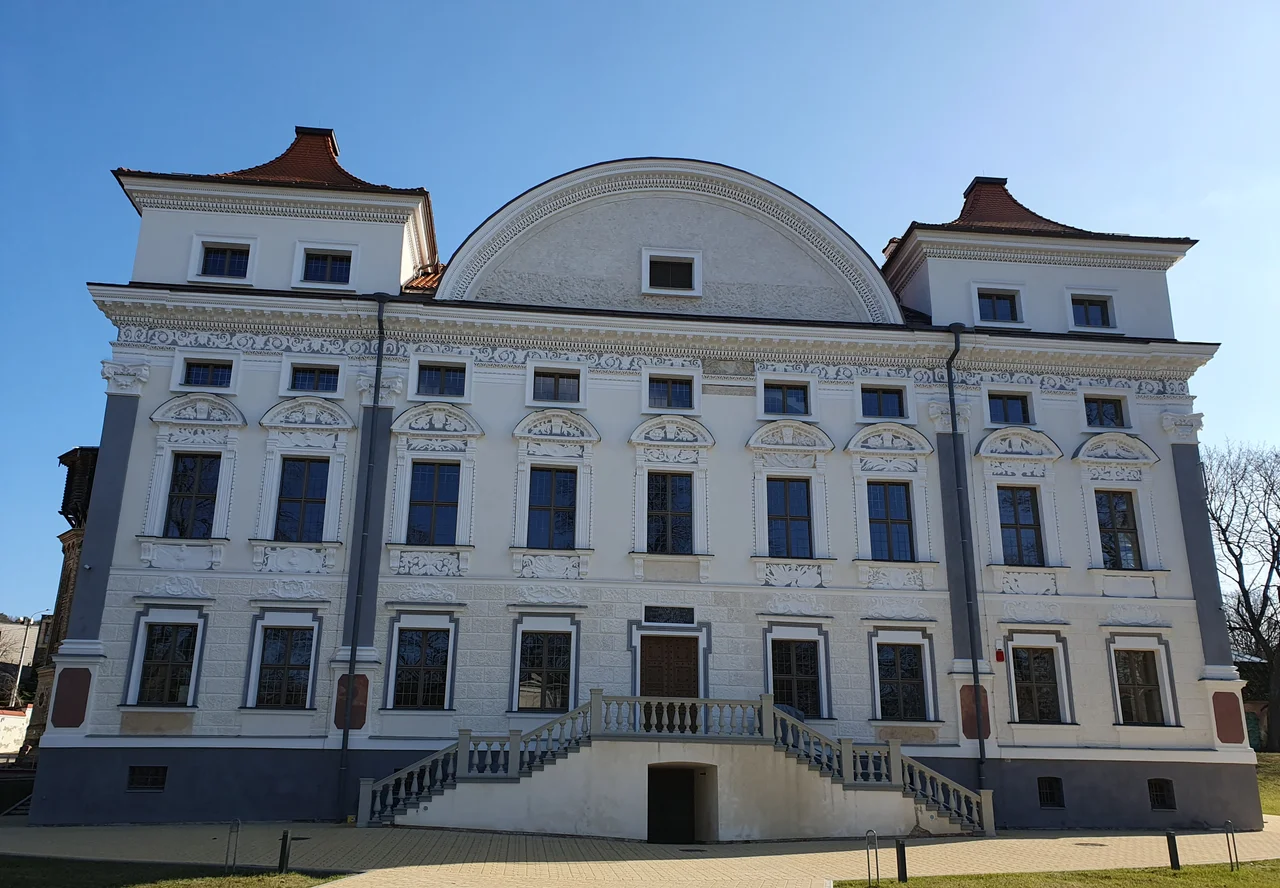
Hetman Jan Kazimierz Sapieha the Younger built this palace to humiliate a king. By the 1690s, the Sapiehas were the most powerful magnate family in the Grand Duchy of Lithuania, and Jan Kazimierz wanted everyone in Vilnius to know it - including King John III Sobieski of Poland, whose suburban projects in Warsaw the hetman intended his Antakalnis residence to surpass. He hired the Italian architect Giovanni Battista Frediani, the stuccoist Pietro Petri, and the painter Michelangelo Palloni. He laid out a French-designed garden with parterres and ponds. He flanked the palace with pseudo-defensive corner towers borrowed from the Italian Renaissance. By 1717, when the complex was finished, it was meant to declare that a Sapieha could become Grand Duke of Lithuania, and perhaps even King of Poland, if he chose. He never did. The palace, though, is still there.
A Site Already Old
When the Sapiehas bought the property from the Jesuits in 1682, there was already a brick palace standing on it. Either Stefan Bielawski or Teodor Lacki had built one at the end of the 16th century; it had passed through several owners, including Hetman Michal Kazimierz Pac, before Kazimierz Jan Sapieha acquired it. His son Jan Kazimierz the Younger did not demolish what he found. Instead, he expanded it, swallowing the older building inside the new one. This is why the palace sits at an odd diagonal to the garden: the old foundations dictated the orientation, and the new gardens, parterres, and avenues had to be laid parallel to the Dyneburg road instead. The result is asymmetrical in a way that floor plans rarely show but that anyone walking the grounds notices immediately.
Italian Bones
Frediani's design borrows from Italian Renaissance villa architecture - particularly the Poggio Reale near Naples, a 15th-century villa that had become enormously influential across the Polish-Lithuanian Commonwealth. The corner towers are pseudo-defensive: thick-looking, decorative rather than military. The side facades carried arcaded loggias, later filled in to gain interior space. External stairs led up to a vaulted vestibule on the upper floor, where the representative rooms were located; the family lived in the corner pavilions. The direct visual model was probably the Villa Regia in Warsaw, built by King Wladyslaw IV - which means Jan Kazimierz Sapieha was deliberately echoing a royal Polish residence to argue, architecturally, that he belonged in the same conversation as kings. A church-mausoleum dedicated to Christ the Redeemer and a Trinitarian monastery were added beside the palace, completing the ensemble around 1717.
From Palace to Hospital
The Sapieha family's political collapse in the early 18th century - culminating in the 1700 Battle of Olkieniki, where a coalition of Lithuanian nobles broke the family's grip on the Grand Duchy - took the steam out of the great residential project. By the late 18th century, after the partitions of Poland-Lithuania, the building had passed to the Russian government. In 1809 it was acquired outright; in 1843, following Jozef Poussier's design, it was restructured into a military hospital. Most of the rich Baroque interior - the stucco by Petri, the paintings by Palloni - was destroyed during the conversion. Through the 19th century the building's role as a hospital meant continual remodeling for utility rather than beauty. The Baroque shell hid an institutional interior.
Twentieth Century, Twenty-First Restoration
Between 1927 and 1928, during the brief interwar period when Vilnius was held by Poland, the exterior was restored. The building housed Vilnius University's ophthalmology institute until World War II. After the war it returned to use as a Soviet military hospital and slowly fell into disrepair. The Sapieha Hospital occupied parts of the complex into the early 21st century. In 2012, the city restored the two great Baroque gates - one opening from Antakalnis Street into the park, the other near the palace itself - and began the long, careful work of bringing the palace back toward its 1717 form. The restoration finished in 2024, opening the palace as a public cultural venue. Frediani's facades have been cleaned, the corner towers brought back to their original profile, and the parterre garden is being slowly recovered from a century of neglect.
What Remains
Of the several Sapieha palaces that once stood in Vilnius, this is the only one that survived. The family that built it never produced a Grand Duke or a King of Poland, and the Polish-Lithuanian Commonwealth they served disappeared from the map in 1795. But the palace's pseudo-defensive towers, its asymmetric relationship to its own garden, the ghost of its arcaded loggias under later additions - these still tell the story of a magnate family that thought of itself as royalty in waiting. Walking the grounds today, with the park's restored ponds and avenues opening toward the Antakalnis hills, the ambition of the place is more legible than at any time since the 18th century.
From the Air
Located at 54.70 N, 25.31 E in the Antakalnis district of Vilnius, on the right bank of the Neris River about 3 km northeast of the Old Town. Vilnius International Airport (EYVI) lies about 9 km south of the palace. From altitude, the green wedge of the formal park stands out clearly against the surrounding residential streets; the Neris and the wooded hills of Antakalnis bound the site to the south and east. Vilnius is recognizable by the broad meandering Neris and the cluster of red-roofed Baroque towers in the Old Town just downriver.
Nearby Stories
- Dubingiai Castle 5.4 km away
- Trakai Island Castle 12 km away
- Battle of Vilnius (1915) 17 km away
- Lida Castle 68 km away
- Lost Shtetl Museum 110 km away
- Grodno Ghetto 116 km away
- Minsk Ghetto 119 km away
- Daugavpils Fortress 129 km away