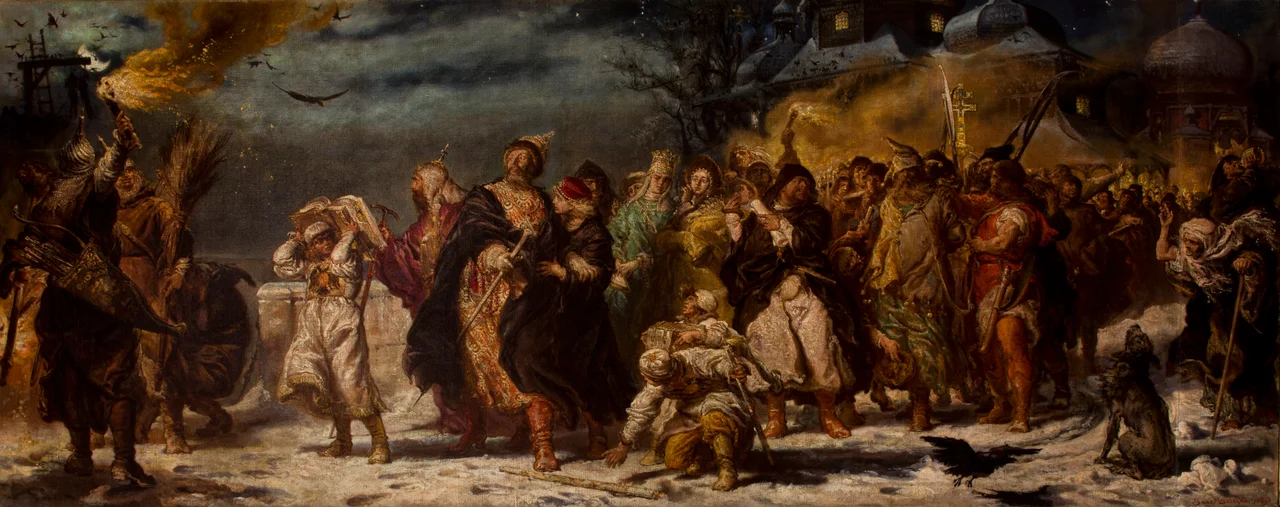

Siege of Polotsk (1563)
On 15 February 1563, the Lithuanian garrison of Polotsk surrendered. The Russian Tsar Ivan IV - already known across Europe as Ivan the Terrible - permitted the Polish defenders to march out with their weapons and banners, and gave provisions to the peaceful refugees in his camp. To the Polish nobility, the gesture was unexpectedly merciful. Then the Tsar turned his attention to the Catholic clergy and the Orthodox Jewish community of the city, and the meaning of the campaign sharpened. Ivan ordered the Catholic priests killed. He ordered the city's Jews - perhaps three hundred of them - given a choice of baptism or drowning in the icy Dvina. Most refused baptism. The atrocities at Polotsk reverberated across Europe, fed German pamphlet wars, and helped shape an image of Muscovy that Ivan himself was already actively cultivating: a tsar who could take a city and was prepared to do anything inside one.
The Livonian War
Ivan IV had been at war for almost a decade by the time he marched on Polotsk. In 1558 he had invaded the lands of the crumbling Livonian Order along the Baltic, and by 1560 the Order had collapsed entirely - its territory carved up among Sweden, Denmark, the Polish-Lithuanian union, and Muscovy. None of this satisfied Ivan. By 1561 he was at war with Lithuania directly, raiding Mstislavl while Lithuanian forces struck back into Livonia. The Polish-Lithuanian commander Mikolaj Radziwill the Red won an important engagement near Nevel, but neither side could land a decisive blow. In autumn 1562, Ivan decided on a campaign that would settle the matter: a full-scale invasion aimed at the great Lithuanian fortress of Polotsk.
The March
The Moscow army gathered from seventeen cities and concentrated at Mozhaisk. The campaign was framed as a kind of crusade to liberate ancient Russian Orthodox cities from Catholic occupation. Period sources gave wildly inflated numbers - up to 360,000 men - but the surviving Polotsk Book records 31,206. With Tatar reinforcements that joined later, modern estimates put the total at roughly 45,000. The Lithuanian garrison numbered between 2,400 and 6,000. King Sigismund II Augustus tried to open negotiations as the Russian column moved into position; he was rebuffed. On 17 December 1562, the army marched. The transition was difficult, with the column stretched thin and forced to protect its baggage train; some Russian troops defected, giving the defenders advance warning that allowed them to prepare.
The Siege
The Russians invested the city on 31 January 1563. Polotsk was a wealthy industrial center but well fortified, divided into several walled sections with moats, log palisades, and a citadel. Initial plans for an assault across the frozen lake were judged too dangerous. A relief force under Hetman Mikolaj Radziwill the Red - roughly 40,000 men, by his own claim - tried to bluff the Russians into lifting the siege. It failed. Russian and Tatar detachments moved out to meet the Lithuanians, and Radziwill chose not to give battle. On 5 February, Russian streltsy fired the forward tower and briefly took it before being thrown back. The garrison opened negotiations that evening, and over several days they tried to extend the talks while waiting for relief that did not come. Ivan saw the delay for what it was. The bombardment resumed.
Surrender, and What Followed
When the heavy siege artillery opened up, parts of the city collapsed. Up to 3,000 yards of wall and structure were destroyed in a single day. Dmitry Khvorostinin's troops took the Veliky Posad - the great suburb - in a fire-lit assault that killed many of the Polish garrison. The remaining defenders attempted a sortie, failed, and capitulated on 15 February. Ivan released the Polish soldiers honorably, with weapons and banners; he did this in part to avoid drawing the Polish crown more deeply into the war. Then he ordered the killing of the Catholic clergy. The Orthodox Jewish community of Polotsk - a centuries-old congregation that had refused baptism - was rounded up and drowned in the Dvina according to multiple contemporary accounts. The reliability of the exact numbers has been debated; the broad fact is recorded. The killings were both an act of religious cruelty and a calculated political message about what kind of ruler now held the city.
Echoes
Mikolaj Radziwill the Black, the Lithuanian chancellor, organized a propaganda campaign across Europe in response. German leaflets multiplied the casualty figures, claiming Muscovites had killed 80,000 inhabitants of a city that could not have held 20,000. The point of the leaflets was less accuracy than warning: Ivan had taken Polotsk and was prepared to do worse. The fortress remained under Russian control for sixteen years, until Stefan Batory's Polish-Lithuanian army recovered it in 1579. By then Ivan was old, half-mad, and had killed his own son in a rage. The Livonian War he had begun would end with Russia having gained nothing - and having spent a generation of men and treasure to lose what it had briefly held. The dead of Polotsk - the priests, the Jewish congregation drowned in the Dvina - became one of the campaigns the Tsar's enemies kept reminding Europe about for centuries.
From the Air
Located at 55.48 N, 28.80 E in northern Belarus, at the confluence of the Polota and the Dvina (Daugava) rivers. Polotsk sits about 100 km west of Vitebsk and 230 km north of Minsk (UMMS). The Dvina runs east to west and provides the most prominent landmark from altitude. The St. Sophia Cathedral - originally built in the 11th century and standing on a bluff above the south bank - is the historical anchor of the city; the medieval citadel that Ivan IV besieged stood nearby. The terrain is gently rolling pine forest and field, typical of the upper Dvina basin.
Nearby Stories
- Battle of Klyastitsy 19 km away
- Vitebsk Museum of Modern Art 65 km away
- Marc Chagall Museum 70 km away
- Dinaburga Castle 90 km away
- Khatyn Memorial 96 km away
- Battle of Berezina 99 km away
- Daugavpils Ghetto 110 km away
- Pskov Oblast 177 km away