.jpg)
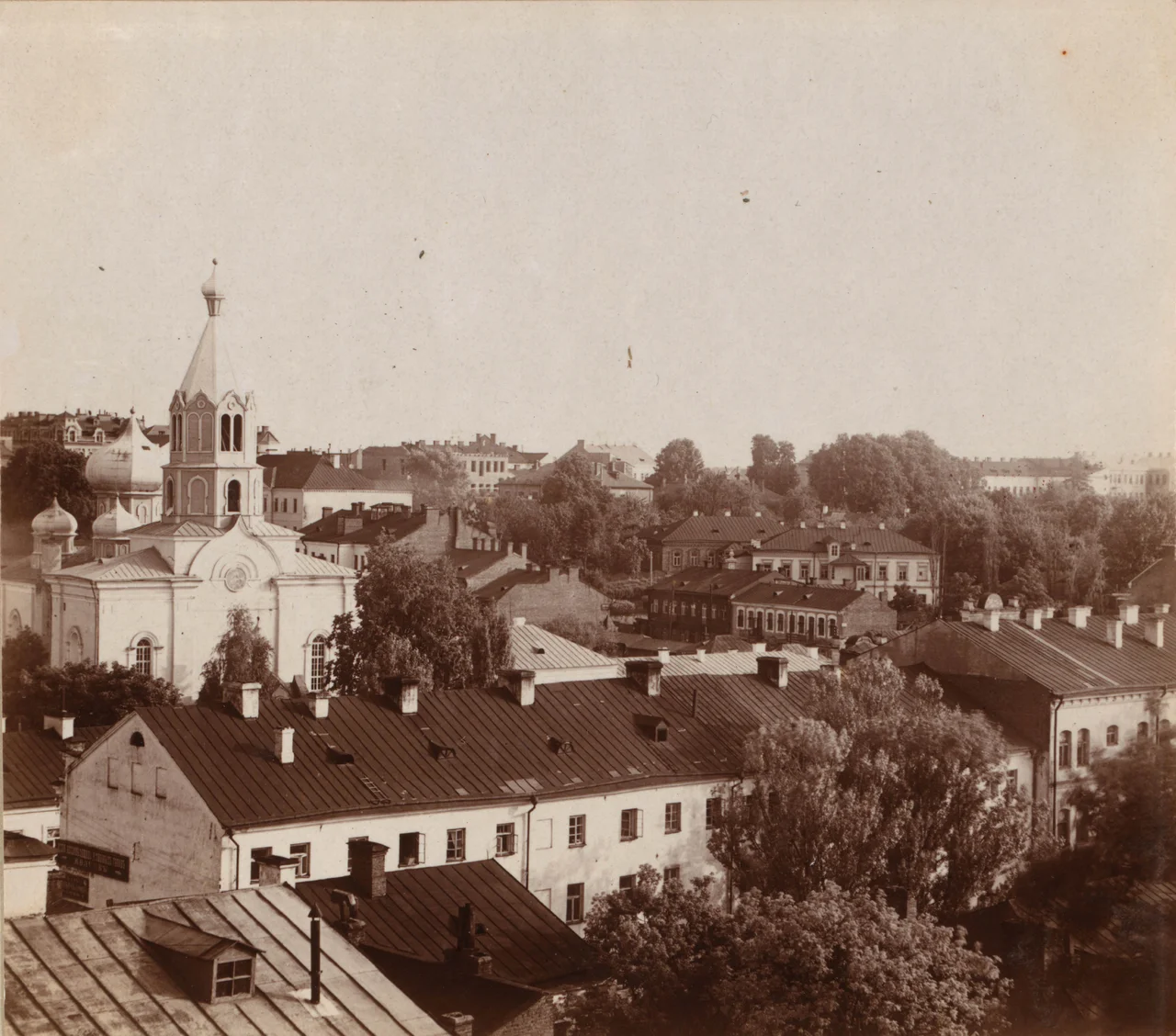
Church of St. Adalbert and Benedictine Monastery
The General Prosecutor's Office of Belarus stands today on what was once a small hilly square at the edge of Minsk, near a Calvinist church already half-ruined by the time the Benedictines arrived. The site has held a Calvinist meeting house, a Roman Catholic convent, an Eastern Orthodox monastery, a Soviet workers' club, a demolition pit, and now an instrument of the modern Belarusian state. Only the foundations remain of the brick Baroque church that Krzysztof Chodkiewicz and his wife Zofia paid 20,000 Polish zlotys to build in the late 1640s. It served Benedictine nuns for 238 years, Orthodox nuns for another 60-some, and then went away entirely.
A Convent on Zborowa Street
Father Wojciech Sielawa, a canon from Vilnius, signed four foundation documents between 1630 and 1633 to bring Benedictine nuns from Nyasvizh to Minsk. King Wladyslaw IV Vasa confirmed the foundation on July 14, 1633. Sielawa bought two houses on Zborowa Street, commissioned a wooden church, and dedicated it to St. Adalbert of Prague, the 10th-century missionary bishop who was martyred in Prussia. The first nuns moved in that same year. Within a decade, the noble Chodkiewicz family had funded a brick replacement, and master builder Andreas Kromer signed a contract in December 1647 to design and oversee the new church. War got in the way. The Russo-Polish War of 1654-1667 burned the wooden monastery buildings and plundered the unfinished brick church. Construction finally finished in 1690, more than four decades after it began.
Catholic Among Orthodox
By the late 17th century the Benedictine community held about 100 voloks of land - roughly 1,800 hectares - across three farmsteads, eight villages, and 94 peasant cottages. An 1830 visitation found 78 people living in the monastery: 26 nuns, 29 secular inhabitants including six girls being educated for tuition in the convent school, and 23 servants. The nuns kept obligatory liturgies for the souls of their founders on a weekly rotation - Mondays for the Chodkiewicz family, Wednesdays for Father Sielawa - and ran a small library of 24 books. The complex sat in a Catholic minority in a city that was becoming, after the partitions of Poland-Lithuania, increasingly Russian Orthodox. The 1780s brought a late-Baroque remodel by Tomasz Romanowski. Lightning damaged one of the towers in the 1790s; the bishop ordered repairs that finished in 1803.
Liquidation and Erasure
The Russian Empire absorbed Minsk in 1793. Catholic religious institutions across the former Polish-Lithuanian Commonwealth came under increasing pressure throughout the 19th century, and the failed January Uprising of 1863-1864 supplied the political pretext for accelerating that pressure. On September 20, 1871, a decree liquidated the Minsk Benedictine monastery. The 12 remaining nuns were sent back to Nyasvizh, where they arrived on October 30. The buildings passed to the Eastern Orthodox Church. Movable property - altars, paintings, vestments - was transferred to other Catholic parishes that still had legal standing. In the 1930s, Soviet authorities turned the former church into a workers' club and demolished the convent buildings. German occupiers during World War II briefly allowed liturgies in the former church; after the war it was closed again. The final demolition came in 1964. The General Prosecutor's Office building rose in its place.
The Foundations Beneath
Walk past the prosecutor's building today and there is no sign that a 17th-century Baroque church stood here for nearly three centuries. The street layout shifted in 1800 when authorities cut Felicjanska Street through the monastery gardens, taking a chunk of the southwestern property. By the time the church came down in 1964, almost no one in Minsk remembered the Benedictine community that had run a school, kept a library, and prayed weekly for the dead Chodkiewiczes. Only the church's foundations remain underground, waiting for the kind of archaeological survey that has not yet happened. Belarus is not a country where the demolished Catholic past is easy to commemorate. But the foundations are still there, somewhere under the prosecutor's parking lot, marking out the footprint of a building that was funded, built, prayed in, taken away, and then unmade.
From the Air
Coordinates 53.90 N, 27.55 E. The site is in central Minsk, Belarus, near the historic Niamiha district just north of the Svislach River. From altitude, look for the dense urban core of Minsk; the location is now occupied by the General Prosecutor's Office, an unremarkable mid-century building. Closest airport: UMMS (Minsk National Airport, ~40 km east). Belarusian airspace and overflight restrictions apply.
Nearby Stories
- Battle of Berezina 25 km away
- Khatyn Memorial 31 km away
- Mir Castle Complex 43 km away
- Battle of Holowczyn 55 km away
- Mir Ghetto 62 km away
- Nesvizh Castle 74 km away
- Medininkai Castle 102 km away
- Mogilev Ghetto 138 km away