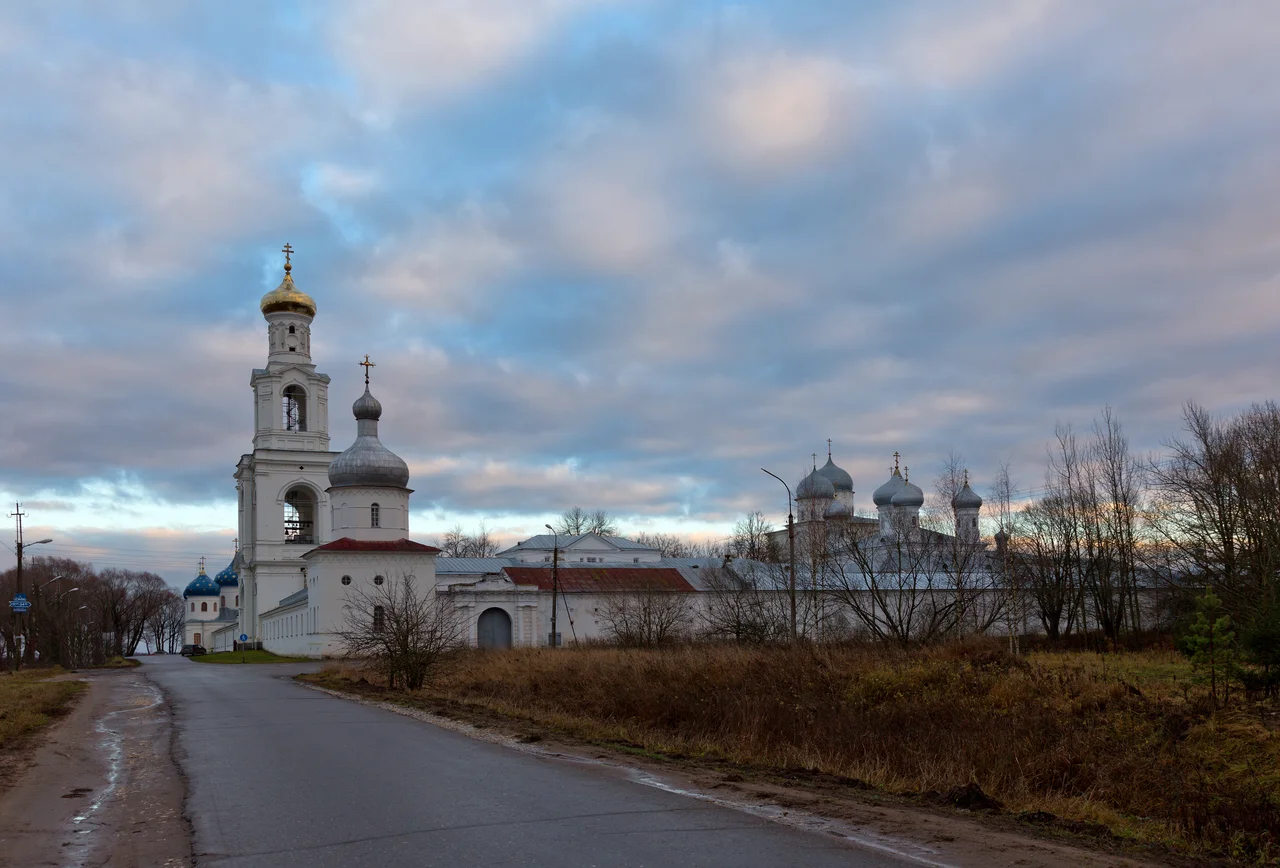

Yuriev Monastery
Stand on the left bank of the Volkhov five kilometers south of the Novgorod kremlin and the gold-domed gateway tower rises above the trees first, before the rest of the monastery comes into view. The river runs slow and broad here, just emerging from the wide silver mirror of Lake Ilmen. The white walls and the central Church of Saint George — 32 meters tall, with three silver domes instead of the usual five — have stood here for nearly a millennium. Russian Orthodox tradition cites Yuriev (the St. George Monastery) as the oldest monastery in Russia, founded around 1030 by Grand Prince Yaroslav the Wise, whose baptismal name was Georgy.
Yaroslav's Foundation
The first monastery, the chronicles say, was wooden — built around 1030 by Yaroslav the Wise, the Kievan grand prince who codified the Russkaya Pravda, the first Russian legal code, and married his daughters to half the kings of Europe. He named the new monastery for his own baptismal patron, Saint George, in the Russified form Yuriev. The first reliable historical reference comes a century later: in 1119, Prince Vsevolod Mstislavich of Novgorod and Pskov, together with the abbot Kyuriak (Kirik), commissioned the master builder Peter to raise the great stone Cathedral of Saint George. That building still stands. It is one of the largest churches in the Novgorod region — about 26 meters long and 23 meters wide, exceptionally tall, capped by its three silver domes. The original 12th-century frescoes are mostly lost; the church was repainted in 1902. But fragments of the medieval painting remain in the upper niches, including a Christ Pantocrator in the main dome and a full-length portrait of Vsevolod Mstislavich on the southwestern pier.
Burial Place of Princes
Yuriev served as a burial place for the princes of Novgorod across centuries. Two sons of Yaroslav the Wise — Izyaslav of Luki and Rostislav — were laid in the Cathedral of Saint George in 1198. In 1233, Prince Theodore of Novgorod, the elder brother of Alexander Nevsky, was buried here at the age of 13, having died on the eve of his wedding. His mother Theodosia followed him to the same church in 1244. Almost four centuries later, during the Ingrian War (1610-1617), Swedish soldiers occupying Novgorod desecrated the graves looking for valuables. According to the chronicle account, when they opened Theodore's tomb they found his body imperishable: 'they put him out of the grave and stood him leaned at the wall, he was like alive.' The discovery led to his canonization, and Saint Theodore of Novgorod is venerated locally to this day.
A Monastery, A Government
Yuriev was wealthy and powerful, and from the early 13th century its abbots held the senior monastic title of archimandrite — the only Novgorodian monastery to have one. In a time and place where monasteries were not just religious institutions but also major landowners, fortresses, prisons, and centers of political power, Yuriev mattered. The Novgorod elite blessed the choice of abbots, and there is some scholarly argument that the city's veche — its assembly — even had a hand in elections, though the evidence is thin. In 1337 a Novgorodian mob, more or less acting as a veche in this case, held the archimandrite Esif overnight in the Church of Saint Nicholas on the marketplace; the chronicle does not say how the crisis was resolved, but Esif was elevated to the Yuriev archimandrite position the next year. The monastery's frescoes carry portraits of Novgorodian archbishops including Feoktist, alongside the secular princes — a reminder that in medieval Novgorod the boundary between sacred and political authority was blurry, and Yuriev sat near its center.
The Photius Revival
By the late 18th century Yuriev had declined. Its revival came through a charismatic abbot, Photius of Novgorod (Petr Spasskiy, 1792-1838), who was unusually effective at attracting lay patronage. He persuaded Countess Anna Orlova-Chesmenskaya — the wealthy unmarried daughter of Catherine the Great's lover Alexei Orlov — to direct her enormous fortune toward the monastery. Together they built the Church of the Transfiguration, with its five domes, and both are buried inside it. The 18th-century Church of the Exaltation of the Cross with its five blue domes painted with gold stars stands in the monastery's northeastern corner. The tall gold-domed gateway tower visible from across the Volkhov dates from the same period of revival.
Closure, Occupation, Return
After 1917 the monastery was ravaged. Five of its six churches were destroyed or badly damaged by 1928. The community was dissolved in 1929. During the Second World War, German and Spanish Blue Division troops occupied the buildings during the long German occupation of the Novgorod region from August 1941 to January 1944, and the damage worsened. Soviet authorities used the surviving buildings as a prison, a holding camp for displaced persons, a school, and finally as a museum. In 1991, with the dissolution of the USSR, the monastery was returned to the Russian Orthodox Church. Restoration has continued since. The cathedral, the bell tower, the Church of the Transfiguration, and the gateway are restored; the western section, including a damaged church, remained in ruins as recently as the 2020s. Yuriev is part of the UNESCO World Heritage Site Historic Monuments of Novgorod and Surroundings, inscribed in 1992. From the cathedral platform on a clear summer evening, the gold of the Novgorod Kremlin's domes is visible across the meadows to the north.
From the Air
Located at 58.486°N, 31.285°E on the left bank of the Volkhov river, 5 km south of central Veliky Novgorod, near where the river emerges from Lake Ilmen. From altitude, look for the broad shallow lake, the river running north toward Lake Ladoga, and the white-walled monastery complex on the western bank. Veliky Novgorod's small Krechevitsy airport (ULLN) is approximately 15 km north. Saint Petersburg's Pulkovo (ULLI) is 175 km north.
Nearby Stories
- Novgorod Oblast 43 km away
- Valday Iversky Monastery 100 km away
- 1981 Pushkin Tu-104 Crash 108 km away
- Battle of Krasny Bor 111 km away
- Pskov Oblast 125 km away
- Catherine Palace 142 km away
- Pskov 169 km away
- Lonin Museum of Veps Ethnography 361 km away