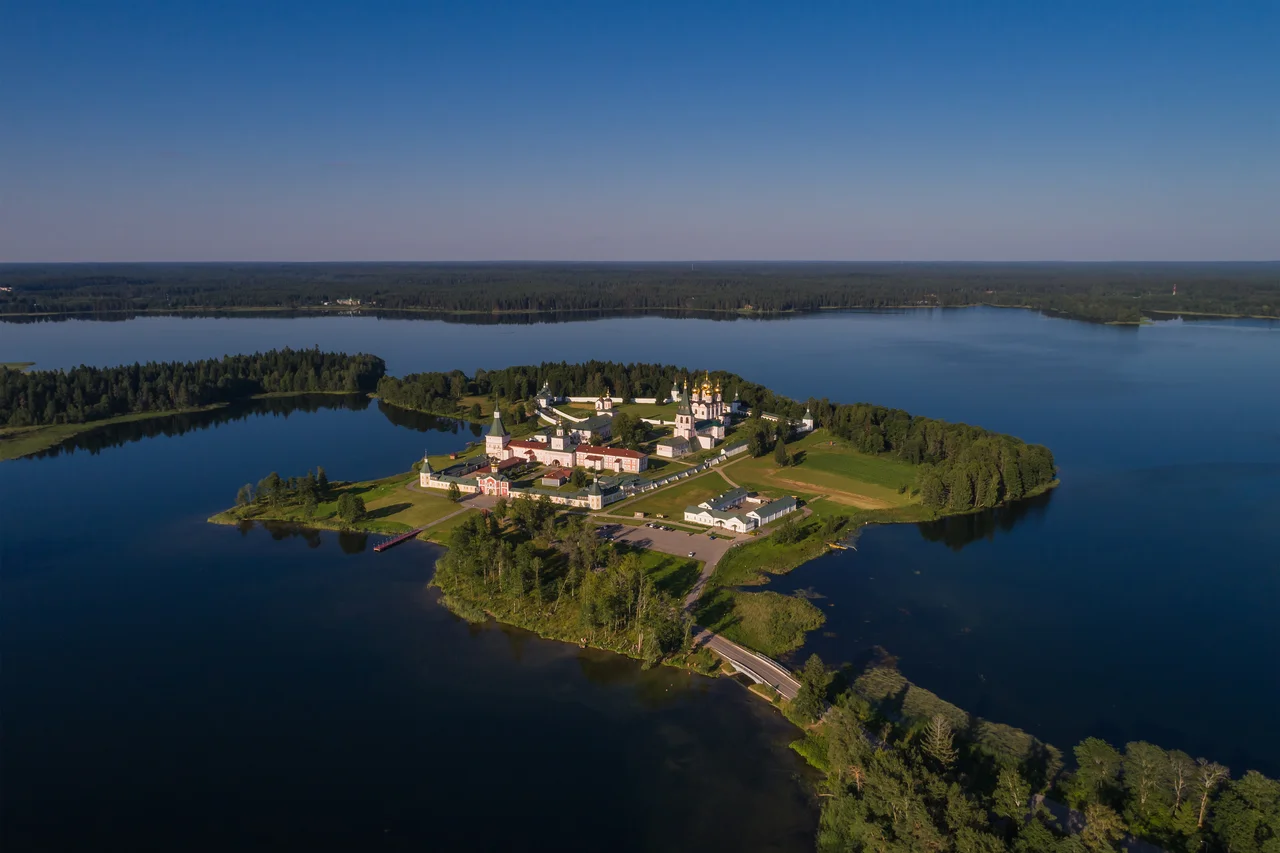

Valday Iversky Monastery
The lake is shallow and clear. Lake Valdayskoye sits at the height of land between the watersheds that flow north toward the Baltic and south toward the Volga, on the wooded plateau of the Valdai Hills, halfway between Moscow and Saint Petersburg. There is a small wooded island in its middle, called Selvitsky, and on that island in the spring of 1653 the Russian Patriarch Nikon ordered the felling of trees for two wooden churches. The Valday Iversky Monastery would within a few years become one of the wealthiest landowners in Russia, the second printing house in the country after the Moscow Print Yard, and the place where porcelain tile was made for the first time on Russian soil. None of which were the reasons the patriarch had picked the spot.
Why Iberia, Why Iviron
Nikon named his new monastery for the Iviron Monastery on Mount Athos in northeastern Greece — Iviron itself named for Iberia, the ancient Georgian kingdom whose monks founded it in the 10th century. The choice was deliberate. Nikon was a reformer, determined to align Russian Orthodox practice more closely with Greek originals, and an explicit invocation of Athos was part of his program. He commissioned a copy of the wonder-working icon of the Theotokos of Iviron — the Panagia Portaitissa, the Keeper of the Gate — to be sent from Mount Athos to Valday. That copy hung in the monastery's main church and was venerated until the 1920s, when it disappeared in the chaos of early Soviet anti-religious campaigns. Its fate is unknown.
Wealth, Books, and Tiles
Nikon was elected Patriarch of Moscow in 1652. The next year, he secured permission from Tsar Alexei Mikhailovich to found the monastery, and by autumn 1653 the first wooden churches stood on the island. In February 1654 the relics of Saint Iosif of Borovichi were transferred to Valday — a symbolic act linking the new foundation to the older sacred geography of the Russian north. That same year, the tsar granted the monastery all the lands around Lake Valdayskoye, including the villages of Valday, Borovichi, and Vyshny Volochyok. With one decree it became one of the largest landowners in the country. In 1655 the entire community of monks at the Orsha Kutein Monastery, in what is now Belarus, fled west under pressure on the Orthodox Church in Polish-ruled territory and resettled at Valday, bringing with them their printing press. The Valday press became the second in Russia, after Moscow, and printed liturgical books for distribution across the new patriarchate. The monastery also began producing glazed porcelain tile — a technical first in Russia — used to decorate its own churches and exported to Moscow.
Nikon's Fall
Nikon's reforms — corrections to the Russian liturgical books to bring them in line with Greek practice, even small changes such as crossing oneself with three fingers instead of two — provoked the lasting schism in Russian Orthodoxy known as the raskol. The Old Believers split off and were brutally persecuted for centuries. Nikon himself fell from favor, was deposed in 1666, and exiled. He died in 1681 on his way back from another exile to Moscow. Valday survived him, sustained by its enormous landholdings, and remained one of the wealthier monasteries of the Russian Empire through the 18th and 19th centuries. The cathedral church of Our Lady of the Iberian, with its characteristic central onion dome and four smaller cupolas, dates from this earlier period and stands today as the visual center of the complex.
The Soviet Century
After the 1917 revolution the monastery was closed. The icon disappeared. The buildings were used in turn as a prisoner-of-war camp, a hospital for tuberculosis patients, and a holiday camp for industrial workers. The cells became dormitories. The cathedral became, at various points, a warehouse and a museum. The bell tower lost its bells. In 1991, with the dissolution of the Soviet Union, the complex was returned to the Russian Orthodox Church. Restoration began under hegumen Stefan and continued through the 1990s and 2000s; the cathedral was reconsecrated, the bells eventually reinstalled, and a small monastic community reestablished. The current hegumen, Antony Bitmayev, has led the community since 2012.
Approaching by Water
Visitors today reach the island either by a causeway built in the 19th century or, in summer, by small ferry. The setting is striking — a forested island in a clear lake, ringed by birch and pine, with the white walls and blue domes of the monastery rising directly out of the water. In winter the lake freezes and pilgrims walk across the ice. In summer it fills with rowboats. The monastery functions: monks live, eat, and pray here on the schedule that has shaped Russian Orthodox monasticism for a thousand years, in a place that twice in its history — once under Nikon's printers and tilemakers, once under the Soviet authorities — was something else entirely.
From the Air
Located at 57.989°N, 33.304°E on Selvitsky Island in Lake Valdayskoye, in Novgorod Oblast roughly halfway between Moscow and Saint Petersburg. From altitude, identify the small wooded lake island with white walls and blue domes; Lake Valdayskoye is among several lakes scattered through the Valdai Hills. Saint Petersburg's Pulkovo Airport (ULLI) lies about 320 km north-northwest. The terrain is wooded uplands at roughly 200 m elevation.
Nearby Stories
- 2023 Wagner Group Plane Crash 23 km away
- Novgorod Oblast 33 km away
- Yuriev Monastery 104 km away
- Khutyn Monastery 116 km away
- Toropets Depot Explosions 141 km away
- Principality of Tver 154 km away
- Pskov Oblast 240 km away
- Krokhino, Vologda Oblast 322 km away