
Khutyn Monastery
Ivan III opened the tomb in 1471 expecting bones. The story goes that smoke and fire poured out instead. The grand prince of Moscow, the man who had just crushed the Novgorod Republic and was about to drag northern Russia under his rule, fled the monastery and the city of Novgorod altogether, leaving behind only his staff as a gift to the local monks. They displayed it in the sacristy for centuries afterward. Whether the smoke was real or pious legend, Khutyn Monastery has always been the kind of place where stories like that get told and remembered, a Russian Orthodox cloister 10 kilometers north-northeast of Novgorod where the medieval Novgorod Republic kept one of its holiest shrines.
A Boyar Becomes a Saint
Khutyn was founded in 1192 by a Novgorodian boyar named Oleksa Mikhailovich, who took the monastic name Varlaam and became the cloister's first hegumen. The transformation was complete enough that Russian nobility later traced family lines back to him, the Chelyadnins and the Pushkins among them. Alexander Pushkin himself, whose verse helped invent modern Russian literature, was descended from this 12th-century boyar who walked away from his fortune. The first church Varlaam built was consecrated by Archbishop Gavril of Novgorod the year Varlaam died, 1193. He was buried inside it, to the right of the altar, where his relics rest today. Varlaam was canonized as patron saint of Novgorod, his cult spreading along the river trade routes that made the medieval republic wealthy.
The Tsars Build, the Tsars Visit
Vasily III, son of the Ivan who fled, ordered the original church demolished and replaced with something grander. The new Cathedral of the Transfiguration was completed by 1515, a six-pillared edifice patterned after the Assumption Cathedral in Rostov. It was the first piece of Muscovite architecture in the Russian North-West, and a model that smaller churches across the region would copy for generations. Vasily's son Ivan IV, the one history calls the Terrible, paid for the refectory and the Church of Saint Varlaam in 1552. The neoclassical belltower came later, during Catherine the Great's reign in the late 18th century, a different aesthetic layered onto the medieval bones. Each ruler left a stone signature, and the monastery accumulated centuries the way old churches do.
Derzhavin's Grave
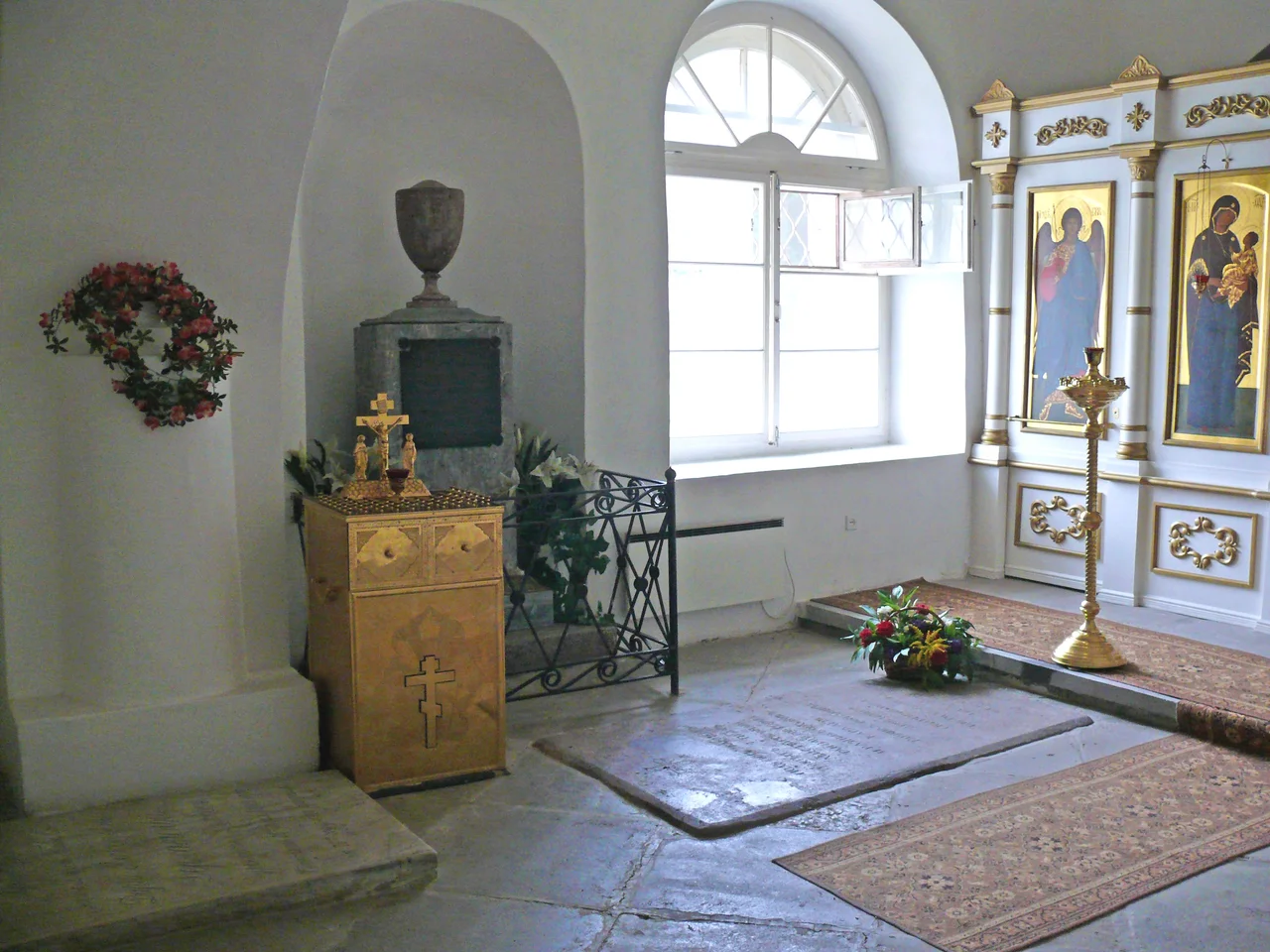
An annex was added to the cathedral in 1646, dedicated to Saint Gabriel. It later got a different name. In 1816 the poet Gavrila Derzhavin was buried in it, and the chapel has been called the Derzhavin annex ever since. Derzhavin had served Catherine the Great as governor and senator while writing odes that helped invent modern Russian poetry, and he was Pushkin's literary godfather, the older poet who blessed the younger one at his lyceum exam. To bury Derzhavin in the same monastery that produced Pushkin's distant ancestor was the kind of literary symmetry Russians have always loved. Pilgrims today still seek out the chapel, the grave a small piece of Russian literary geography hidden inside a working monastery.
An Asylum, Then a Hostel
When the Bolsheviks closed the monasteries in the 1920s, Khutyn was emptied of its monks and turned into a lunatic asylum. Later it became a vacation home and hostel for visitors to the area. The Cathedral of the Transfiguration still stood, the Derzhavin annex still stood, but the function had been ripped out and replaced. This was one of the more typical Soviet fates for a working monastery, less violent than demolition but harder on the daily life of the place. Archbishop Aleksei Simansky had served as Archbishop of Khutyn from 1926 to 1932 while the monastery was being dismantled around him; he later became Patriarch Aleksei I of Moscow and All Rus from 1945 until his death in 1970, having survived a system that destroyed many of his peers. Khutyn was returned to the church in 1993.
Now a Convent
For most of its eight centuries Khutyn was a male monastery. Today it houses a women's convent, the bells still ringing across the right bank of the Volkhov, the Cathedral of the Transfiguration still holding Varlaam's relics. The Volkhov flows north out of Lake Ilmen toward Lake Ladoga, and along its banks the medieval Novgorod Republic built one of the most distinctive cultures in early Russia, oriented as much toward the Hanseatic trading world as toward Moscow. Khutyn outlasted the republic, outlasted the empire, outlasted the Soviet Union. The white walls and the green roofs of its central cathedral have been the same color for centuries. From the river the monastery still appears as it would have to a 14th-century pilgrim arriving by boat from Novgorod, the silhouette unchanged enough that you could mistake the year.
From the Air
Khutyn Monastery sits at 58.587 degrees north, 31.395 degrees east, on the right bank of the Volkhov River about 10 km north-northeast of Veliky Novgorod. From altitude, look for the white-walled monastic compound with the green-domed Transfiguration Cathedral set among trees on a slight rise above the meandering river. Veliky Novgorod Airport (ULNN) lies roughly 15 km southwest. Best viewed at 1,500 to 3,000 feet on a clear day, with the river arc as a navigation reference.
Nearby Stories
- Battle of Shelon 20 km away
- Novgorod Oblast 31 km away
- Valday Iversky Monastery 87 km away
- Battle of Krasny Bor 90 km away
- 1981 Pushkin Tu-104 Crash 109 km away
- Catherine Palace 125 km away
- 2023 Wagner Group Plane Crash 162 km away
- Lonin Museum of Veps Ethnography 333 km away