.jpg)
Battle of Krasny Bor
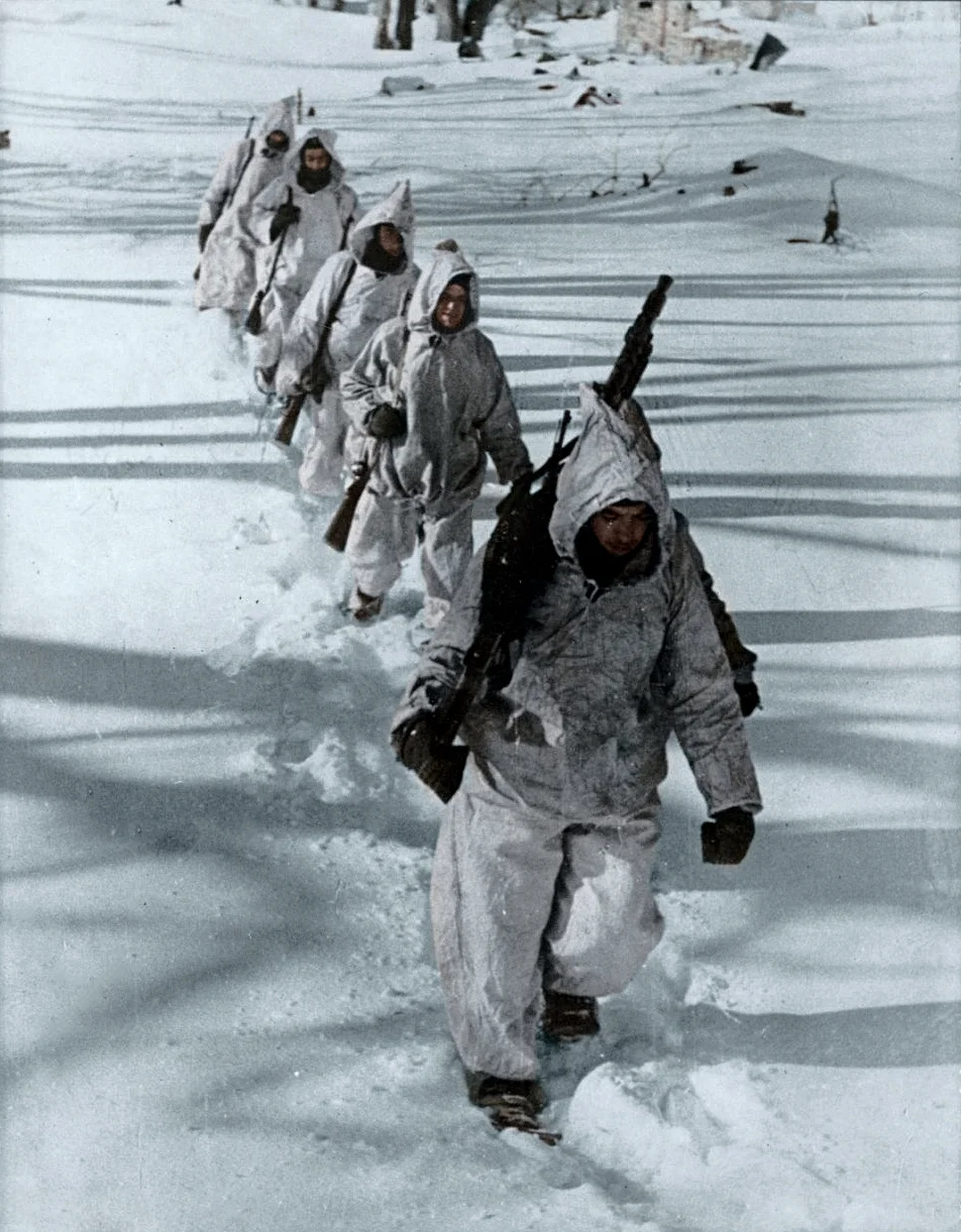
At precisely 6:45 on the morning of 10 February 1943, a thousand Soviet guns and mortars opened fire along the eastern flank of Army Group North, south of Leningrad. The shelling came down on the trenches and dugouts of the 250th Infantry Division of the Wehrmacht — better known by the color of its old uniform tunics, the Spanish Blue Division. Forty-nine hundred Spanish volunteers, dispatched by Franco's regime to fight Bolshevism on someone else's frozen plain, were buried in their bunkers under a two-hour bombardment. Then the artillery shifted onto the village of Krasny Bor itself, and 33,000 Soviet soldiers of the 55th Army began walking forward through the snow.
Why Spanish soldiers were dying outside Leningrad
The Blue Division — División Española de Voluntarios in Spanish, 250. Infanterie-Division on Wehrmacht rolls — was the strangest formation on the Eastern Front. Spain was officially neutral in the Second World War. Franco, who owed Hitler and Mussolini his victory in the Spanish Civil War but feared the cost of full alliance, had threaded a political needle: he would send volunteers to fight the Soviets, framing the war against the USSR as a continuation of his own anti-Communist crusade, while keeping Spain itself out of the war against the Western Allies. Roughly 47,000 Spaniards rotated through the division between 1941 and 1944. They wore German uniforms with a small Spanish shield on the sleeve. They fought in the long siege lines south of Leningrad. By February 1943, after eighteen months in the line, they were holding a quiet sector that the Soviet high command had decided would no longer be quiet.
Operation Polar Star
Three weeks earlier, on 18 January 1943, Operation Iskra — Spark — had cracked open a narrow corridor into besieged Leningrad. After eighteen months of starvation in the city, supplies began moving along a rail line built through the gap. Georgy Zhukov, promoted to marshal of the Soviet Union the same day, immediately planned something more ambitious. Operation Polyarnaya Zvezda — Polar Star — would not just lift the siege. It would destroy the entire German Army Group North in a vast double encirclement, with the Northwestern Front collapsing the Demyansk salient in the south while the Leningrad and Volkhov Fronts linked up behind the German 18th Army at Tosno. The 55th Army's job was to break the Leningrad-Moscow highway, and the pivot point of the whole operation was a small town called Krasny Bor that sat between the highway and the railway line. The Spanish division held the eastern side of that pivot.
Two hours of shelling, then the wave
Pinned in their bunkers by the artillery, many of the Spanish forward positions were physically unable to retreat when the bombardment lifted. The 63rd Guards Rifle Division and the 45th Guards Rifle Division came forward with tanks, advancing on Staraia Mysa, Krasny Bor, Raikelevo, and Podolvo. The Blue Division had a battle motto — Sin posible relevo, hasta exterminio, no relief possible until extinction — and on the morning of 10 February, in many positions, that is what happened. Spanish formations fought from collapsed trenches until they were overrun. Major General Emilio Esteban Infantes, the divisional commander, watched his front line disintegrate from a command post at Raikelevo that the Soviet artillery had targeted directly. The frontline was gone in a few hours. The Spanish division took roughly seventy percent casualties — somewhere between 3,200 and 3,800 men killed, wounded, missing, or captured in a single day, the worst losses any Spanish formation had suffered since the Civil War.
Why the Soviet attack stalled
The shocking thing, from the Soviet perspective, was that the offensive failed anyway. By the second day, the German 4th SS Police Division was moving up to plug the gap. Battle groups from the 11th, 21st, 212th, 215th, and 227th Infantry Divisions were pulled in. By 13 February the Soviet 55th Army had advanced perhaps four to five kilometers, taken horrendous casualties of its own — somewhere on the order of ten thousand killed and wounded — and gone over to the defensive. Tosno was not reached. The pincer never closed. Operation Polar Star, the great operation that was supposed to destroy Army Group North, ground to a halt. The siege of Leningrad would not be fully lifted until January 1944, almost a year later. The dead of Krasny Bor, Spanish and Russian alike, achieved very little except buying time.
What the soldiers were fighting for
It is worth saying clearly what the Blue Division was: a unit fighting alongside the Wehrmacht, in a war of conquest and racial extermination, against a country that had not attacked Spain. The Spanish volunteers were not innocents. But many of them were also young men who had been told, by a regime that had survived a civil war by lying about almost everything, that they were defending Christian Europe against Bolshevism. They died at Krasny Bor in temperatures below minus twenty Celsius, in trenches they had not chosen, eight thousand kilometers from Madrid. The Soviet Guardsmen who killed them were also mostly young, also conscripted, also far from home. After Krasny Bor, Franco quietly began pulling the division back to Spain, partly under Allied pressure, partly because he could see which way the war was going. By October 1943, the Blue Division had been officially dissolved. The pine forest where it was destroyed is now a quiet outer suburb of Saint Petersburg.
From the Air
Krasny Bor lies at 59.68°N, 30.67°E — about 25 kilometers south-southeast of central Saint Petersburg, in Tosnensky District of Leningrad Oblast, just east of the modern M10 Moscow highway and rail line. From cruising altitude in clear weather the Neva delta and the broad geography of the Leningrad-Moscow corridor dominate the view. The 1943 battlefield is now suburban forest and farmland. Nearest major airport is Saint Petersburg Pulkovo (ULLI), about 25 kilometers northwest. Helsinki-Vantaa (EFHK) lies roughly 280 nautical miles to the west-northwest.
Nearby Stories
- Levashovo Memorial Cemetery 17 km away
- Constantine Palace 22 km away
- Memorial to the Victims of Political Repression (Saint Petersburg) 22 km away
- Khutyn Monastery 92 km away
- Yam Fortress 93 km away
- Siege of Novgorod (1170) 101 km away
- Novgorod Oblast 152 km away
- Battle of Kollaa 238 km away