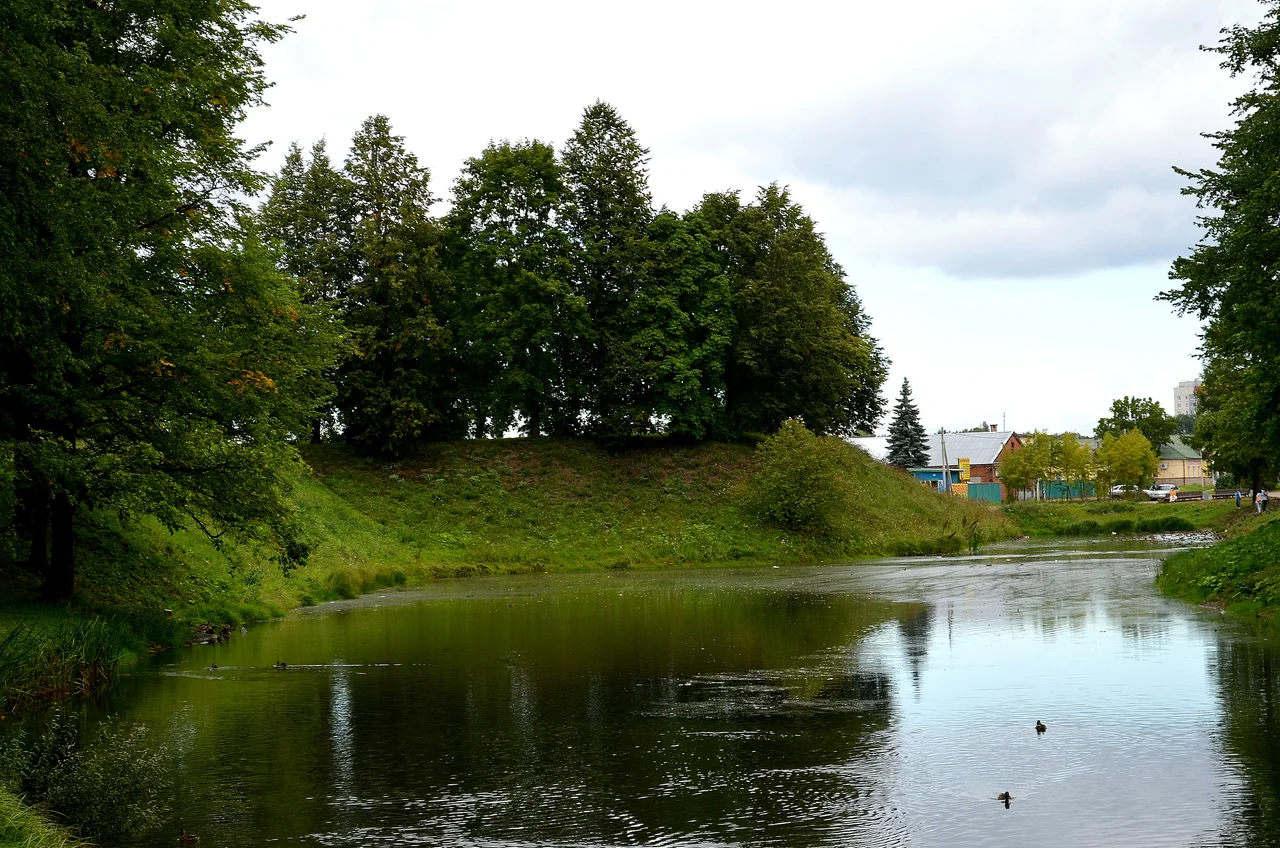

Yam Fortress
It was built in 33 days. The chronicles record this as a remarkable fact — that in the summer of 1384, a Novgorodian boyar named Ivan Fyodorovich, with a party of nobles and assistants, raised a stone fortress on a steep bend of the Luga river in just over a month. The work was important enough that 'all the nobles of Novgorod' were said to have taken part. The fortress they built was called Yam, then Yamgorod, then Yamburg, and finally — when the Soviets renamed the surrounding town for the Estonian Bolshevik Viktor Kingisepp in 1922 — the place around it became Kingisepp. The fortress itself fell into ruin centuries earlier. Today only earthworks, a moat now turned ornamental pond, and fragments of limestone wall remain in what locals call the Summer Garden.
Why the Bend in the River
Yam was built where the Luga makes a sharp bend, at the intersection of the river route from Novgorod toward the Baltic and a land road from Novgorod to its outpost at Koporye. The Novgorod Republic was Russia's great medieval merchant democracy, ruled by an elected veche and dependent on its grip over the rivers and portages between the Baltic and the Volga. The western frontier was the dangerous one. To the west and north lay Sweden; to the southwest, the German crusading orders that had built Turaida and Riga. Yam was meant to slow them. It worked: in 1395 a Swedish assault was beaten back by the garrison under Prince Konstantin. In 1397 the Livonian Knights raided the surrounding villages but did not attempt the walls. The pattern repeated through the 15th century, with serious sieges in 1443, 1444, and 1447, all repulsed. The 1444 siege ended with a cannon duel in which the Livonian Order's Prussian bombard was destroyed; the 1447 siege lasted 13 days before Novgorod reinforcements arrived with artillery and broke it.
Trapezoid With Four Round Towers
The original fortress was trapezoidal, with its long base facing the river. Walls of fitted limestone up to 4.5 meters thick rose on a high steep bank, surrounded by water on every side: the Luga to the west, deep moats on the north, east, and south. Four round towers stood at the corners, with three additional square towers in the middle of three walls — providing the crossfire that medieval siegecraft required. A separate inner stronghold, the detinets, occupied the southwest corner, with its own gate and a drawbridge over a pit at the entrance. The 17.5-meter gate passage held three successive doors. By 1449 the fortress had been damaged enough by Livonian sieges, and made obsolete enough by gunpowder, that the Archbishop of Novgorod ordered it disassembled and a new modern fortress built immediately on the same spot — designed for cannon, with thicker walls and more bastions.
Three Centuries of Changing Hands
When Moscow absorbed the Novgorod Republic in 1478, Yam continued as a frontier post. Ivan III ordered a new fortress built nearby in 1492, just across the river from Swedish-then-Estonian Narva — that became Ivangorod, today still a Russian border post. With Ivangorod taking over the front-line role, Yam was demoted but kept garrisoned. Then came the Livonian War. In September 1581, the Swedish field marshal Pontus De la Gardie captured Yam after the surrounding Russian fortresses had already fallen. Russia recaptured it in 1590 after a three-day siege. The Treaty of Tyavzino in 1595 returned Yam to Russia. The Time of Troubles brought the Swedes back in 1612, and the Treaty of Stolbovo in 1617 gave Sweden Yam — now called Yamburg — for almost a century. In 1658 a Russian assault broke into the outer fortress but could not take the detinets. Swedish engineers in 1681 surveyed Yamburg's walls and recommended demolition; in 1682, 40 barrels of gunpowder destroyed most of what remained. Peter the Great recaptured the site in 1703, in the early phase of the Great Northern War, and finished construction of a new bastion fortress that fall.
From Border Post to Town Park
After Peter pushed the Russian border far to the west — taking Narva, taking Tartu (then Derpt), taking Reval (now Tallinn) — Yamburg lost any military reason for existing. Through the 18th century the fortress decayed. Catherine the Great upgraded the surrounding settlement to a city in 1764, ordering the new town laid out on a regular plan; most of the old fortress buildings were demolished to make room. In 1762 the architect Antonio Rinaldi reused stone from the detinets walls to build St. Catherine's Church in the new town. In 1781, Catherine II personally passed through Yamburg on her way from Saint Petersburg to Reval, looked at the ruined detinets, and ordered it completely destroyed. By the late 18th century even the bastions were being torn up to provide foundations for a chintz factory. By the 19th century the fortress site had become a town park.
What Remains
The 1971 archaeological excavation under Anatoly Kirpichnikov, working from the Leningrad branch of the Institute of Archaeology, established the dimensions and history of the medieval fortress against detailed Swedish plans drawn in 1680 and held in the Royal Military Archive in Stockholm. The dig confirmed the trapezoid plan, located the foundations of an apse-and-four-column church inside the detinets dating to the 14th century, and recovered Russian and Swedish military artifacts — many now in the Kingisepp local history museum. The site was designated a cultural heritage site in 1974. Today, walk the Summer Garden in central Kingisepp and you can trace the moats as ornamental ponds, see fragments of fitted limestone wall poking through the sod near the Luga's bank, and understand why the Novgorodians spent 33 days in the summer of 1384 building exactly here.
From the Air
Located at 59.377°N, 28.595°E on the eastern bank of the Luga river in the town of Kingisepp, Leningrad Oblast, Russia — about 130 km west of Saint Petersburg and 25 km east of the Estonian border. From altitude, identify by the Luga river bend with the town immediately east; the fortress site is the central park area near the river. Saint Petersburg Pulkovo (ULLI) is the nearest major airport, 145 km east.
Nearby Stories
- Ingrian War 8.3 km away
- Battle of Kronstadt 63 km away
- English Palace 73 km away
- Battle of Suursaari 82 km away
- Battle on the Ice 99 km away
- Battle of Wesenberg (1268) 101 km away
- Battle of Shelon 133 km away
- Song Celebration Museum 134 km away