
English Palace
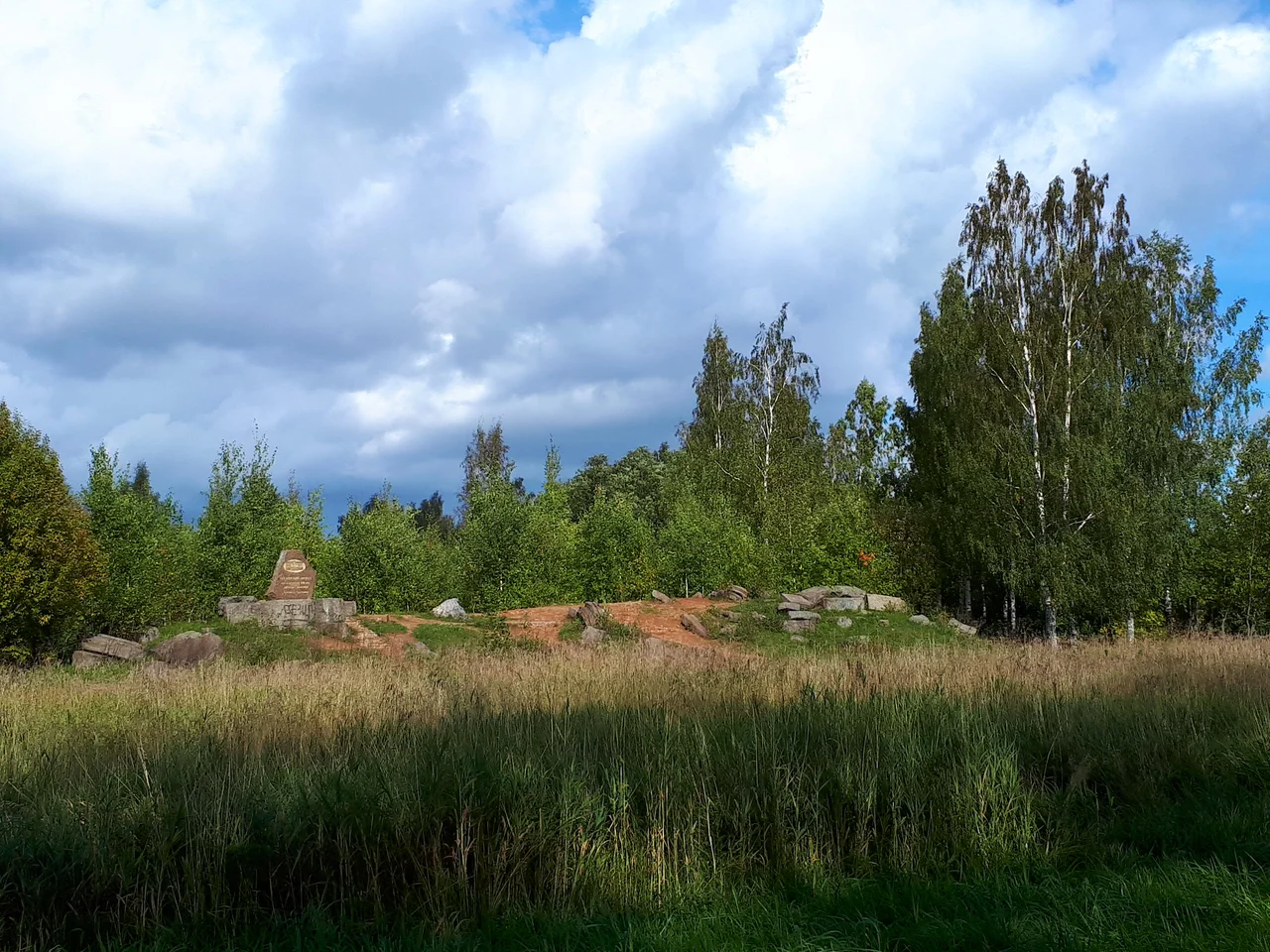
There is a granite staircase in the English Park at Peterhof that leads up to nothing. A Corinthian portico used to stand at the top of it. Behind the portico stretched a precise rectangular palace with an eight-column pediment, white walls, and a granite-clad ground story. Catherine the Great commissioned the building from a young Italian architect named Giacomo Quarenghi in 1781 and lived to see it nearly finished in 1796. It was Quarenghi's first major commission in Russia and the building that established his Palladian neoclassicism as the dominant Petersburg style for the next forty years. In 1942 the Wehrmacht turned it into a forward observation post on the Leningrad front and shelled it heavily. After the war the Soviet government decided not to rebuild and finished the job with dynamite. A monument now stands on the basement foundations.
Quarenghi's First Russian Job
Giacomo Quarenghi arrived in Saint Petersburg in 1779, recommended to Catherine by her agents in Italy. He was thirty-five years old and had spent his apprenticeship studying Andrea Palladio's villas in the Veneto. Catherine wanted a refuge from court life, somewhere she could read and write and walk in a private garden. The site she chose was a piece of low ground at the southern edge of the Peterhof palace complex, far from the famous gilded fountains and the noise of the imperial summer routine. For the design Quarenghi looked to two English models: Prior Park, the Bath country house John Wood the Elder had built for Ralph Allen in the 1730s, and Wanstead House, the Palladian seat in Essex that Colen Campbell had documented in his Vitruvius Britannicus. The English Palace took its inspiration from both. Construction began in 1781 and dragged on for fifteen years. Granite blocks for the foundations had to be barged across the shallow Peterhof harbor, the design changed several times, and funds were repeatedly diverted to Catherine's war with Turkey. The palace was finally completed in 1796, the year Catherine died.
The Refuge That Was Not One
Catherine had imagined the English Palace as a quiet retreat. She got little use from it. After her death the throne passed to her son Paul I, who had detested his mother in life and made a point of dismantling her favorite projects in death. Paul converted the English Palace into army barracks, just as he had done with the Catherine Palace in Moscow. It was a deliberate insult, made worse by his choice to install enlisted men in rooms his mother had decorated for solitude. Paul was assassinated in 1801. His son Alexander I, who had loved his grandmother, restored the palace. Quarenghi himself supervised the renovation between 1802 and 1805, completing the interior decoration in classical style. From then until the start of the First World War, the palace served as a guesthouse for foreign diplomats and high-ranking guests attending the summer receptions at the main Peterhof palace. It also served as an art gallery, with a collection that focused on portraits of European monarchs. Public events were occasionally held there. The pianist and composer Anton Rubinstein gave a concert in the palace on July 14, 1885.
An English Garden Around an English House
The garden surrounding the palace was as much a part of Quarenghi's vision as the building itself. Designed in the English landscape style that had taken over European garden taste in the 1770s, it rejected the geometric parterres and clipped hedges of the French baroque tradition Peter the Great had imported to the main Peterhof complex. Instead, winding paths, irregular ponds, and informally placed groves were meant to look as if they had grown that way naturally. The Scottish gardener James Meader, who had worked at Wanstead House and other English Palladian estates, was brought to Russia to lay out the grounds. He wrote letters home complaining about the climate, the workers, and the impossibility of getting English garden tools imported through Russian customs. The English Park survives today, mostly intact, even though the palace at its center does not. The artificial pond Meader designed is still there. So are the bridges. Walking the paths, you can sometimes see the geometric outline of where the palace stood.
1942
After the Russian Revolution in 1917 the palace was nationalized and converted into a sanatorium. It functioned in that capacity through the 1920s and 1930s. Then the German army arrived. The Siege of Leningrad began in September 1941 and the front line stabilized just south of the city, with Peterhof and its palaces inside the German-held arc. The English Palace, sitting on slightly elevated ground at the southern edge of the Peterhof complex, was a useful artillery observation post for the Wehrmacht. Soviet artillery began counter-shelling. The palace was destroyed in 1942, the masonry shell standing roofless among the trees. After the war the Soviet government had to decide which Peterhof buildings to restore and which to abandon. The main Peterhof palace was given priority. The English Palace was not. The decision was made to demolish the ruins entirely. Engineers placed dynamite charges in what remained of the walls and brought them down. The cellars and basement of the palace have been partially preserved. A small monument has been placed on the foundations to mark what was lost.
What Quarenghi Built Anyway
Even without the English Palace standing, Quarenghi's mark on Saint Petersburg is everywhere. He built the Smolny Institute on the Neva, where the first Russian school for noble girls was established and where Lenin would later run the October Revolution from a borrowed office. He built the Hermitage Theatre adjoining the Winter Palace, where the imperial family watched plays. He built the Alexander Palace at Tsarskoye Selo, where Nicholas II spent his last years before his arrest. The English Palace was the building where he found his Russian voice. The strict rectangular plan, the granite ground story, the portico of Corinthian columns rising directly from the staircase: these became Quarenghi's signature, repeated in different proportions across his subsequent commissions. Stand on the granite staircase in the English Park today, where the columns once rose, and you are standing at the source of an architectural language that shaped the look of imperial Saint Petersburg from 1780 to the end of the Romanov dynasty.
From the Air
The English Palace ruins and the surviving English Park are at 59.881°N, 29.882°E, in the southern section of the Peterhof palace and park complex about 30 km west of central Saint Petersburg. From the air, look for the geometric layouts of the Lower Park along the Gulf of Finland coast and follow inland; the English Park is the wilder, more naturalistic park to the south of the main Peterhof palace. Pulkovo (ULLI) is about 28 km southeast. Recommended viewing altitude 2,000 to 3,500 ft AGL. The palace site itself is now just a clearing with a small monument and is best identified in winter when the bare trees reveal the ground plan, or in early spring before leaves obscure the foundation outline.
Nearby Stories
- Russian Railway Museum 6.8 km away
- Yam Fortress 41 km away
- Battle for Narva Bridgehead 76 km away
- Ivangorod Fortress 88 km away
- Battle of Fredrikshamn 119 km away
- Khutyn Monastery 130 km away
- Battle of Svensksund (1789) 154 km away
- Battle of Kollaa 239 km away