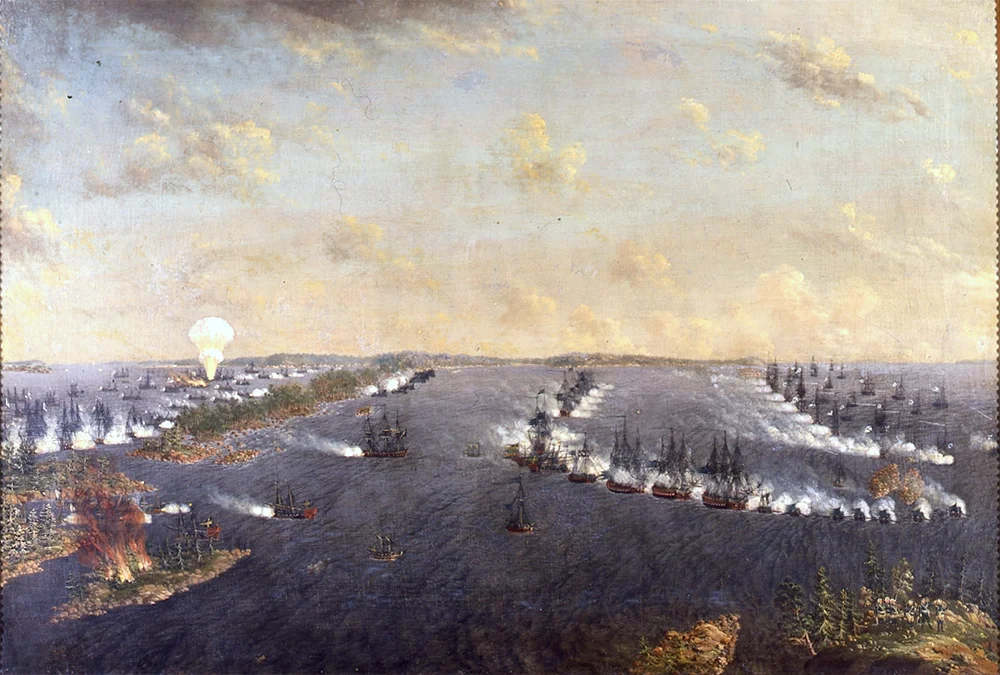
Battle of Svensksund (1789)
The Swedes thought the channel was too shallow to use. On 24 August 1789, in the maze of granite islets off the modern Finnish city of Kotka, a Russian galley squadron under the Italian-born commander Giulio Litta proved them wrong. He took his small, flat-bottomed warships through the unblockaded narrows between Tiutinen and Koiromsari and broke through the Swedish line of scuttled blockship hulks from behind. By nightfall the Swedish archipelago fleet was burning its own transports to prevent capture and limping westward toward the safety of Svartholm fortress.
Two Fleets, Two Designs
The First Battle of Svensksund — known to Russians as the First Battle of Rochensalm, after the Finnish word for the strait, Ruotsinsalmi — was a fight unique to the Baltic. The water here is too shallow and too rocky for ships of the line. Both sides built specialized 'archipelago fleets' for it: shallow-draft frigates with strange names like turuma, hemmema, udema, and pojoma; gun sloops and mortar longboats; oared galleys descended directly from those of ancient Greece. King Gustav III's Sweden fielded one light frigate, a handful of these archipelago frigates, twenty gun sloops and a scattering of galleys, with about five thousand men. Catherine the Great's Russia brought a much larger force — a frigate, eight xebecs, eighteen galleys, twenty-nine half-galleys, and supporting ships totaling around twelve thousand men, with a separate squadron of three frigates and other ships under Ivan Balle in support.
The Blockade That Wasn't
The Swedish commander, Carl August Ehrensvärd, had a sound plan but a bad king. He wanted to scuttle ships across the narrow passages between the islands, sealing the channels through which Russian forces could approach. On 23 August, his crews began sinking blockships in the choke points. They missed one. Ehrensvärd judged the strait between Tiutinen and Koiromsari too shallow to navigate — a small mistake that would cost a fleet. King Gustav III had also overruled key parts of the plan, refusing to let Ehrensvärd withdraw to Svartholm fortress after dealing with Balle's squadron, even though everyone aboard the Swedish flagships knew their ships were running low on ammunition for the longer fight that was coming.
Six Hours and Then Disaster
The action began at ten in the morning on the 24th. The first phase, against Balle's supporting squadron coming up from the south, went well for the Swedes — six hours of artillery duel, three Russian ships captured, others badly damaged, the southern attack beaten back. Then, at four in the afternoon, the rest of the Russian coastal fleet arrived from the east. Litta's galleys threaded the supposedly unnavigable strait. Suddenly the carefully scuttled blockships meant nothing; Russian crews could clear the rest of the obstacles from the safe side. Swedish ships defending the line were forced to fall back. The turuma Sällan Värre ran aground while fighting and was captured. Enrique MacDonell's hemmema Oden, coming to her aid, was taken too. Captain Ehrensvärd's own flagship, the turuma Björn Järnsida, ran aground and struck her colors only after fighting nearly to the last man. The frigate af Trolle and the turuma Ragvald followed her into Russian hands.
What the Swedes Lost
The final tally was brutal. Three turuma archipelago frigates, one hemmema, one light frigate, a galley, a half-galley, a schooner, nine gun sloops, and thirty transports and auxiliaries — gone, captured, or burned by their own crews north of Kotka island to keep them out of Russian hands. Roughly fifteen hundred Swedes were killed, wounded, or captured, with another five hundred sick men in a hastily formed field hospital, too unwell to evacuate. Russian losses were astonishingly light by comparison: one galley and one gun sloop blown up, 383 dead, 628 wounded, 22 captured. The ships Balle had lost early were all recovered. The shallow channel that Ehrensvärd had not blocked was, by every honest measure, the single deciding factor of the day.
A Year Later, the Same Strait
The story does not end there — and that is what makes Svensksund unusual in naval history. Almost exactly one year later, on 9 and 10 July 1790, the Russian and Swedish fleets met again in nearly the same waters. That second battle, the Second Battle of Svensksund, became the largest naval engagement ever fought in the Baltic Sea and Sweden's greatest naval victory of all time. King Gustav III, in personal command, destroyed roughly a third of the Russian fleet and saved Sweden from a disastrous peace. The two battles together — defeat in 1789, triumph in 1790 — turned this stretch of skerry-strewn coast off modern Kotka into one of the most concentrated patches of naval history in northern Europe. Today the seabed here is a protected marine archaeological zone, with the wrecks of dozens of warships from both navies still lying among the rocks where they sank.
From the Air
60.45°N, 26.99°E, just off the south coast of Finland near the city of Kotka in the Kymenlaakso region. The battlefield is a maze of small forested granite islands and narrow channels — visually striking from above. Cruise at 5,000–10,000 ft for the best view of the skerries. Nearest major airports are Helsinki Vantaa (EFHK) about 110 km west, Lappeenranta (EFLP) about 80 km north, and Saint Petersburg Pulkovo (ULLI) about 220 km east. The Maritime Centre Vellamo museum on Kotka's waterfront has exhibits on both Svensksund battles and the wrecks below.
Nearby Stories
- Battle of Hogland 2.6 km away
- Svartholm fortress 3.8 km away
- Battle of Lahti 54 km away
- Battle of Wesenberg (1268) 85 km away
- Battle for Narva Bridgehead 93 km away
- Battle of Kronstadt 107 km away
- Hakoinen Castle 128 km away
- Kerimaki Church 173 km away