
Battle of Lahti
Tens of thousands of people were walking east. They were soldiers, and the wives of soldiers, and the children of soldiers, and people who had just happened to live in the wrong factory district of the wrong town when the Reds lost the Battle of Tampere on 6 April 1918. They were heading toward the Russian border, hoping to reach Soviet Petrograd before the Whites and the Germans caught them. The road ran through Lahti — a small Finnish railway town of 6,500 people on the Riihimäki–Saint Petersburg line, the only practical eastern route. On 19 April, a German column under Colonel Otto von Brandenstein got there first.
A country tearing itself apart
The Finnish Civil War had begun three months earlier, in January 1918, in the wreckage of an empire. Finland had been a Russian Grand Duchy until the October Revolution; with imperial authority gone, the country had declared independence in December 1917 and immediately split. The Whites — Finland's conservative establishment, the rural farmers, the army officer corps, supported eventually by Imperial Germany — wanted a bourgeois nation-state. The Reds — the urban working class, the trade unions, the social democrats radicalized by the Russian example — wanted a workers' republic. Both sides were Finnish. Both believed they were defending Finland from the other. By April, Tampere had fallen to the Whites in the bloodiest urban battle in Nordic history, and the Red front was collapsing across southern Finland. People who had voted social democrat, or whose husbands had served in a Red Guard, knew what came next. They began to walk.
The German intervention
The Imperial German Baltic Sea Division had landed at Hanko on 3 April 1918, sent at the request of the White government and with longer-term German strategic motives in the closing months of the First World War. After capturing Helsinki in mid-April, the Germans pushed north toward Riihimäki and Hämeenlinna, cutting off direct retreat routes. A second German formation, Detachment Brandenstein, landed at Loviisa on 12 April. The original orders were to take the Red stronghold at Kotka and cut the Saint Petersburg railway at Kouvola further east. For reasons that remain unclear, Brandenstein turned north to Lahti instead. The Reds were caught completely by surprise — they had known the Germans were coming but seem to have failed in their reconnaissance. By the evening of 20 April, the Germans held Lahti. The eastern escape route was closed.
The counterattack and the surrender
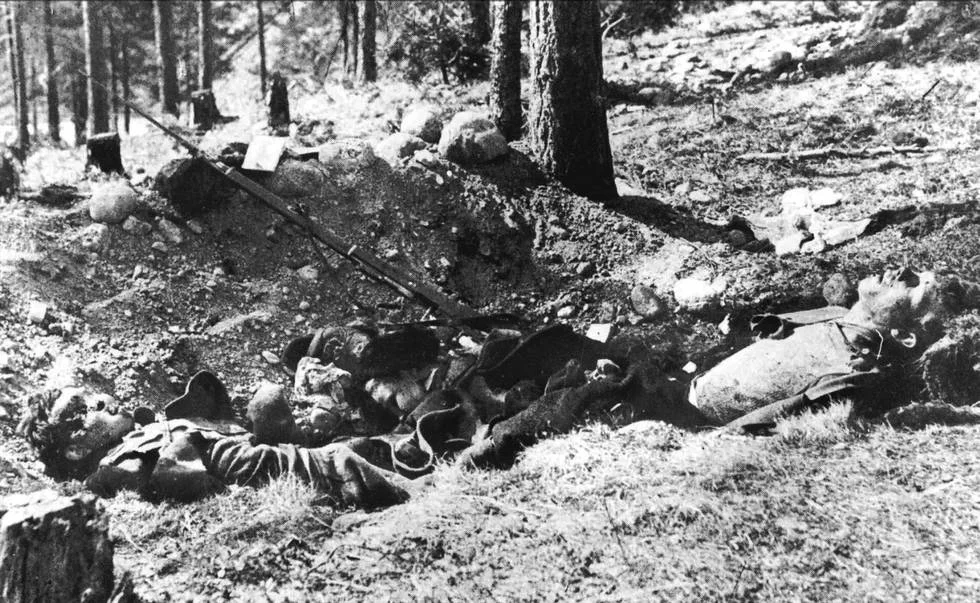
About 40,000 Reds were trapped between Hämeenlinna, Riihimäki, and Lahti — a triangle perhaps fifty kilometers on a side, surrounded on three sides by White and German forces. On 22 April, the Reds launched a counterattack at Lahti, trying to break through Brandenstein's lines and clear the railway for the refugee column behind them. The attack failed. They tried again. By 1 May, with their ammunition exhausted and their position untenable, the Reds surrendered. About 30,000 fighters and family members fell into White and German hands. They were marched into the fields of the Fellman Manor on the edge of Lahti, where 22,000 of them — soldiers and civilians, men, women, and children — were held in an open-air enclosure that became known as the Fellman camp. More went to the old Hennala Garrison, built by the Russians a few years earlier.
What happened at Hennala
What happened next was the dark heart of the Finnish Civil War. More than five hundred captured Reds at Lahti were executed in the weeks that followed, most of them killed by a Finnish battalion commanded by an Estonian colonel named Hans Kalm. Among those killed at Hennala were more than two hundred women, including girls as young as fourteen — many of them shot for nothing more specific than working in a Red Guard kitchen, being the wife of a Red soldier, or wearing their hair short in what was taken as a sign of revolutionary sympathies. The Germans, who had taken the town and shot perhaps twenty or thirty Reds during the actual fighting, did not participate in the executions. There are records of German officers trying to stop the Whites from killing prisoners. Across the country, the camps killed about 12,500 Reds in 1918 — most from disease and starvation, thousands from execution. The civil war as a whole killed roughly 36,000 Finns, around one percent of the population, and left wounds that would shape Finnish politics for generations.
The trenches in the ski hills
Lahti recovered. In the decades after the war, the town grew into a regional center and a winter sports capital, hosting the Nordic World Ski Championships seven times. The Salpausselkä ridge that the Reds had defended became a famous ski-jumping venue. And along that ridge, in the pine forest above the modern jumps, the trenches and shell craters from April 1918 are still visible — preserved by the Finnish National Board of Antiquities as a heritage site, except for a stretch accidentally destroyed in 2015 when new ski trails were widened for the 2017 World Championships. Hennala Garrison was decommissioned in 2014. The barracks where the women were shot now house apartments, businesses, a museum. Finland chose, over the long century after 1918, to remember this honestly — to call the camps what they were, to publish the names of the dead, to acknowledge that the new nation had begun by killing its own people. The reconciliation has been imperfect, as reconciliations always are. But the memory has not been buried.
From the Air
Lahti sits at 60.98°N, 25.65°E, about 100 kilometers north-northeast of Helsinki on the Salpausselkä esker ridge. The 1918 battle area now includes the Lahti ski stadium, the Fellman park (site of the wartime camp), and the former Hennala Garrison. From cruising altitude in clear weather Lake Vesijärvi just north of Lahti is a prominent landmark. Nearest major airport is Helsinki-Vantaa (EFHK), about 75 nautical miles south-southwest. Lappeenranta (EFLP) lies about 90 nautical miles east. Tampere (EFTP) is about 75 nautical miles to the west.
Nearby Stories
- Hakoinen Castle 21 km away
- Svartholm fortress 33 km away
- Battle of Pälkäne 42 km away
- National Museum of Finland 52 km away
- Uspenski Cathedral 60 km away
- Battle of Svensksund (1789) 74 km away
- Hervanta 93 km away
- Kerimaki Church 192 km away