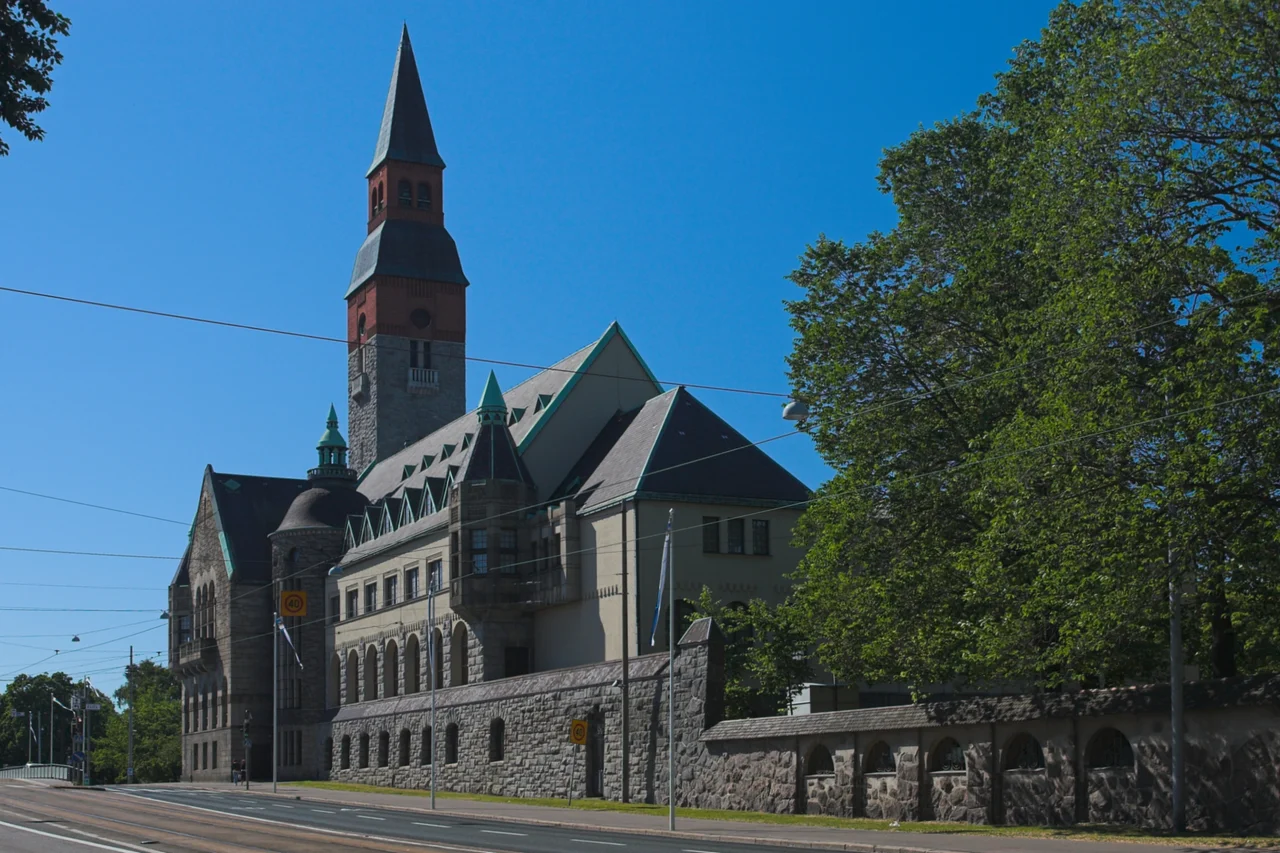

National Museum of Finland
Three architects in their twenties drew up the design that became the National Museum of Finland. Eliel Saarinen, Hermann Gesellius, and Armas Lindgren had only just opened their joint office when they won the competition in 1902. They were building a national museum for a country that was not yet a country, a Grand Duchy of the Russian Empire that would not declare independence until 1917, and they made it look like every Finnish medieval church and castle melted together: dark Finnish granite, a tall stone tower, dragon ornaments, owls and bears worked into the masonry. Construction ran from 1905 to 1910. The museum opened in 1916. A year later Finland was a country, and the building had been a kind of architectural prophecy.
National Romanticism in Stone
The National Romantic style did for Finnish architecture what Sibelius was doing for Finnish music: it took a culture under foreign rule and gave it monumental form. Gesellius, Lindgren, Saarinen looked at the medieval stone churches of Finland and the surviving wooden castles and worked their motifs into a building that felt rooted in the country's deep past, even while inside the rooms tipped into Art Nouveau elegance. Saarinen would go on to design the Helsinki Central railway station, then leave for America in 1923 and become one of the founders of modern American architecture; his son Eero would design the Gateway Arch in St. Louis and the TWA terminal at JFK. The museum on Mannerheimintie was the project where the future began for all of them.
From Stone Age to the Present
Inside, the museum walked visitors through Finnish history from the Stone Age forward, organized into prehistory, the Middle Ages, the Swedish Kingdom period, the Russian Empire era, and Finnish folk culture. The Elk's Head of Huittinen, an eight to nine thousand year old stone sculpture carved by Finland's first inhabitants, is the kind of object that anchors the long view: someone made this when the ice was still leaving Scandinavia. Coins, medals, decorations, silver, jewelry, and weapons fill specialist galleries. The folk culture displays show life in the Finnish countryside before industrialization, kitchens and tools and textiles from a peasant world that survived almost into living memory. Renamed the Finnish National Museum after independence in 1917, the institution has been one of the country's primary self-portraits ever since.
Mesa Verde in Helsinki
One of the museum's strangest collections is Native American. In 1891 the Swedish-speaking Finn Gustaf Nordenskiöld, son of the Arctic explorer Adolf Erik Nordenskiöld, traveled to Mesa Verde in Colorado and excavated the Ancestral Puebloan cliff dwellings. He was arrested by US authorities, who recognized the cultural significance of what he was taking but had no legal framework to stop him; he was released and shipped his finds back to Europe. They became the largest collection of Mesa Verde material outside the United States and one of the largest collections of Native American items outside the Americas. In 2019 the museum agreed to repatriate a portion of the collection to representatives of the Pueblo peoples, returning ancestral remains and sacred objects, while keeping about 600 items for continued exhibition. It is the kind of restitution that should have happened decades earlier.
Methane in the Silver Room
On January 23, 2006, an explosion ripped through the museum's Silver Room. Methane gas had leaked from a pipe under nearby Museokatu, seeped into the drainage system through a dried floor drain, and accumulated in a broom cupboard until a spark from the cleaning closet's power distribution cabinet ignited it. Most display cases and 49 of the more than 200 silver objects were damaged. Nobody was hurt. All the objects were repaired the same year, and the Silver Room reopened in early 2007. Today the museum is closed for a renovation and expansion that was supposed to finish in 2027. The current Finnish government's budget cuts to the Heritage Agency, however, have postponed the reopening indefinitely. The granite fortress on Mannerheimintie waits, its tower still rising over the city it was built to define.
From the Air
The National Museum of Finland stands at 60.175 N, 24.932 E on Mannerheimintie 34 in central Helsinki, immediately north of the Eduskuntatalo (Parliament House) and across from Finlandia Hall. The museum's National Romantic granite mass with its tall stone tower is a clear feature against the surrounding cityscape. Nearest airport is Helsinki-Vantaa (EFHK), 18 km north. Recommended viewing altitude 1,500-3,500 ft over central Helsinki; observe Finnish urban airspace regulations.
Nearby Stories
- Karkali Strict Nature Reserve 26 km away
- SuperShe Island 30 km away
- Liesjärvi National Park 32 km away
- Hakoinen Castle 47 km away
- Tallinn TV Tower 53 km away
- Svartholm fortress 58 km away
- Battle of Lahti 60 km away
- Battle of Wesenberg (1268) 88 km away