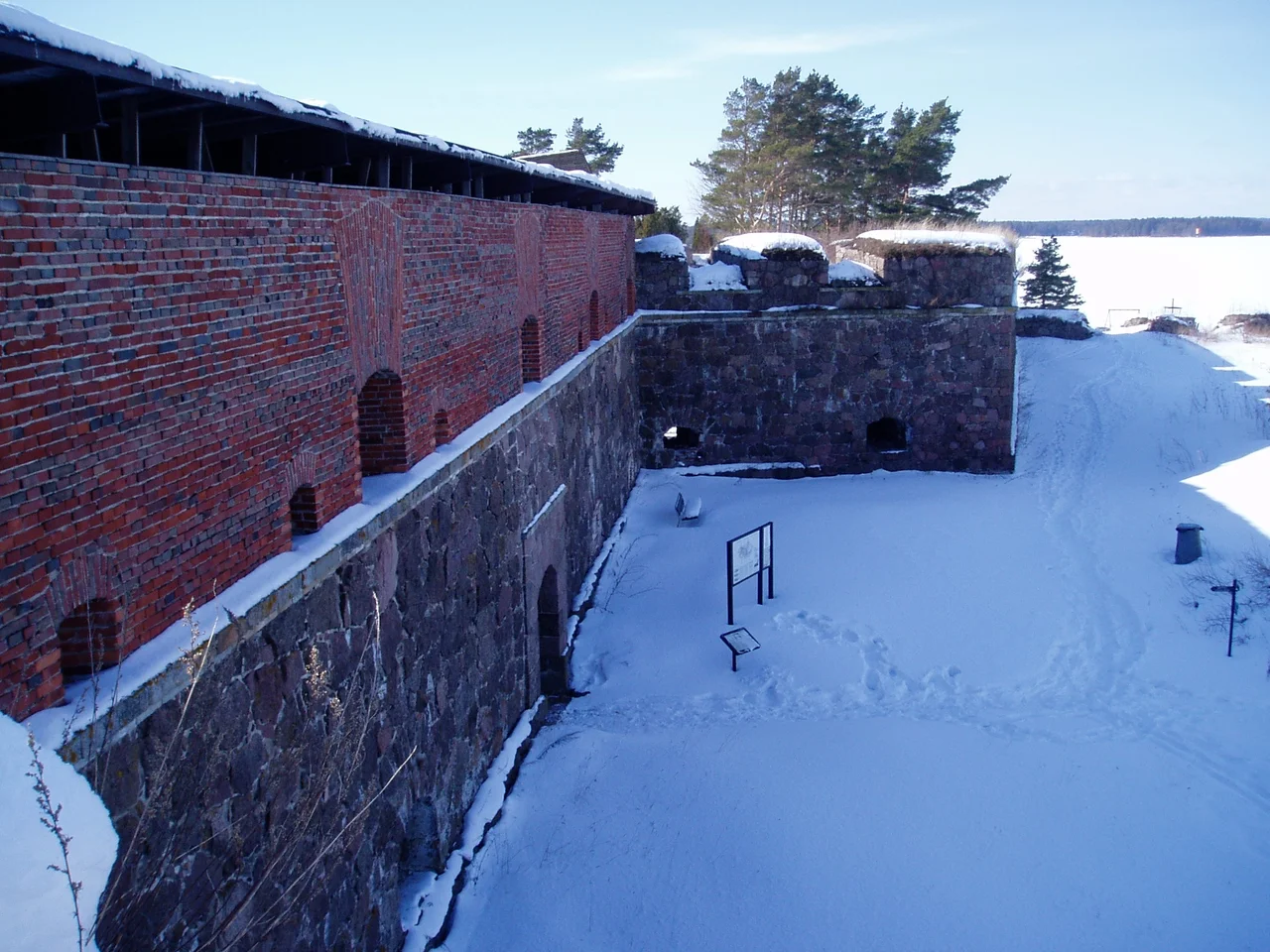

Svartholm fortress
Augustin Ehrensvard had a problem. Sweden had just lost two wars to Russia in thirty years and now had to defend the long Finnish coast against an enemy that had already proven it could march wherever it pleased. His answer was a chain of stone fortresses: the great seaward bastion of Sveaborg outside Helsinki, and a smaller cousin sixty miles east, sitting on a tiny island at the mouth of the Bay of Loviisa. They called it Svartholm, the Black Island. Construction started in 1748. Sixty years later it surrendered to the Russians without firing more than a token defiance, and the slow ruin has been a Finnish summer destination ever since.
Six Thousand Men with Shovels
By 1750 more than 6,000 Swedish soldiers were at work on Sveaborg and Svartholm, a staggering construction effort that consumed over half the army Sweden had stationed in Finland. Ehrensvard, a brilliant artillery officer turned engineer, designed both, then handed daily supervision of the Loviisa works first to Captain Clansenstierna and from 1751 to Lieutenant Colonel Fabian Casimir Wrede, who had around 2,000 men at his disposal. King Adolf Frederick visited the site in 1751, and in his honor the nearby town of Degerby was renamed Lovisa after his queen, Louisa Ulrika of Prussia. The Seven Years' War interrupted construction, then the death of Ehrensvard in 1772 slowed it again, and by 1788, when war with Russia returned, the main fort of Svartholm was complete but the outer breastworks were not. Of the six bastions planned for Loviisa town itself, only two ever rose. Sveaborg got the resources and the glory; Svartholm got what was left.
The Garrison That Did Not Want to Fight
By 1808, when the Finnish War broke out and Russia invaded Sweden's Finnish provinces, Svartholm was a tired, half-finished fortress with serious problems. It had 86 guns and 8 mortars on paper, but most of the gun carriages had rotted; some guns had never had carriages at all. Drinking water was short because several wells were unusable. Food and ammunition stocks were inadequate. The 700-man garrison was poorly trained, badly disciplined, and only one in three could be issued a working firearm. Captain Carl Gustaf von Schoultz, the original commander, was relieved on 15 February by Major Carl Magnus Gripenberg, who was respected by neither his superiors nor his men. The Russians crossed the border on 21 February 1808 and invested Svartholm the next day. Bombardment revealed another design flaw: the firing slits were so narrow that only 8 of the fortress's guns could actually be aimed at the besieging Russian positions. A sixth of the garrison was sick. Officers feared a mutiny. On 14 March, three days into a brief truce that was supposed to extend much longer, Gripenberg surrendered. The fortress and all its weapons changed hands intact; the mostly Finnish garrison was simply dismissed and sent home.
Traitor and Amnesty
Like several other Swedish officers who lost Finland in 1808-1809, Gripenberg took service with the Russians after surrendering. Sweden labeled him a traitor and a Stockholm court sentenced him to death in absentia. A general amnesty interrupted the proceedings before any execution could be carried out, and Gripenberg lived out his life in Russian service. The strategic logic of Svartholm collapsed the moment Finland became Russian territory; the fort it was built to keep enemies out of was now an interior position, and the enemy was Sweden, three days' sail across the Baltic. The Russians used it as a minor naval station and as a prison for Finnish convicts. It mattered to almost nobody.
The British Came and Blew It Up
On 7 July 1855, in the middle of the Crimean War's almost-forgotten Baltic theater, two British steam frigates appeared off Svartholm. HMS Arrogant and HMS Magicienne, under Captain Hastings Yelverton, expected resistance. They got an evacuation. The Russians simply abandoned the fortress, taking the guns with them, and Yelverton landed parties to demolish what remained. The British engineers blew up the casemates, breached the curtain walls, and sailed off having added one more set of ruins to the world. Large parts of the granite-and-brick structure were too solid to destroy completely, and over the following century Svartholm settled into a second life as a picnic destination for Loviisa families who rowed out for the day. In the 1960s the Finnish National Board of Antiquities began a slow restoration program, finally completed in 1998. Today you can walk through the partially reconstructed northern casemate, see the bastion called Nordenskiold and the sharp stone edge of bastion Rook, and stand in the inner yard where 700 men once waited to find out what their commander would decide.
From Above
From the air, Svartholm looks like a star or a four-pointed crown sitting on its own little patch of land in the bay. The bastioned walls rise almost directly from the water, with deeper Baltic only a few meters from the masonry. Loviisa town lies at the head of the bay to the north, the Gulf of Finland opening south. In summer the surrounding water dotted with sailboats; in winter the bay freezes hard enough to walk on. The fort's geometry is pure Vauban-school engineering, and seen from above the regular angles of bastions and tenailles still tell you everything you need to know about how 18th-century fortification was supposed to work.
From the Air
Svartholm fortress sits on a small island at 60.38 N, 26.30 E, in the mouth of the Bay of Loviisa on Finland's southern coast. View from 2,000-4,000 feet to take in the star-shaped fortifications. Helsinki Vantaa (EFHK) is 80 km west. Tallinn (EETN) is 80 km south across the Gulf of Finland. Best in clear summer weather; winter sea ice and Baltic fog can obscure the island.
Nearby Stories
- Battle of Hogland 12 km away
- Battle of Svensksund (1789) 17 km away
- Battle of Lahti 38 km away
- Battle of Suursaari 44 km away
- Uspenski Cathedral 45 km away
- Tallinn TV Tower 84 km away
- Hakoinen Castle 91 km away
- Kerimaki Church 197 km away