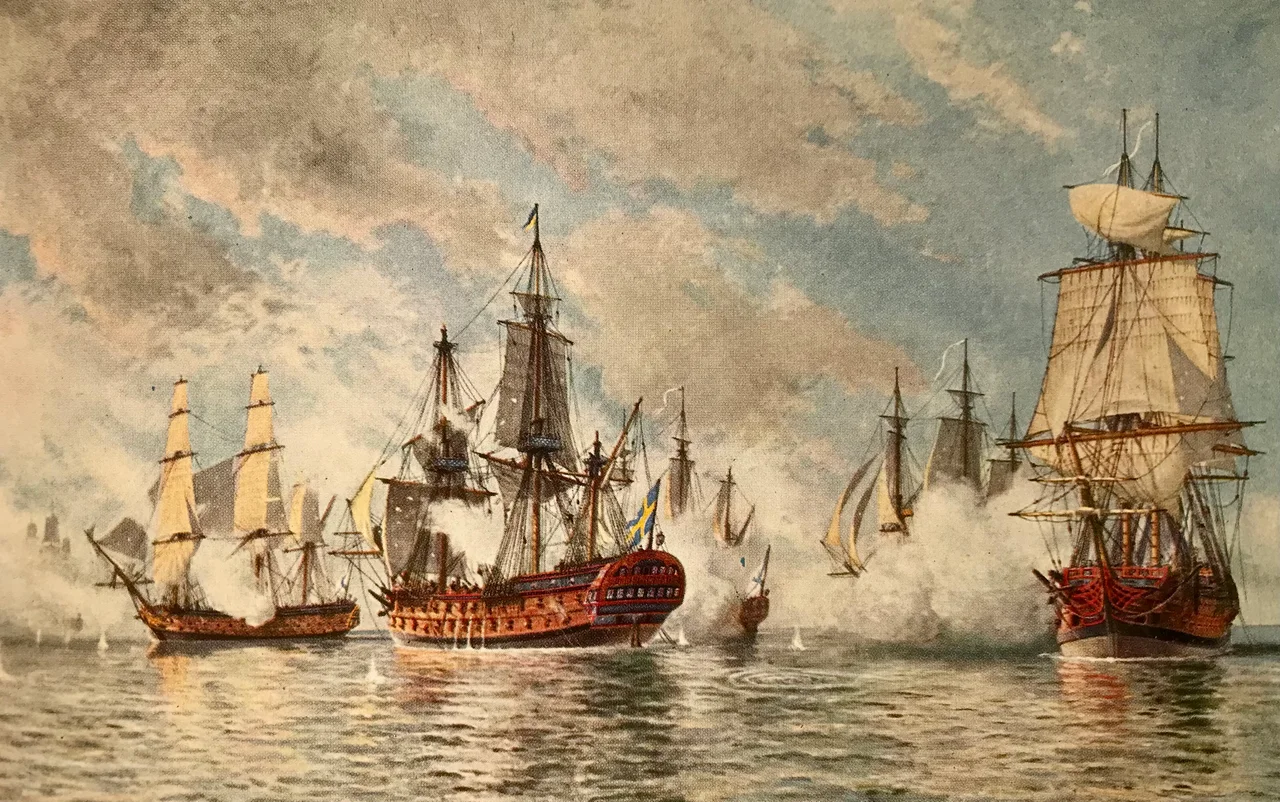

Battle of Hogland
The wind died at the worst possible moment. By late afternoon on 17 July 1788, the Swedish and Russian battle fleets had finally drawn close enough to fire on each other off the rocky island of Hogland in the eastern Gulf of Finland — and at exactly that moment the breeze that had carried them there abandoned them. Sailors hauled at oars in longboats to drag two-thousand-ton ships of the line into firing position. Gunpowder smoke that had nowhere to go hung between the hulls in a thickening fog, hiding ships from their own squadrons. For five hours the two fleets battered each other in this strange, slow ballet, neither able to maneuver, neither able to break off, until darkness and exhausted magazines ended the day.
An empire's gamble for Saint Petersburg
Gustav III of Sweden had concocted a plan that was either brilliant or reckless, depending on whether it worked. With Russia distracted by war against the Ottomans, Sweden would strike directly at the empress Catherine the Great in her capital. One Swedish army would push through Finland, a second would follow the coast with the archipelago flotilla, and a third would sail with the main battlefleet to land at Oranienbaum and march on Saint Petersburg itself. The whole scheme rested on one condition: the Russian Baltic Fleet had to be either destroyed or trapped in its bases at Reval (now Tallinn) and Kronstadt. If Sweden's twelve ships of the line under Prince Charles, Duke of Södermanland — the king's brother — could break Russian sea power in the Gulf of Finland, the road to the capital would lie open. So in early July, fifteen Swedish ships of the line and five frigates sailed deeper into the gulf hunting the Russian fleet.
Greig's hastily-trained fleet
On the Russian side, Admiral Samuel Greig — a Scotsman who had risen to flag rank in the service of the empress — faced a problem few admirals would envy. His seventeen ships of the line were freshly manned with crews who had never been to sea. As the fleet drifted in light winds near the island of Bolshoi Tyuters, Greig drilled them in everything he could squeeze into a few days: gunnery, sail handling, signal recognition. When the two fleets finally sighted each other on the morning of 17 July, his sailors were still strangers to their guns and their ships. They were about to learn under fire.
Five hours in the smoke
The Swedish lead ship Hedvig Elisabeth Charlotta opened the action at five in the afternoon. Within the hour, the wind died entirely. The Swedish flagship Gustaf III drew the attention of the Russian flagship and two consorts, taking such damage to her rigging that she began drifting helplessly, her vulnerable stern swinging toward the Russian guns. Far down the line, the seventy-four-gun Vladislav had drifted into the Swedish formation after losing her own rigging, and after a brutal close-range exchange with two Swedish ships she struck her colors. By eight in the evening, in the deepening twilight and the smoke that would not clear, the Swedish ship Prins Gustaf — commanded by Vice-Admiral Gustav Wachtmeister — found herself alone, surrounded by four Russian ships of the line, her companions invisible somewhere in the haze. She fought on for two hours before surrendering at ten o'clock. Both navies had captured exactly one ship of the line from each other, an outcome unusual enough to be remembered.
The cost and the consequence
Between 319 and 580 Russian sailors died. Two to three hundred Swedes were killed. Greig's ships had taken the worse beating — eight Russian ships of the line were severely damaged, four so badly they had to be towed — but the Swedish fleet had run nearly empty of heavy cannon shot and could not stay to finish the job. They sailed for Sveaborg, the great fortress off Helsinki, expecting resupply, only to discover that the magazines there had been stocked for the smaller archipelago fleet, not for ships of the line. They were stranded. Worse followed: prisoners taken from the Vladislav had carried relapsing fever, and the disease swept through the Swedish crews at anchor. The strategic verdict was unambiguous. Greig had not won the gunnery duel, but he had stopped the Swedish landing at Oranienbaum cold. Saint Petersburg was safe. The dream of marching on the capital died at Hogland in five hours of smoke and stillness.
The shape of a war
The 1788 campaign had exposed the Swedish navy's brittle logistics and the Russian fleet's raw but improving readiness. The war ground on for two more years across the Baltic, producing larger and bloodier battles — Reval, Vyborg Bay, Svensksund — before the Treaty of Värälä restored the prewar borders in August 1790. Hogland's specific tactical lesson, that fleets becalmed in narrow waters become floating gun platforms more than maneuvering ships, would matter less in the age of steam to come. But its strategic lesson was older and would never go out of date: in war, sometimes a tie is a victory, depending on what you needed the day to do.
From the Air
The battle was fought west of the island of Hogland (Russian: Gogland) in the eastern Gulf of Finland, near 60.11°N, 26.94°E. The island sits roughly 35 nautical miles south of the Finnish coast and 110 nautical miles west of Saint Petersburg. From cruising altitude on a clear day the wooded ridge of Hogland is visible from well over fifty miles. Nearest major airports: Helsinki-Vantaa (EFHK) about 100 nautical miles to the west-northwest, and Saint Petersburg Pulkovo (ULLI) about 110 nautical miles to the east. Aircraft transiting the gulf at FL300+ get a clear top-down view of the entire 1788 battle area in good visibility.
Nearby Stories
- Svartholm fortress 10 km away
- Battle of Svensksund (1789) 18 km away
- Battle of Wesenberg (1268) 46 km away
- Battle for Narva Bridgehead 61 km away
- Military Museum of Finland 78 km away
- Ivangorod Fortress 85 km away
- Yam Fortress 105 km away
- Kerimaki Church 206 km away