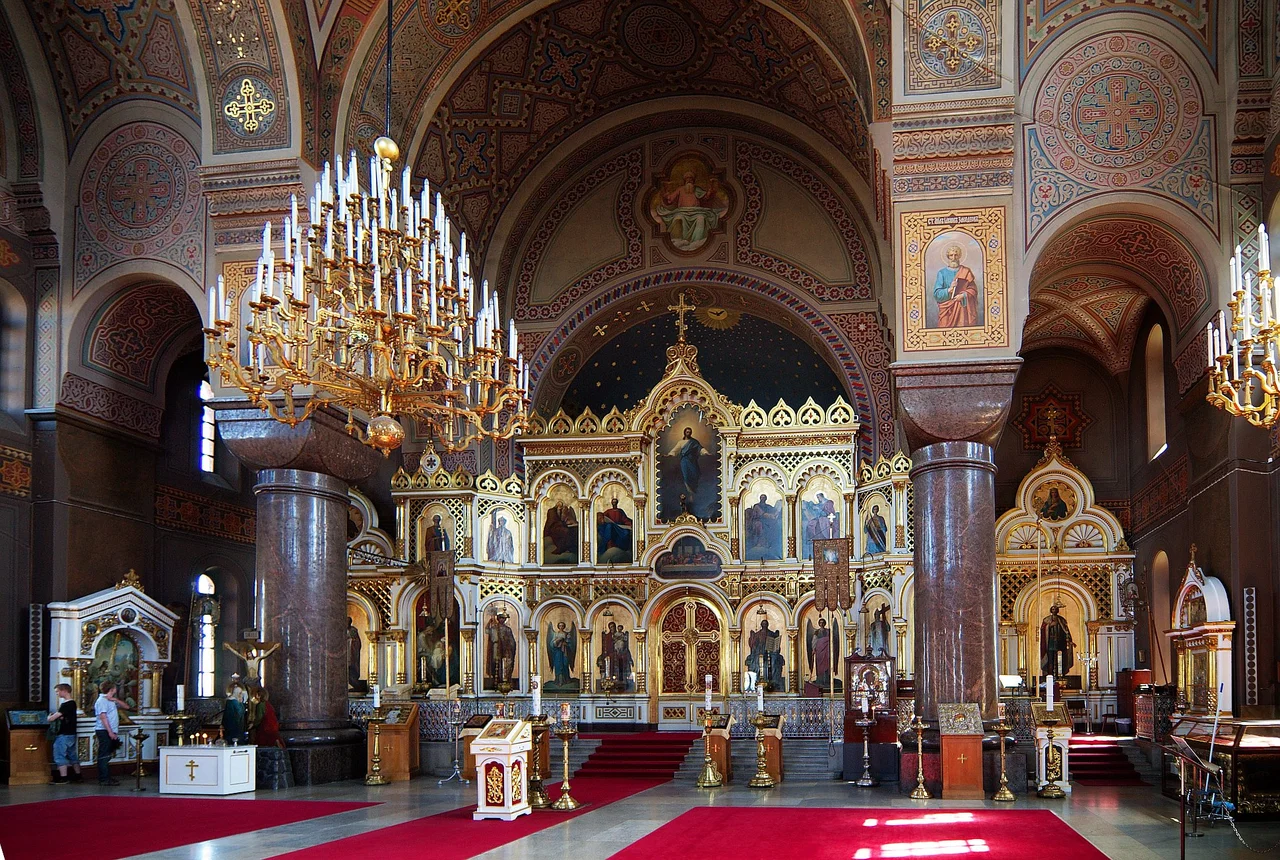

Uspenski Cathedral
The bricks once belonged to a fortress that no longer exists. After Bomarsund Fortress in the Åland Islands fell to a British and French naval expedition in August 1854 during the Crimean War, the victors blew up what they had captured to keep it from being rebuilt. The Russians, still nominally in possession of the rubble, salvaged what they could. About 700,000 of those reused Bomarsund bricks were floated by barge across the northern Baltic to Helsinki and laid up, between 1862 and 1868, into the walls of a cathedral on the rocky knob at the eastern end of the city. From the harbor today, the building rises in dark red over the gulls and the ferry terminals, golden onion domes catching the low northern light: Uspenski Cathedral, the largest Orthodox church in Western Europe.
An Imperial Decision in 1814
Helsinki had been the capital of the Grand Duchy of Finland for only two years when Tsar Alexander I, in 1814, decreed that 15 percent of the salt import tax would go into a fund to build two new churches in the new capital — one Lutheran for the majority population, one Orthodox for the growing Russian-speaking minority. The Lutheran one became the great white-domed Helsinki Cathedral that crowns Senate Square, finished in 1852. The Orthodox project waited longer. The architect Aleksey Gornostayev designed it in a Russian Revival style — onion domes, kokoshnik gables, brick body, polished granite columns — and submitted his plans before his death in 1862. The building was raised on the Katajanokka peninsula, on a rocky outcrop above the harbor, between 1862 and 1868. Most of the funding came from parishioners and private donations, in addition to the salt-tax fund.
The Crypt Chapel and a Martyr
Walk down to the crypt chapel and you find a memorial to a priest most visitors would not recognize. Alexander Hotovitzky was vicar of the Helsinki Orthodox parish from 1914 to 1917 — the years when the Russian Empire was collapsing. He went home to Russia after the Revolution, served in Moscow, and was caught up in Stalin's Great Purge. He was arrested in 1937 and executed; his exact date of death is unknown. The Russian Orthodox Church canonized him in 1994, and the crypt at Uspenski now bears his name. On the back of the cathedral, facing the harbor, a plaque commemorates Tsar Alexander II, who reigned during the cathedral's construction and was the sovereign of the Grand Duchy of Finland during the years when the bricks were being barged in from the destroyed Bomarsund.
The Iconostasis, the Icons, and a Theft
Inside, the iconostasis carries the cathedral's wealth. The thirteen icons of the screen are mounted in dark wood and gilt, the central royal doors carved with vine and grape. Among the most venerated icons is the Theotokos of Kozeltshan, a wonder-working image with its own remarkable recent history. In June 2010 it was stolen from the cathedral by two thieves who broke in through a window. They stole it again in August. They were caught the second time but denied the first robbery — until DNA evidence from a bloodstain confirmed the link, and one of them eventually confessed in February 2011 and led police to where the icon had been buried in the ground. It had spent eight months underground and was recovered nearly immaculate. The icon of Saint Nicholas the Wonder Worker, a rarer 19th-century variant, was stolen from the cathedral in broad daylight on 16 August 2007 with hundreds of tourists in the building. That icon has never been recovered.
On the Border Between East and West
The cathedral is sometimes described as the largest Orthodox church in Western Europe, and the claim is contested only on definition — Western Europe being a slippery border that some draw east of Helsinki and some draw west of it. Either way the building is large for its setting: a Byzantine-Russian liturgical space at the edge of a city that is overwhelmingly Lutheran and Nordic. Its position is part of its meaning. Helsinki was, for most of the 19th century, the capital of a Russian-ruled Finland in which the relatively small Orthodox minority — Karelians, Russian merchants and officials, Russian soldiers — needed a serious church and got one in this Russian-Revival landmark on the harbor. After Finland's independence in 1917, the Finnish Orthodox Church separated from the Moscow Patriarchate and aligned with Constantinople; the cathedral remains the seat of the Diocese of Helsinki of the autonomous Orthodox Church of Finland.
Today
About half a million tourists visit each year. For decades admission was free; in May 2025 a 5-euro adult admission fee was introduced outside service times, with the funds going to ongoing restoration of the building. Services continue: the Divine Liturgy on Sunday mornings, vespers in the long northern evenings, the great festivals of the Orthodox calendar. From the harbor side the cathedral and the Lutheran Helsinki Cathedral on Senate Square stand within sight of one another — the white classical dome and the red Russian one, the two churches that the salt tax built, framing a city that has spent two centuries balancing between Stockholm, Saint Petersburg, and itself.
From the Air
Located at 60.168°N, 24.960°E on the Katajanokka peninsula on the eastern side of central Helsinki, near the South Harbor and the Market Square. From altitude, look for the red-brick body and golden domes on a rocky promontory just east of the white Helsinki Cathedral. Helsinki Vantaa Airport (EFHK) is approximately 17 km north of the city center. Best viewed in the long evening light of the Finnish summer.
Nearby Stories
- Karkali Strict Nature Reserve 26 km away
- SuperShe Island 30 km away
- Liesjärvi National Park 32 km away
- Hakoinen Castle 47 km away
- Tallinn TV Tower 53 km away
- Svartholm fortress 58 km away
- Battle of Lahti 60 km away
- Battle of Wesenberg (1268) 88 km away