
Battle of Hanko (1941)
Twenty-five thousand Soviet soldiers spent the summer and autumn of 1941 on a peninsula they had been given by treaty and surrounded by people who wanted them gone. Hanko, the southwestern tip of Finland, had been leased to the Soviet Union as a naval base in March 1940 — one of the harsh terms imposed on Finland after the Winter War. The Finnish civilians had been forced to evacuate. Soviet engineers built an airfield, garrisoned the islands, and dug in. When Finland joined the German invasion of the Soviet Union in June 1941, Hanko became an island in enemy territory. For six months neither side wanted to assault the place head-on, so they fought the kind of war the geography invited: artillery duels, sniper exchanges, small amphibious raids on lighthouses, and a final evacuation across mined seas that cost the Soviet Baltic Fleet three destroyers and two passenger liners crammed with troops.
The Base Nobody Wanted
The Moscow Peace Treaty of March 1940 ended the Winter War on terms that left Finland independent but humiliated. One clause leased the Hanko Peninsula to the Soviet Union for thirty years as a naval base controlling the western approach to the Gulf of Finland. The roughly 8,000 Finnish residents were evacuated. Soviet forces moved in: coastal artillery at Russarö, harbor facilities, and a new airfield. Despite being called a naval base, Hanko was held mostly by ground troops — by 1941 about 25,300 men under Major General Sergei Kabanov. Finnish-Soviet relations through the Interim Peace of 1940 to 1941 were poisonous. Soviet trains transiting Finnish territory to and from Hanko were a constant reminder of defeat. When the Germans began building toward Operation Barbarossa, Finnish leaders quietly agreed to allow German troops through northern Finland — and when Barbarossa launched on 22 June 1941, Finland joined the war within days.
A Front Without a Battle
Both sides had reasons to avoid a serious assault. Marshal Mannerheim, commanding Finnish forces, declared liberating Hanko a war aim but never authorized the costly attack required. The Soviet garrison had no realistic offensive goal — the peninsula was nearly forty kilometers behind Finnish lines and there was no Soviet front to link up with. So both armies dug in. The Finns occupied the Harparskog defensive line they had built during the Interim Peace. The Soviets manned their perimeter. Action settled into trench warfare familiar from the previous world war: artillery exchanges, sniper duels, patrols probing through the woods at night. A Swedish Volunteer Battalion served alongside the Finns — Swedes who had crossed the Gulf of Bothnia to fight for what they considered a Nordic cause. The 17th Finnish Division, which had made up the bulk of the besieging force, was transferred to East Karelia by late summer.
The Lighthouse Raid
The most dramatic action of the siege came not on the main front but on a tiny island twenty-five kilometers south of Hanko. Bengtskär held a lighthouse — at 52 meters, the tallest in the Nordic countries — that the Finns used as an observation post tracking Soviet ship movements. In July 1941 the Soviets sent a small amphibious raid against it. The landing was managed in fog at night, and Finnish sentries initially thought the boats were German minesweepers. The small Finnish garrison recovered quickly and held the lighthouse through the night while calling for naval support. By morning Finnish reinforcements drove off the Soviet boats and forced the surviving raiders to surrender. The lighthouse, scorched by gunfire, still stands. A small museum at Bengtskär now tells the story to summer visitors who arrive by boat from Hanko.
Evacuation Through the Minefields
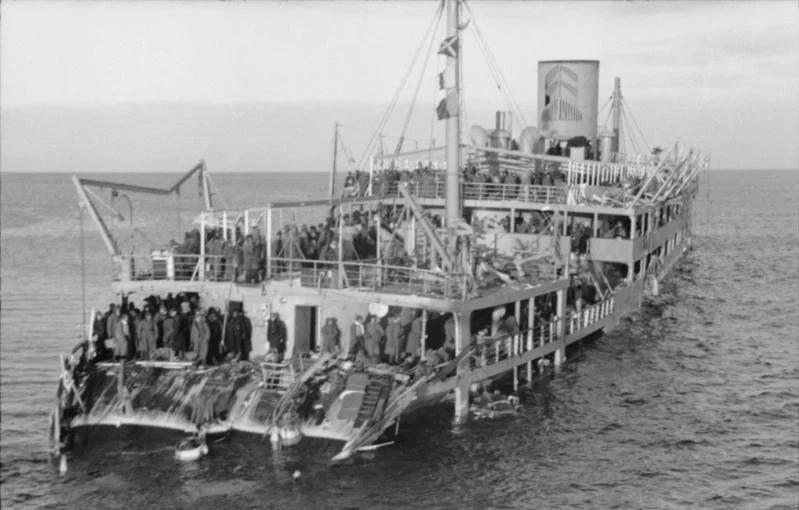
By autumn 1941 the German Army Group North was at the gates of Leningrad. The Soviet Baltic Fleet was stretched thin, and Hanko's strategic value — already debatable — collapsed. On 16 October the Soviet command ordered the base evacuated. Convoys ran through the Gulf of Finland between mid-October and 1 December, carrying 23,000 troops to a Leningrad already encircled by Germans. The route was a gauntlet of Finnish minefields and coastal artillery. Three Soviet destroyers were lost. The large troop transports Andrei Zhdanov and Iosif Stalin were both hit; the Iosif Stalin, packed with thousands of evacuees, was disabled by mines on 3 December and eventually captured by the Germans. Heavy equipment that could not be moved was sabotaged or blown up. When Finnish troops walked into the abandoned base in December 1941 they found it heavily mined. Several men were killed by booby traps over the following weeks.
After the Siege
Hanko stayed in Finnish hands for the rest of the war and was returned to Finnish civilian use after the 1944 armistice. The displaced families came back to a town badly damaged and a peninsula scarred by trenches and dugouts. Many of those scars remain — visible in the woods just east of the town today, concrete bunkers crumbling among the pines. The Soviet base buildings have mostly disappeared. The lighthouse at Bengtskär still works. The cemetery in Hanko holds Finns and Swedes who died defending what was, by treaty, foreign territory; the Soviet dead lie scattered across the bay. About 23,000 Soviet soldiers left Hanko alive through one of the most contested patches of water in northern Europe. The siege never decided anything strategic, but for the men who fought it — Finnish farmers defending a homeland the Soviets had carved into, Soviet conscripts isolated and outnumbered, Swedish volunteers far from home — it was the war.
From the Air
The Hanko Peninsula extends southwest from the Finnish mainland at 59.82°N, 22.97°E, marking the western entrance to the Gulf of Finland. The town of Hanko sits at the peninsula's tip; the Bengtskär lighthouse rises from a rocky island 25 kilometers south. Helsinki Vantaa (EFHK) is 130 kilometers east; Turku (EFTU) is 95 kilometers northwest. The Hanko approach is dotted with the small islands and skerries of the Finnish archipelago, which channeled the small-boat warfare of 1941. Russarö Island, site of the Soviet coastal artillery, lies just south of the town. Best viewed at 2,000 to 4,000 feet AGL in clear weather, with the open Gulf of Finland to the south and the dense archipelago to the north and east.
Nearby Stories
- Raseborg Castle 16 km away
- Battle of Lemo 32 km away
- Archipelago National Park 35 km away
- Peter the Great's Naval Fortress 50 km away
- Sinking of the MS Estonia 52 km away
- University of Turku 56 km away
- Padise Abbey 75 km away
- National Museum of Finland 77 km away